Blog · Mixing from start to finish · Part 12 of 20
Mixing backing vocals and doubles: stacks, octaves and harmonies behind the lead
How to stack and pan doubles and harmonies, add octave voices that sound like real singers, make a double from a single take, and keep the backing vocals behind the lead instead of on top of it.
The lead vocal is finished: its chain from part 10, de-essed and ridden in part 11. Now the voices around it. Backing vocals, doubles and harmonies make a chorus feel bigger than the verse, but they are also the quickest way to bury the singer you just worked so hard on. The rule for this whole part is simple: everything here supports the lead, and nothing competes with it.
Know what you’re stacking
- Doubles: the singer sings the lead line again. Panned apart, two or more takes make the line thicker and wider.
- Harmonies: other notes of the chord, usually a third or a fifth above or below the melody.
- Octaves: the same melody an octave up for lift, or an octave down for weight.
- Group vocals and “oohs”: pads made of voices that sit behind everything.
Route all of them to one bus, so one fader sets the whole stack against the lead and you can solo it as a group. Before any processing, edit the parts so they start and end with the lead. Tight consonants matter more than tight vowels: five different “s” sounds at the end of a word are the most common giveaway of careless backing vocals, and if only one voice keeps the hard consonants while the others drop them, the stack sounds tighter at once.
Pan for width, keep the lead alone in the middle
The lead owns the centre. Doubles go wide, often hard left and right in pairs, so they frame the lead instead of sitting on top of it. Harmonies sit in between, around 30 to 70 % to each side, and a low harmony can sit closer to the centre than a high one. If you only have one double, pan it opposite a harmony or a guitar part so the picture stays balanced. Then check the stack in mono: if the chorus loses its size or turns hollow, two near-identical voices are partly cancelling each other, often a copy of a take sitting a few milliseconds behind the original.
Octave voices that sound like singers
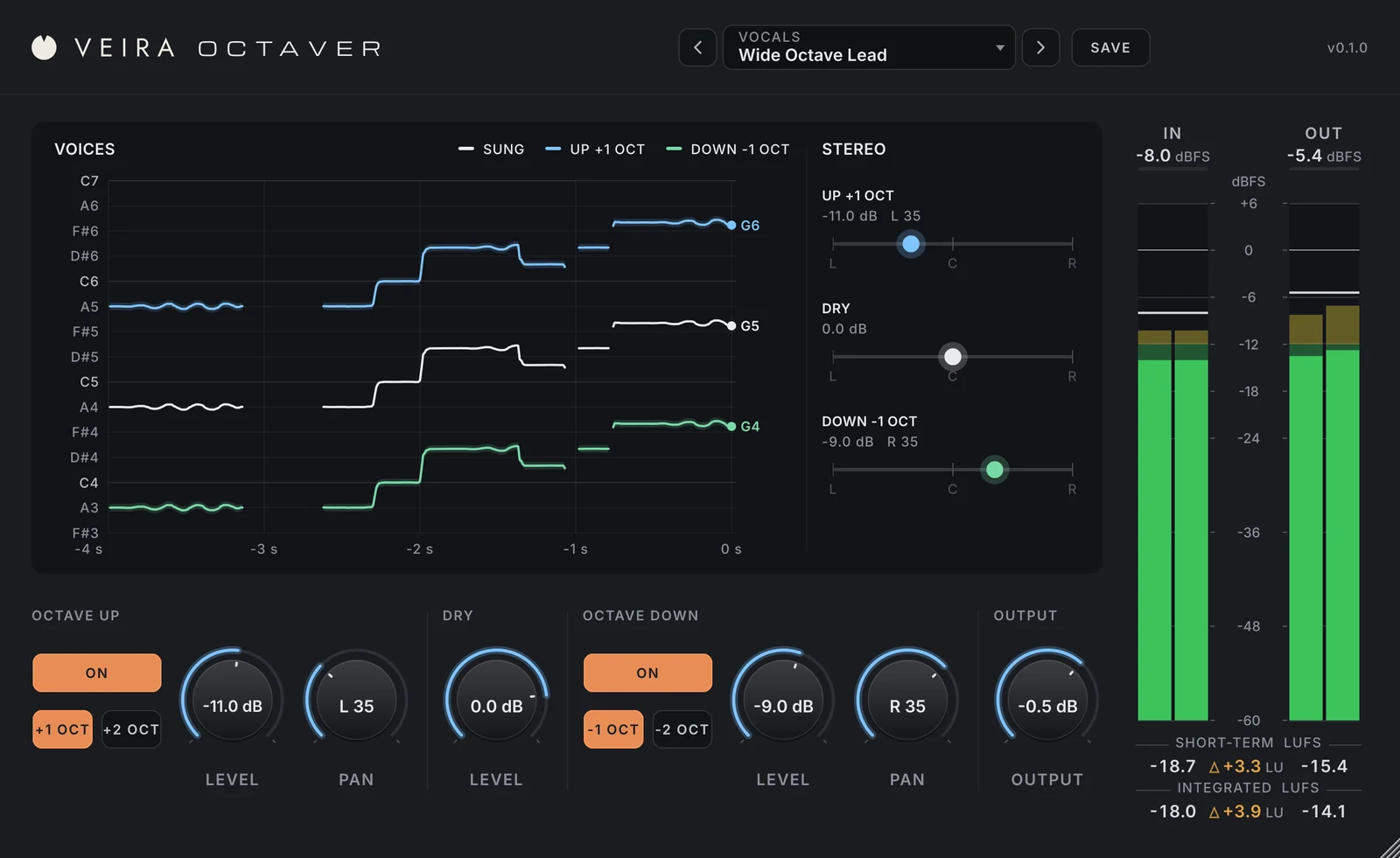
Octaves are hard to sing and often weren’t recorded at all. VEIRA Octaver sings along with a voice, an octave or two above it, below it, or both, and only the pitch moves: the formants stay where they are, so the octave above is never a chipmunk and the octave below is never a monster. Put it on a copy of the lead or on a double rather than on the lead itself, so you can balance the octaves separately.
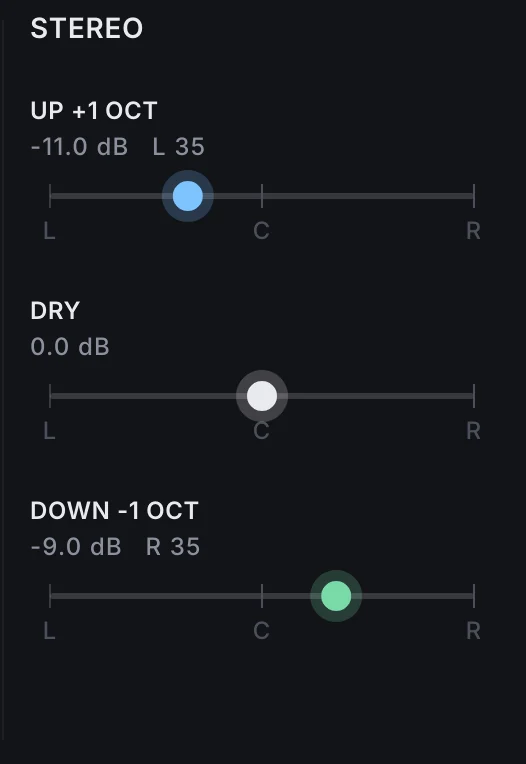
Init has OCTAVE DOWN on, one octave down at −6 dB in the centre: a low double that adds weight under a chorus. Switch on OCTAVE UP for lift. Each octave is level-matched to the dry voice, so 0 dB LEVEL means as loud as the singer; behind a lead, −9 to −15 dB is usually enough to be felt rather than heard. PAN spreads them, for example the octave above at L 35 and the octave below at R 35, and DRY sets the singer’s own voice, which you can turn down to −inf on a copy track when you only want the octaves.
Consonants, breaths and noise have no pitch, so the octave voices let them through unshifted, about 12 dB down, the way engineers treat doubled vocals by hand: the dry voice carries every word, and an octave never doubles an “s”. The pitch range is 72 Hz to 1000 Hz, which covers most singing voices, and the constant 29.1 ms latency is reported to your DAW, so the track stays in time.
Doubles and harmonies from one take
When the singer didn’t record a double, or a harmony needs one more voice, VEIRA Vocal Studio can make them from what you have. Insert it on a mono track and the voice comes out in stereo. In the global bar, DOUBLING makes a second take from the first, 18 and 26 ms behind and 8 cents sharp and flat, left and right. In the VOICE section, UNISON adds up to four detuned copies around the voice, spread left and right, for a thicker, choir-like sound on group vocals.

For a harmony, PITCH moves the voice up or down by up to an octave, and VOICE MIX blends the shifted voice with the natural one: +7 semitones is a fifth above. A fixed shift moves every note by the same interval, while a sung harmony follows the key, so a shifted fifth fits some lines and clashes on others: listen through the whole part, and for a line that needs a true third, have it sung. Leave FORMANT alone unless you want a bigger or smaller voice on purpose. The Backing & Doubles preset folder is a good place to start. Vocal Studio’s latency is about 61 ms at 48 kHz, so use it while mixing, not while the singer records.
Keep the lead in front
The backing stack should be a little darker, thinner and quieter than the lead, without the close detail that makes the lead feel near.
- Level: start the backing bus 6 to 10 dB under the lead in the chorus, bring it up until the chorus grows, and stop before the lead loses its place.
- Low end: use LOW CUT in Vocal Studio’s global bar, often 150 to 300 Hz on a stack, so a dozen voices don’t add up to mud under the lead.
- Top: a HIGH CUT around 8 to 12 kHz keeps the stack’s air and sibilance under the lead’s.
- Go easy on FOCUS EQ on the backing: it brings a voice forward, and that is the lead’s job.

Finally, play the chorus with the stack muted, then unmuted. It should feel bigger and wider, and the lead should still be the first thing you hear. If the singer seems to step back when the backing comes in, turn the bus down rather than the lead up. With the voices placed, the arrangement is complete, and part 13 starts adding colour across the mix.