Blog · Mixing from start to finish · Part 9 of 20
Mixing guitars and keys: tone, colour and width around the vocal
How to turn an acoustic DI into a finished guitar, EQ electric guitars and keys so they stop masking each other, and add drive and modulation for colour and width while leaving room for the vocal.
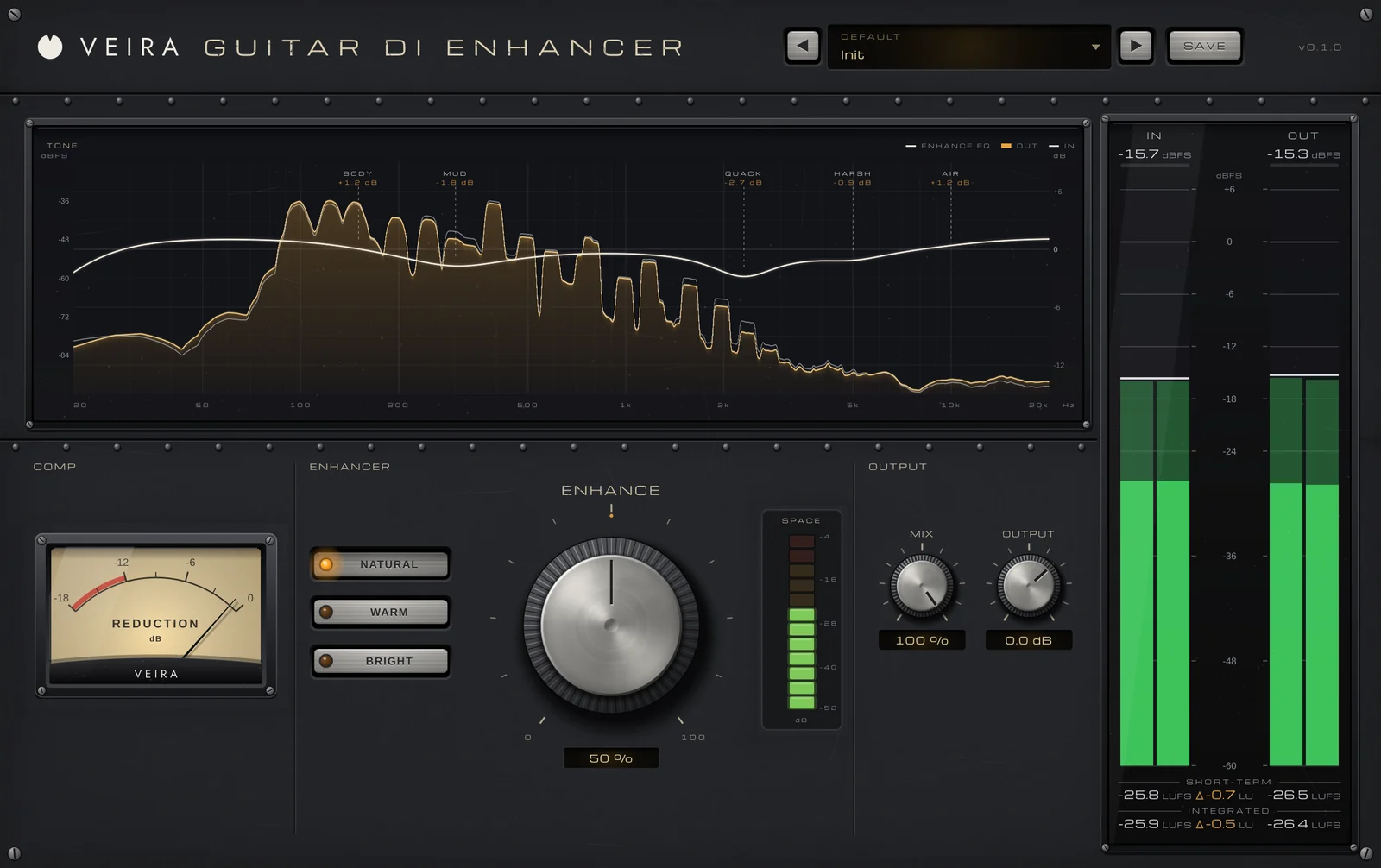
By now the drums are punchy and glued on their bus, and the bass and kick share the low end, as we set up in parts 6 to 8. Next come the instruments that fill the middle of the song: guitars, piano, organ, pads. They give a mix its harmony and colour, and they crowd it more easily than anything else, because they live in the same few octaves as the lead vocal that arrives in part 10.
Give every part a job first
Before you reach for any processing, decide what each part is for. A strummed acoustic is often rhythm and shimmer; a rhythm electric is the wall in the chorus; a pad is glue that nobody should notice. That tells you how bright, how wide and how loud each part can be, and stops you making every instrument sound great on its own, only to find no space left for the voice.
- Rhythm parts can be thinner and wider than you expect: in the mix they read as energy, not tone.
- A part that answers the vocal between lines can be brighter and more forward, since it plays when the singer doesn’t.
- Pads and sustained keys usually want the least top and the least low end of anything in the session.
Turn an acoustic DI into a guitar
An acoustic recorded from its pickup rarely sounds like the guitar in the room: an under-saddle piezo has a plasticky honk around 2 to 3 kHz, the body is missing, and the strums jump around in level. VEIRA Guitar DI Enhancer handles all three with one knob. ENHANCE moves a pickup EQ (the body back around 130 to 160 Hz, the boxiness out around 300 Hz, the quack out around 2 to 2.5 kHz, air from 9 kHz), a gentle leveller and a room together, in proportion. Start at the default 50 % and stay between 40 and 65 %, the typical range for a pickup that should sound like the guitar.
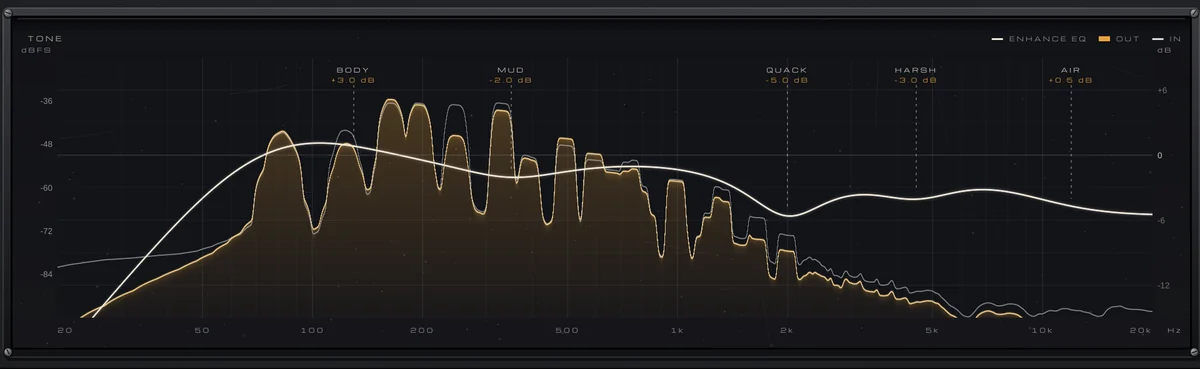
STYLE picks the path: NATURAL is the guitar in its room, WARM is rounder and fuller with the top shelved down and an echo chamber, and BRIGHT adds sparkle on a plate. AUTO GAIN keeps the output within 1.2 dB of the input’s loudness from 25 to 100 %, so you judge the tone, not a jump in volume. On the TONE display, when the amber output drops under the grey input line between 2 and 3 kHz, that is the honk going. For only part of the effect, MIX blends in the dry pickup, in time, since the plugin adds no latency.
EQ electric guitars and keys so they fit together
Electric guitars and keys fight over the same ranges: the low mids from about 200 to 500 Hz, where things get muddy, and the presence region from about 2 to 4 kHz, where the vocal’s words live. VEIRA EQ Blue, a channel EQ in the tradition of the 1970s British inductor desks, is quick and musical for this job.
- HIGH-PASS first: 80 Hz on most electric guitars and on a piano in a band, 160 Hz on a strummed part or a pad that only carries harmony. The 18 dB/oct slope leaves the low end to the bass and kick.
- LOW is a shelf: if a piano’s left hand clouds the bass, cut a few dB at 110 Hz.
- MID: the bell is broad for small moves and narrows as you push it. Cut 2 to 4 dB at 360 Hz on a woolly guitar, or at 700 Hz to take the boxiness out of a dense rhythm part.
- HIGH: the shelf at 10, 12 or 16 kHz is very gradual, so a small lift opens a dull piano without a hard edge, and a small cut tames the fizz of a distorted guitar.
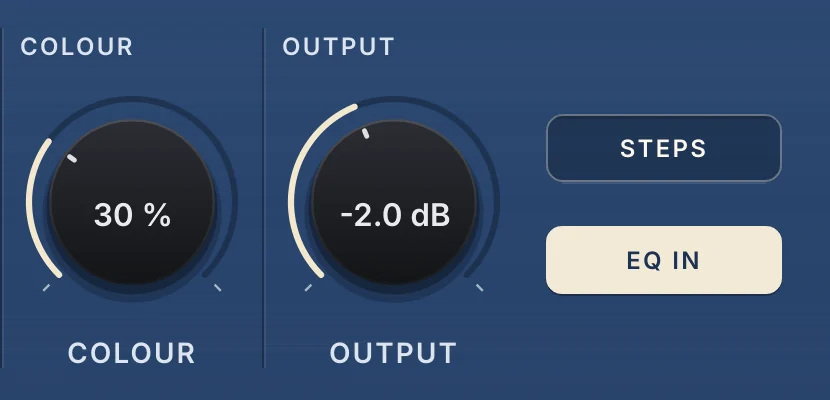
Every frequency knob clicks between fixed positions, and STEPS makes the gains click in 2 dB steps too, so a left and a right guitar get exactly matching moves. COLOUR drives the console’s transformers and inductors, and the lows saturate first, so 20 to 30 % on a clean guitar or an electric piano adds weight and thickness without more EQ. Before you judge a change, trim OUTPUT until the difference on the meters reads about 0 LU.
Drive and modulation for colour and width
Sometimes a part needs more character, not more EQ. VEIRA Mod Drive puts a drive pedal into a modulation pedal, in one unit. DRIVE runs from a touch of warmth to a fuzz, and its loudness is taken back automatically, so the knob changes the colour, not the level: on strummed chords the loudness stays within 0.5 dB from 0 to 100 %. A clean DI guitar or an electric piano at 20 to 35 % gets a little grit and density, and TONE tilts it darker to stay behind the vocal or brighter to speak up.
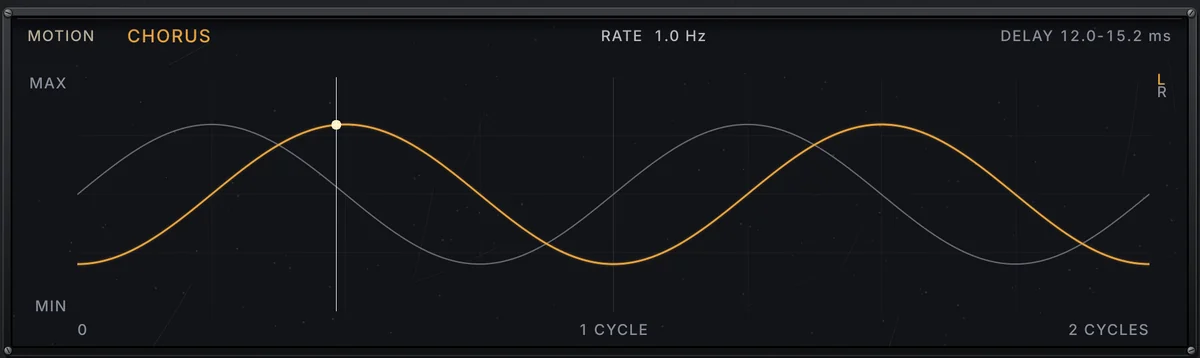
Insert it on a mono track as a mono-to-stereo plugin, and CHORUS, FLANGER and PHASER come out wide, the right side’s movement a quarter cycle behind the left’s, and still solid in mono. That widens a single DI guitar or a mono keyboard and moves it out of the centre, where the vocal will live. Keep DEPTH around 25 to 50 % and RATE under 1 Hz for width you feel rather than hear. TREMOLO suits an electric piano: press SYNC and set RATE to 1/8 or 1/16, and the pulse is locked to the song’s position, the same in every bounce.
Leave room for the vocal
- Pan the rhythm guitars and the widened keys away from the centre, and keep whatever stays in the middle a little darker.
- Cut, don’t boost, where the voice speaks: 2 to 3 dB with the MID of VEIRA EQ Blue at 1.6 or 3.2 kHz on the busiest part often does more for the vocal than any work on the vocal itself.
- Check the chorus, not just the verse: that is where the guitars double up and the keys get louder.
Then bring the instruments up under the static balance from part 3 and check in mono. If a part only sounds good louder than the singer allows, change its tone, not its fader.