Mastering with two controls: how loud, and how wide
What a quick master really needs to decide, why most of mastering can listen to the song and set itself, and how to choose PUSH and WIDEN for streaming, the radio or the club.
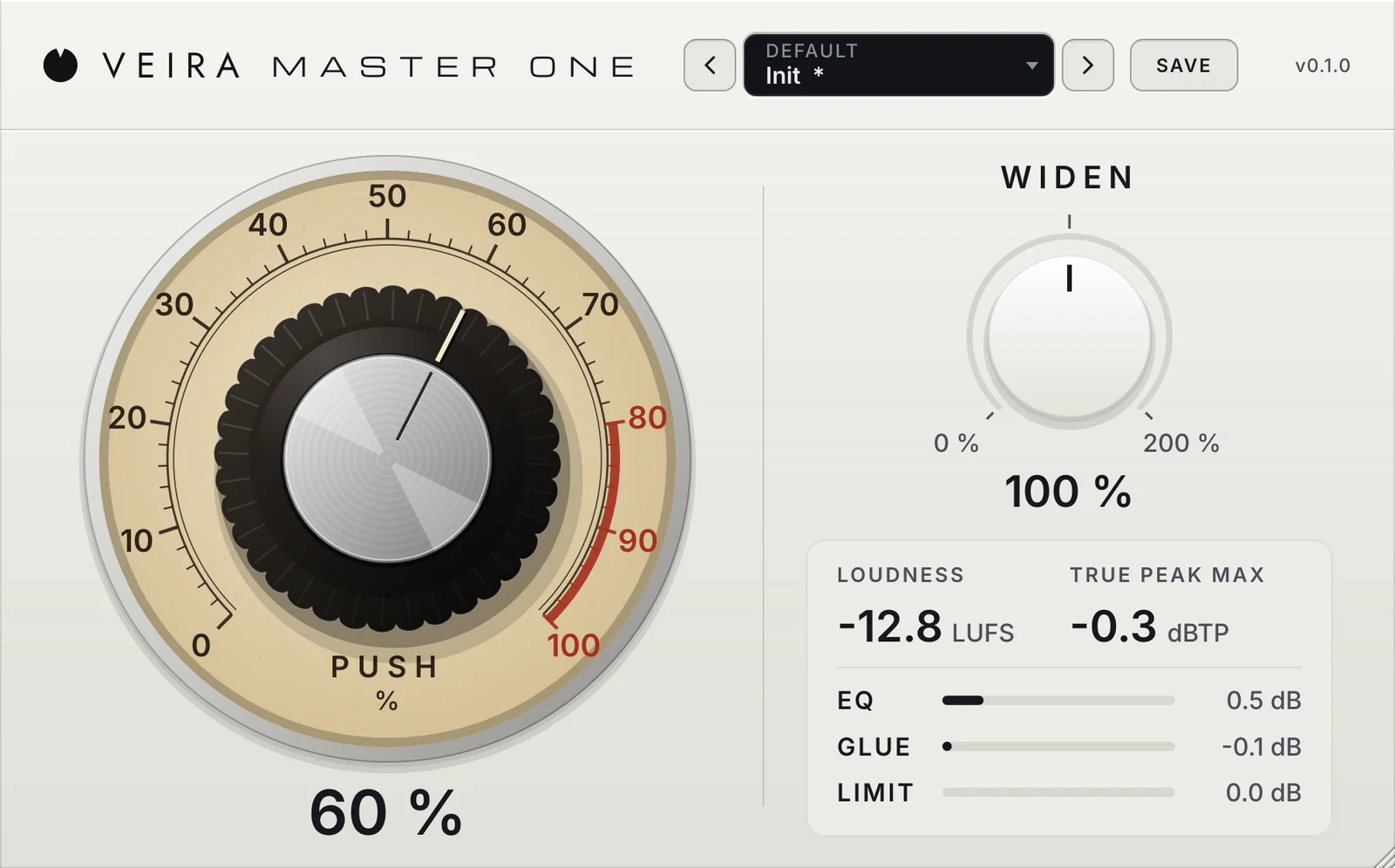
A mastering chain has many controls, but a finished master only answers two questions: how loud and firm should it be, and how wide? Everything else, the tonal balance, the glue, the density and the limiting, can follow from the song itself. VEIRA Master One is built on that idea: PUSH answers the first question, WIDEN the second, and the rest listens to the music.
What listens, and how carefully
An adaptive master has to be patient. Master One measures the song’s lows, low mids, presence and air over about six seconds and nudges them towards a balanced mastering curve by at most a few decibels, never faster than half a decibel a second. The glue compressor’s ratio rises with the song’s crest factor, so a dynamic song gets more control and a dense one less, and the level settles on its target over about twenty seconds. That is why it follows the song, not its drum hits, and why a quiet verse still sounds quieter than the chorus.
PUSH: choose the loudness, not the settings
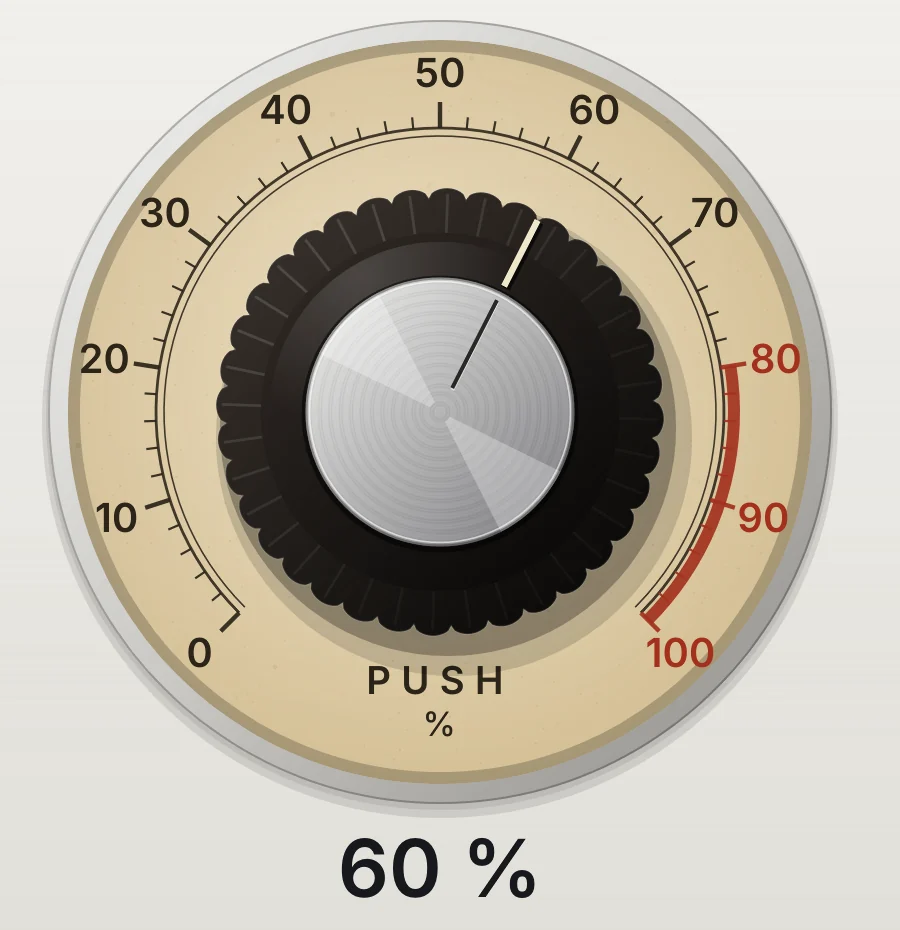
PUSH turns every stage up together: at 0 % the master sits around −16 LUFS with the lightest touch, at 50 % around −14 LUFS, the level streaming services play at, and at 100 % around −8 LUFS on dense music, with firm glue, thicker peaks and a faster limiter. Whatever you choose, the true peak stays under −0.1 dBTP. The useful question is where the music will be heard.
- Streaming: about 50 %. Nothing gets turned down, and the dynamics survive normalisation.
- Ballads, acoustic and classic rock: 60 to 65 %, about −12 LUFS.
- Radio pop and rock: 80 to 85 %, about −10 to −9.5 LUFS.
- Club, trap and loud rock: 90 % and up, about −8.5 to −8 LUFS. Stop before the chorus flattens.
WIDEN: width that keeps the low end together
Width sells a master on headphones, but too much of it in the low end makes the kick and the bass fall apart on a club system or a phone. WIDEN only works on the side signal above 120 Hz, behind a Linkwitz-Riley split, so the lows stay mono whatever you set. Around 105 to 130 % opens most mixes; 85 to 95 % is safer for phones and small speakers; turning it to 0 % for a moment is the quickest mono check.
Reading the result
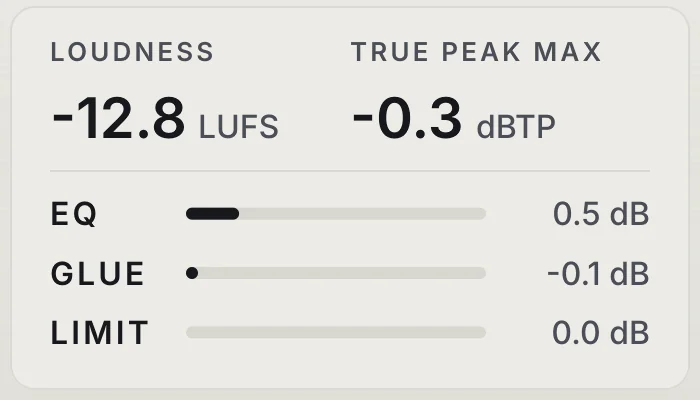
Click LOUDNESS at the start of the song, play it through and read the integrated loudness at the end: that is the number streaming services measure. The three quiet bars tell you how hard Master One is working; if the limiter shows several decibels all the time, PUSH is high for that song. When you want to shape each stage yourself, VEIRA Master Rack gives you a vintage rack to set by hand and VEIRA Mastering Suite a modern console with a reference track to match. When you want a great master in a minute, start with VEIRA Master One and one of its presets.