VEIRA Mod Drive

A drive pedal into a modulation pedal in one vintage unit: grit that doesn’t get louder, then chorus, flanger, phaser, tremolo or vibrato, free or locked to the song.

$39.99, a one-time purchase with free updates

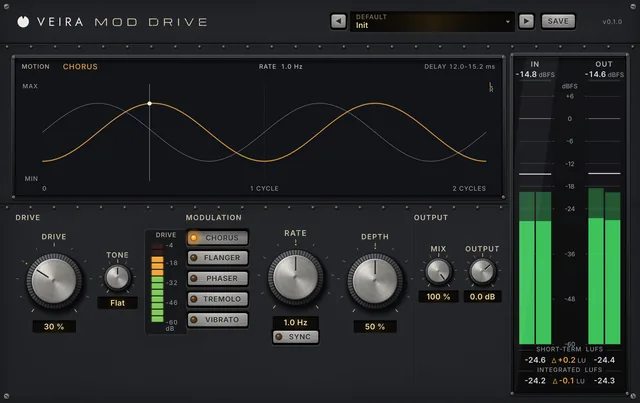
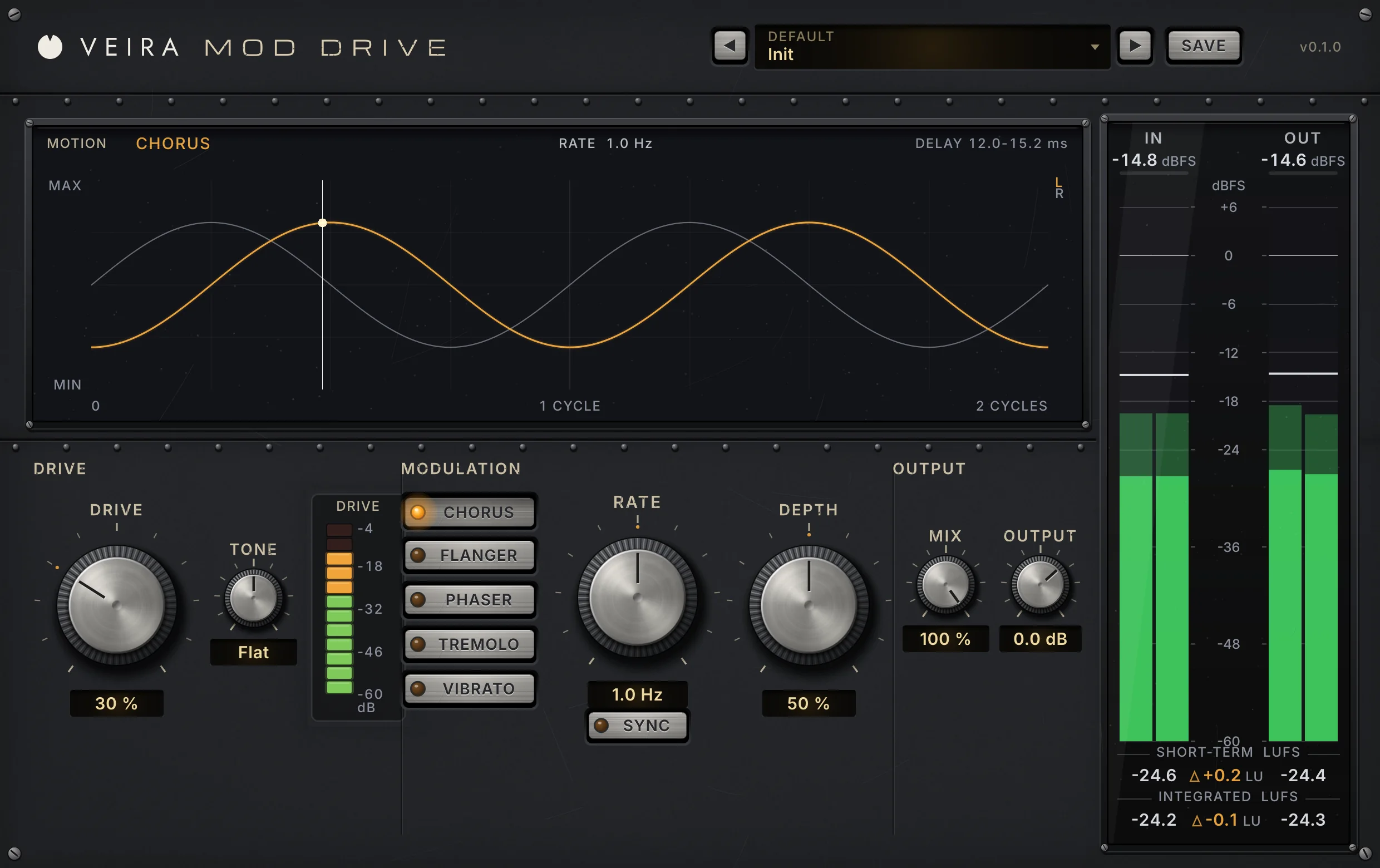
VEIRA Mod Drive with the Init preset while an electric guitar strums chords: the MOTION display with two cycles of the chorus, the left side in amber and the right a quarter cycle behind in grey, RATE 1.0 Hz and DELAY 12.0-15.2 ms above it, DRIVE at 30 % with TONE flat and the DRIVE lamps, the CHORUS button lit, RATE, SYNC and DEPTH at 50 %, MIX and OUTPUT, and the IN and OUT meters with loudness.

VEIRA Mod Drive is the two pedals that sit at the start of countless pedalboards, in one vintage unit, for electric guitars, keys and synths. First a drive: DRIVE warms the sound and breaks it up, from a touch of warmth to a fuzz, against your playing’s own level, so a quiet DI and a hot one break up alike, and TONE tilts it darker or brighter. Then a modulation pedal on five buttons, CHORUS, FLANGER, PHASER, TREMOLO and VIBRATO, at a free RATE or, with SYNC, a note value locked to the song, with DEPTH for how far it moves and MIX to blend it with the dry signal.

Everything about it is made so you judge the sound, not the volume. The drive’s loudness is taken back as you turn it, every mode at every depth is trimmed to the loudness of the sound going in, measured within 0.7 dB, and a MODE change crossfades without a click. On a mono guitar track it comes out in stereo, the two sides moving a quarter cycle apart, and with SYNC on the movement sits in the same place in the song on every play and in every bounce. The MOTION display shows exactly what the modulation does: two cycles of it, with a playhead running through.

A tour of VEIRA Mod Drive

VEIRA Mod Drive with the Init preset while an electric guitar strums chords: the MOTION display with two cycles of the chorus, the left side in amber and the right a quarter cycle behind in grey, RATE 1.0 Hz and DELAY 12.0-15.2 ms above it, DRIVE at 30 % with TONE flat and the DRIVE lamps, the CHORUS button lit, RATE, SYNC and DEPTH at 50 %, MIX and OUTPUT, and the IN and OUT meters with loudness.
  1. The whole of VEIRA Mod Drive

    VEIRA Mod Drive puts the two pedals at the start of countless pedalboards in one unit, for guitars, keys and synths. DRIVE warms and breaks up the sound against your playing’s own level, and its loudness is taken back automatically, so the knob changes the colour, not the level; TONE tilts it darker or brighter. Then the modulation sets it moving: CHORUS, FLANGER, PHASER, TREMOLO or VIBRATO, at a RATE from 0.05 to 10 Hz or, with SYNC, a note value locked to the song’s position, with DEPTH for how far. MIX blends it with the dry signal in time, a mono guitar comes out in stereo, and the MOTION display draws two cycles of the movement with a playhead running through them.

  2. The motion

    Two cycles of the modulation, both sides, with a playhead running through them and what DEPTH sweeps.

  3. The drive

    DRIVE from warm to fuzz at the same loudness, TONE darker or brighter, and lamps that show how hard it works.

  4. The modulation

    Five pedals on five buttons, RATE free or locked to the song with SYNC, and DEPTH for how far it moves.

  5. Mix and output

    Blend the effect with the dry signal, in time, and set the level.

  6. In and out

    Peak and RMS for the input and the output, with short-term and integrated loudness.

What VEIRA Mod Drive does for you

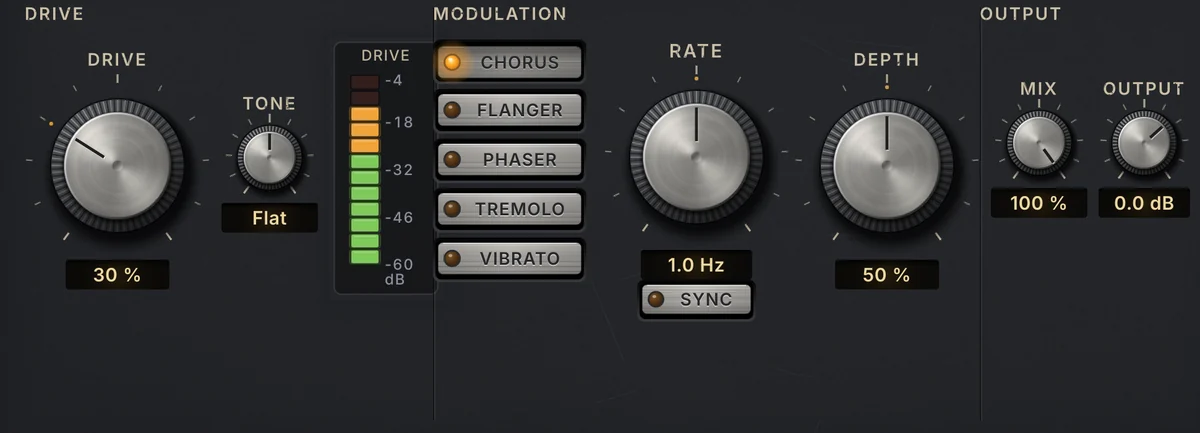
The controls: DRIVE at 30 %, TONE flat and the DRIVE lamps; the CHORUS, FLANGER, PHASER, TREMOLO and VIBRATO buttons with CHORUS lit, RATE at 1.0 Hz with SYNC and DEPTH at 50 %; MIX at 100 % and OUTPUT at 0.0 dB.

Two pedals in one vintage unit

The drive comes first, as on a pedalboard, so the modulation moves a sound that already has its grit. The DRIVE section has DRIVE, from a touch of warmth to a fuzz, TONE and a column of lamps that shows how hard the drive works; the MODULATION section has five buttons, RATE with SYNC, and DEPTH; MIX and OUTPUT finish it. Every knob glides, every control can be automated, and the faceplate is VEIRA Drum Bus’s vintage unit: aged metal, lit buttons and glass.

  • Drive into modulation
  • Eight controls
  • Everything automatable
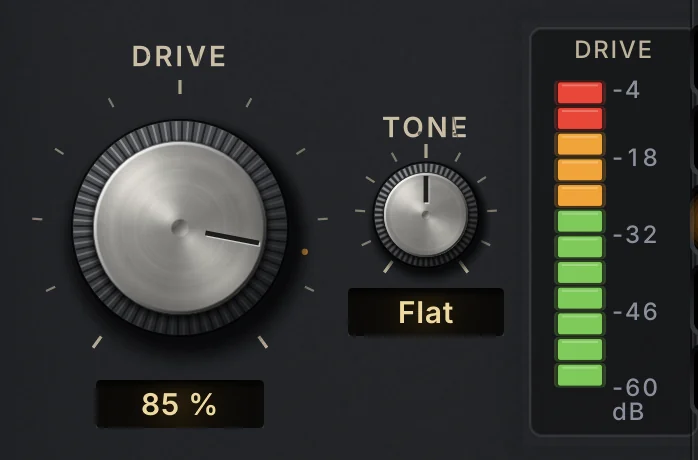
The drive section with Fuzz Phase: DRIVE at 85 %, TONE flat and the DRIVE lamps lit almost to the top.

Grit, not volume

A real drive pedal gets louder as you turn it up, and louder always sounds better at first. Here the drive’s loudness is taken back by itself, a fixed makeup plus AUTO GAIN measured on what you play, so DRIVE changes the colour, not the level: on strummed chords the loudness stays within 0.5 dB from 0 to 100 % while the peaks come down by up to 9 dB. The curve is soft and slightly asymmetric, warm with even harmonics at low settings and a fuzz with odd ones at the top, and it darkens as it rises, like a pedal, with a low-pass closing from 16 to 4.5 kHz.

  • Loudness kept within 0.5 dB
  • Warm to fuzz
  • Darkens like a pedal
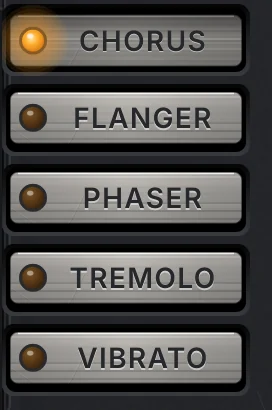
The MODE buttons CHORUS, FLANGER, PHASER, TREMOLO and VIBRATO, CHORUS lit.

Five modulation pedals

CHORUS: two copies around 12 ms drifting against the dry sound, a quarter cycle apart on the two sides. FLANGER: a very short delay swept from 0.4 ms, with feedback that rises with DEPTH: the jet-plane comb. PHASER: six all-pass stages swept from 160 Hz over up to six octaves: the swirl of a phase pedal. TREMOLO: the level pulsing, down to silence at full depth. VIBRATO: the pitch bending up to about a semitone either way, with no dry signal. A MODE change crossfades over 60 ms, so switching never clicks.

  • CHORUS, FLANGER, PHASER
  • TREMOLO, VIBRATO
  • 60 ms crossfade
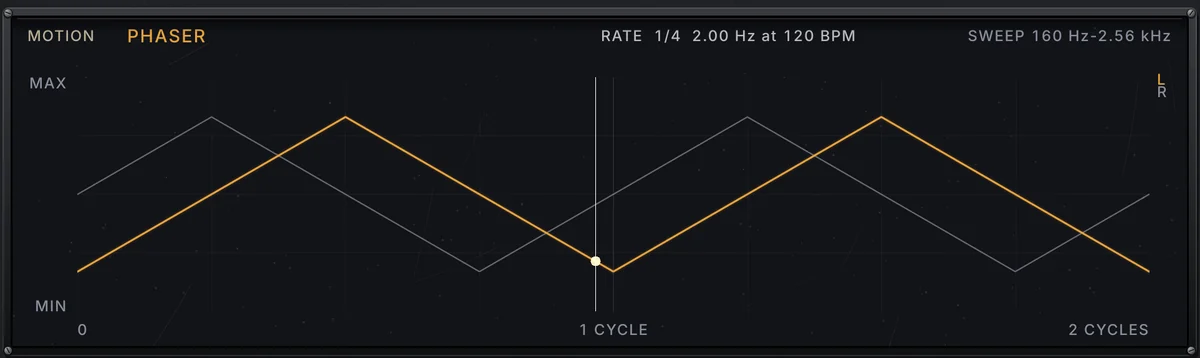
The MOTION display with Funk Phase: RATE 1/4, 2.00 Hz at 120 BPM, the phaser sweeping from 160 Hz to 2.56 kHz, the two sides a quarter cycle apart.

Locked to the song

Press SYNC and RATE becomes a note value from 2/1 to 1/32, dotted and triplets included, at the song’s tempo. More than that, the modulation’s cycle is tied to the song’s position: while the song plays, the plugin reads where it is and sets the movement there, so every bar moves the same way, every time you press play, wherever you start, and in a bounce. Tempo changes are followed at once, and the MOTION display shows the note value and what it comes to in Hz.

  • 14 note values
  • Locked to the bar
  • The same in every bounce
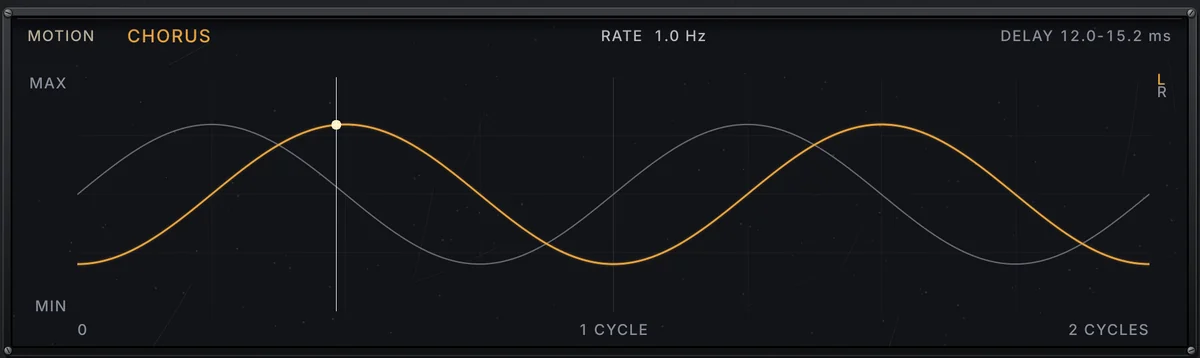
The MOTION display: two cycles of the chorus, the left side in amber and the right side in grey a quarter cycle behind, the playhead, and the MODE, the RATE and the delay it sweeps above.

A wide guitar from a mono DI

Insert it on a mono guitar or keys track as a mono-to-stereo plugin and the input is copied to both sides, then processed as stereo: in CHORUS, FLANGER and PHASER the right side’s movement runs a quarter cycle behind the left’s, so a mono DI comes out wide (measured, the side 3 to 9 dB under the mid) and still solid in mono. TREMOLO and VIBRATO move both sides together, so the image stays centred. The MOTION display draws both sides, the left in amber and the right in grey, with a playhead running through two cycles.

  • Mono in, stereo out
  • A quarter cycle apart
  • Solid in mono
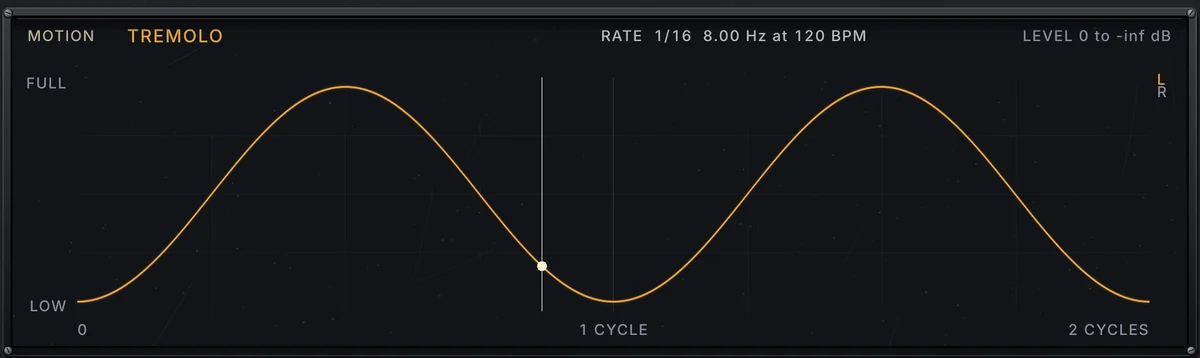
The MOTION display with Sixteenth Chop: the tremolo at full depth, RATE 1/16, 8.00 Hz at 120 BPM, from full level down to silence.

Every mode at the same level

Mixing a moving copy with the dry sound changes the loudness, by a different amount in every mode and at every depth. VEIRA Mod Drive trims each one back to the loudness of the sound going in: measured on strummed chords, every mode at every DEPTH stays within 0.7 dB. The tremolo raises its high points a little so its average holds, even at full depth. So you can switch modes and turn DEPTH without riding the fader, and bypass is a fair comparison.

  • Within 0.7 dB, measured
  • Tremolo average held
  • A fair bypass
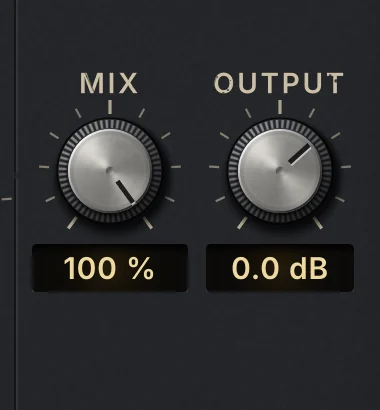
MIX at 100 % and OUTPUT at 0.0 dB.

Clean, smooth and in time

The drive is computed at four times the sample rate (twice at 88.2 and 96 kHz) with antiderivative anti-aliasing, so even full fuzz stays clean at the top. MIX blends the effect with the dry signal, delayed to the sample, so it adds no phasing of its own, and at MIX 0 % the output is the input, bit for bit. The latency is 64 samples (1.3 ms at 48 kHz), reported to your DAW, and the output doesn’t depend on the buffer size, even while the settings change.

  • Drive at 4x
  • Sample-aligned MIX
  • 64 samples of latency
The preset browser showing Default: Init, with previous, next and SAVE.

40 presets, each one measured

Ten folders: one per mode (Chorus, Flanger, Phaser, Tremolo, Vibrato), Drive & Mod with the drive up front, Synced for parts in time with the song, Keys & Synths for electric piano, organ and pads, and Creative FX, from a broken radio to a helicopter. Each was measured through the real processor at 120 BPM on guitar chords, a riff, arpeggios and keys: every one keeps the input’s loudness within 1 dB on the material it was made for, most within 0.2 dB.

  • 10 folders
  • Save your own
  • Recalled with your session

Get VEIRA Mod Drive

Pay once and it’s yours, with every future update included.

VEIRA Mod Drive

A drive pedal into a modulation pedal in one vintage unit: grit that doesn’t get louder, then chorus, flanger, phaser, tremolo or vibrato, free or locked to the song.

  • Yours to keep: pay once, no subscription
  • Every future update, free for life
  • VST3, AU, Standalone on up to 3 computers
  • Changed your mind? Cancel within 14 days (refunds)
USD

One-time payment, in your cart.

Welcome offer

Get 10% off your first order

Leave your email and we’ll send you a code for 10% off your first order, on any plugins. One code per person.

Specifications

Type
Drive and modulation in one vintage unit: a drive with a tone tilt into a chorus, flanger, phaser, tremolo or vibrato
Drive
0 to 100 % (default 30 %): a soft, slightly asymmetric curve whose input runs from 18 dB under to 30 dB over the playing’s own level, at 4x (2x at 88.2 and 96 kHz) with anti-aliasing, then a low-pass from 16 kHz down to 4.5 kHz; its loudness taken back by a fixed makeup and AUTO GAIN (±12 dB); 0 % is out
Tone
Dark 50 to Flat to Bright 50 (default Flat): a tilt around 800 Hz, up to 4 dB each way
Mode
CHORUS (two voices around 12 ms, up to 5 ms of sweep), FLANGER (0.4 to 6.4 ms, feedback 35 to 80 %), PHASER (six all-pass stages from 160 Hz over 1 to 6 octaves), TREMOLO (down to silence at full depth) or VIBRATO (up to about ±1 semitone, no dry); default CHORUS; a change crossfades over 60 ms
Rate
0.05 to 10 Hz (default 1.0 Hz), or with SYNC a note value from 2/1 to 1/32 with dotted and triplet values (default 1/4), locked to the song’s position while it plays
Depth
0 to 100 % (default 50 %)
Mix
0 to 100 % (default 100 %): a linear blend with the dry signal, sample-aligned
Output
−24 to +12 dB
Level
Every mode trimmed to its input’s loudness (within 0.7 dB on strummed chords at every DEPTH); the drive within 0.5 dB from 0 to 100 %; every factory preset within 1 dB on its material
Latency
64 samples at 44.1 to 96 kHz (1.3 ms at 48 kHz), none at 176.4 and 192 kHz; at MIX 0 % and bypassed, the output is the input delayed, bit for bit
Metering
MOTION display (two cycles of the modulation, both sides, with a playhead; the MODE, the RATE and what DEPTH sweeps); DRIVE lamps (−60 to −4 dB); IN and OUT peak and RMS; short-term and integrated LUFS
Presets
40 factory presets in 10 folders (Default, Chorus, Flanger, Phaser, Tremolo, Vibrato, Drive & Mod, Synced, Keys & Synths, Creative FX), plus your own
Channels
Mono, stereo, or mono in to stereo out (CHORUS, FLANGER and PHASER widen a mono track)
CPU (measured)
About 4 % of one core of a 2-core cloud machine (stereo, 48 kHz)
Formats
VST3, AU, Standalone
macOS
macOS 11 or later, Apple silicon or Intel (universal). VST3, AU and Standalone.
Windows
Windows 10 or later, 64-bit. VST3 and Standalone.
Pro Tools
Pro Tools (AAX) versions are built and tested, and arrive once they’re signed for Pro Tools.
Latest version
0.2.0, released October 30, 2026 · What’s new
Read more on the blog: Drive and modulation on guitars, keys and synths without level jumps · Mixing guitars and keys: tone, colour and width around the vocal

Questions? 7 answers about VEIRA Mod Drive

Works well with

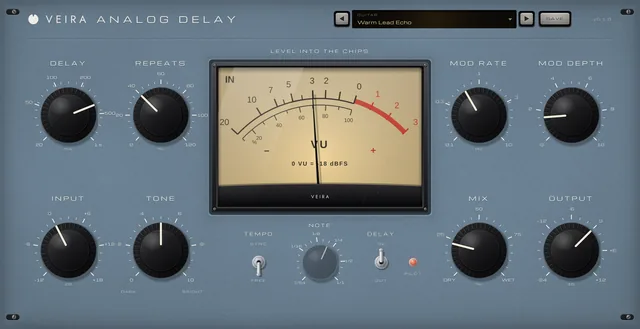
VEIRA Analog Delay

A bucket-brigade analog delay behind a vintage blue-grey panel: the longer the delay, the darker and grainier the repeats, each one a little darker than the last, and the pitch bends as you turn DELAY.

$149.99

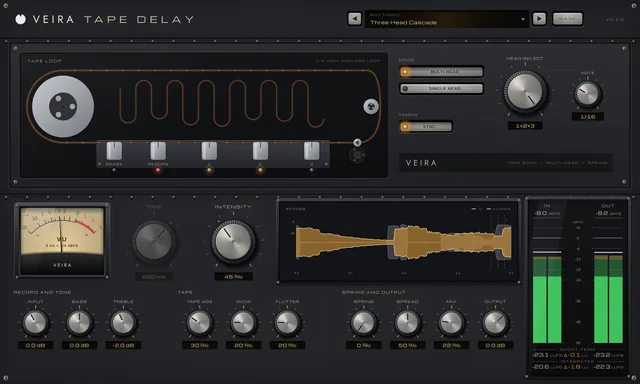
VEIRA Tape Delay

A tape echo machine: a loop of tape past three playback heads, every repeat recorded onto the tape again, so the echoes saturate, darken and bend in pitch as on the classic studio echoes.

$149.99

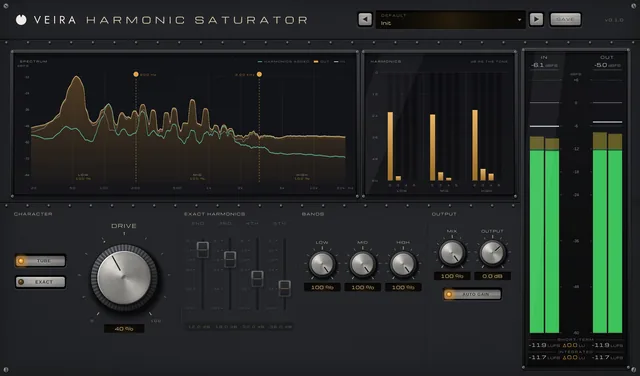
VEIRA Harmonic Saturator

Harmonic colour, by the band: a warm tube or exactly the harmonics you set, at the same level.

$29.99