Drive and modulation on guitars, keys and synths without level jumps
How to set drive for color rather than volume, which modulation effect suits which part, when to sync it to the song and how to keep the level steady as you switch.
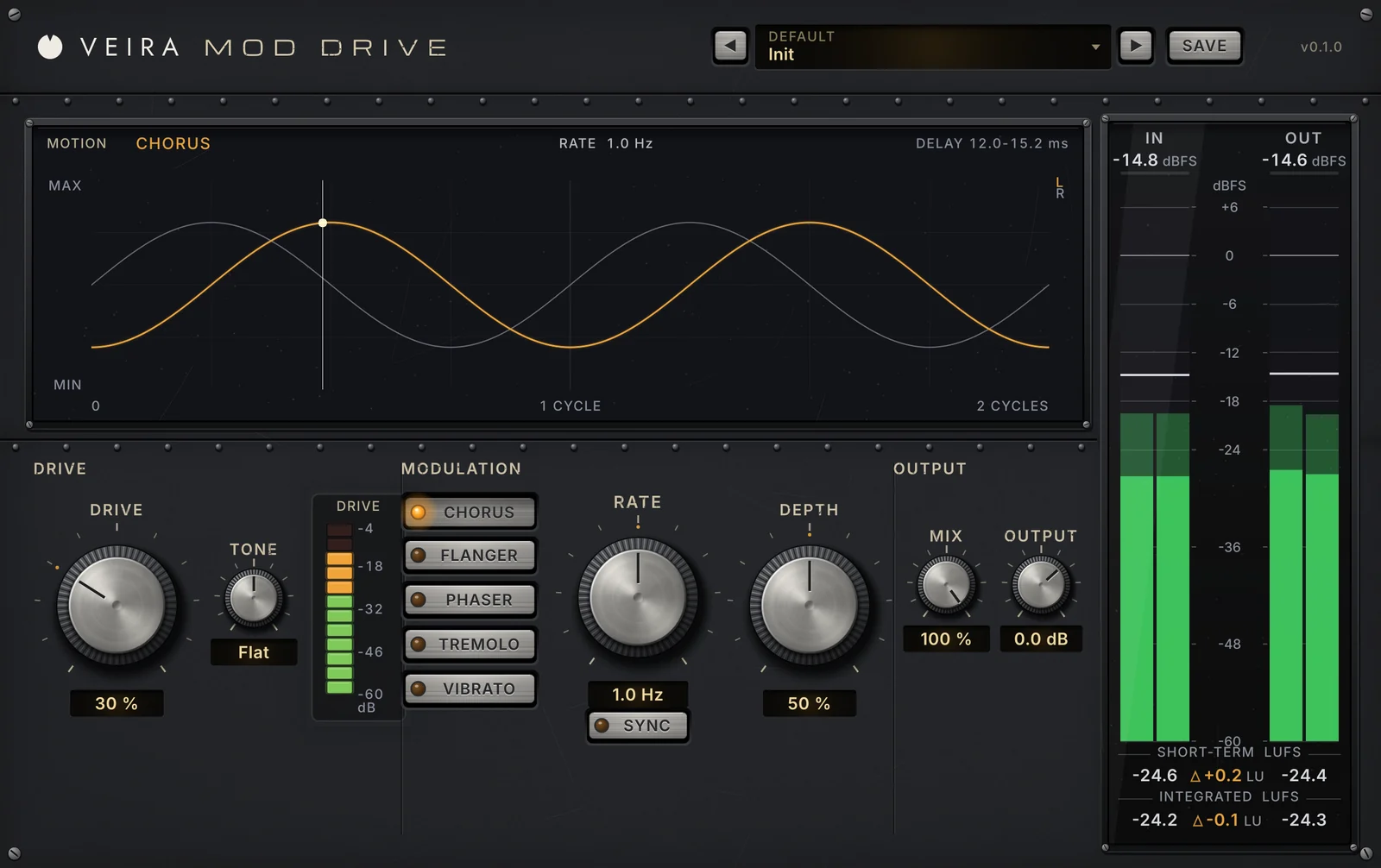
Drive and modulation are two of the oldest ways to make a guitar, an electric piano or a synth pad feel alive. A bit of grit thickens a part and helps it cut through; a chorus, phaser or tremolo gives it movement so it doesn’t just sit there in the mix. The trouble is that both change the level as well as the sound, and a louder signal almost always sounds better at first. If you don’t keep that in check, you end up choosing settings by volume and riding the fader every time you change something.
Drive for color, not volume
Turning up a drive pushes the signal into a clipping curve. Low settings add warmth and mostly even harmonics; higher settings move toward fuzz, with more odd harmonics and a harder edge. As the drive rises the peaks get squashed while the average level climbs, so the part gets denser and louder at the same time. To hear what the drive really does, turn its output down as you turn the drive up, until the loudness matches the bypassed sound. A tone control or a gentle low-pass after the drive tames the fizz that heavy settings bring.
Pick the modulation for the part
Each modulation effect moves something different, so each one suits a different job.
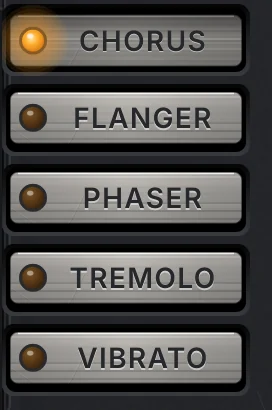
- Chorus: slightly delayed copies drifting against the dry sound. It thickens clean guitars, electric pianos and pads.
- Flanger: a very short delay swept with feedback, for the jet-plane comb. It works best in small doses or as a moment.
- Phaser: a chain of all-pass stages sweeping notches through the spectrum. A classic on funk guitar, organ and keys.
- Tremolo: the level pulsing up and down. Great on rhythm parts, and choppy at full depth.
- Vibrato: the pitch bending gently either way, with no dry signal. A little goes a long way.
Get the order and the timing right
On most pedalboards the drive comes before the modulation, so the movement acts on a sound that already has its grit; the other way round, the drive tends to flatten the sweep. For timing, a free rate somewhere between about 0.2 and 2 Hz suits slow, washy movement, while rhythmic effects like tremolo usually sound best locked to the tempo, in quarter, eighth or sixteenth notes. If the movement is tied to the song’s position, it lands the same way in every bar and in every bounce.
Keep the level steady, and check in mono
Mixing a moving copy with the dry sound changes the loudness too, by a different amount for each effect and each depth. Match the level whenever you change mode or depth, so that bypass is a fair comparison. A chorus, flanger or phaser can turn a mono DI into a wide part if the two sides move slightly out of step, but always check the mix in mono: the part should get narrower, not disappear.
Doing it with VEIRA Mod Drive
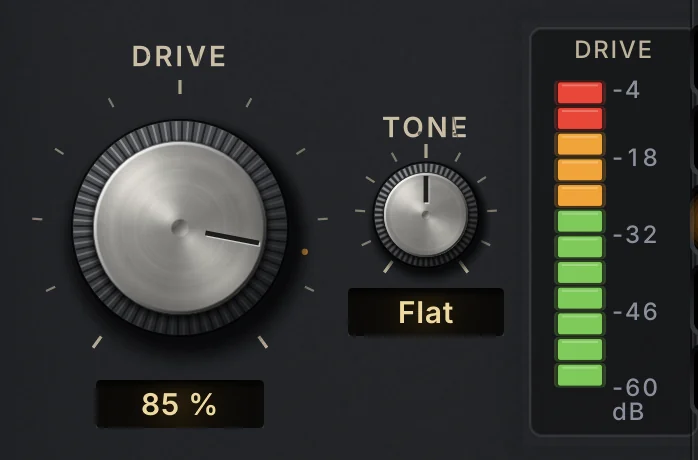
VEIRA Mod Drive puts a drive and a modulation pedal in one unit, in that order. DRIVE goes from a touch of warmth to a fuzz and TONE tilts it darker or brighter. Its loudness is taken back automatically: on strummed chords it stays within 0.5 dB from 0 to 100 % while the peaks come down by up to 9 dB, so the knob changes the color, not the level.
The MODULATION section offers CHORUS, FLANGER, PHASER, TREMOLO and VIBRATO, with DEPTH for how far it moves. RATE runs from 0.05 to 10 Hz, or with SYNC becomes a note value from 2/1 to 1/32 tied to the song’s position, so every bar moves the same way every time you press play, and in a bounce. Measured on strummed chords, every mode at every DEPTH stays within 0.7 dB of the input, so you can switch without touching the fader.
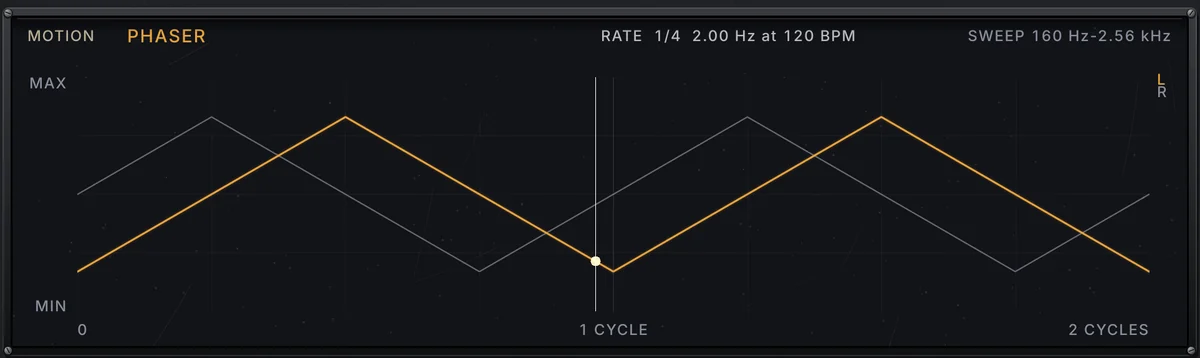
Inserted mono in, stereo out on a guitar or keys track, CHORUS, FLANGER and PHASER run the right side a quarter cycle behind the left, so a mono DI comes out wide and still solid in mono. MIX blends the effect with the dry signal, in time.