FM synthesis from the first operator
How FM synthesis works, with VEIRA FM Six: carriers and modulators, why a modulator’s level is brightness, ratios for tones and bells, envelopes that make a sound strike and ring, algorithms, and MODERN or VINTAGE.
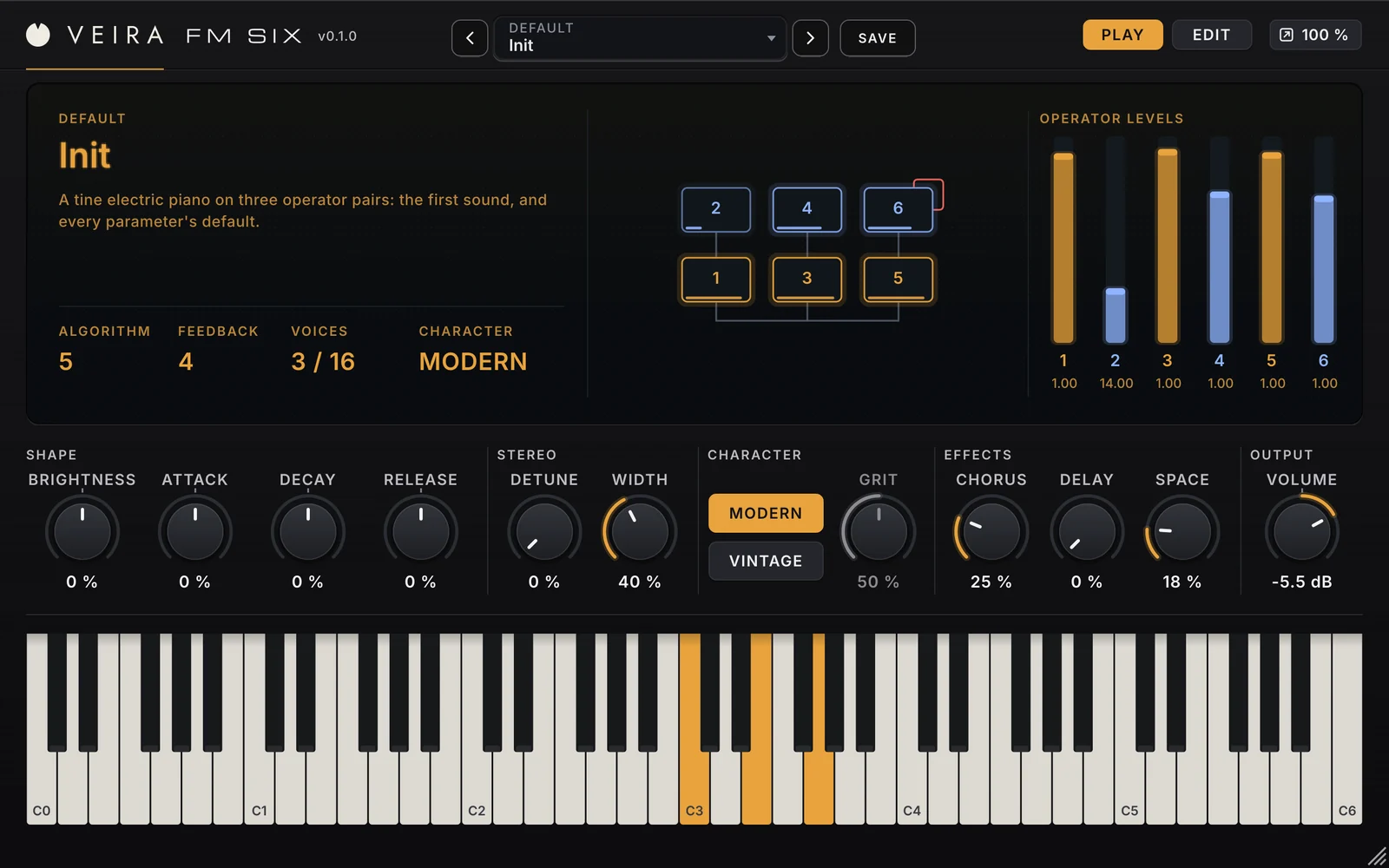
FM synthesis has a reputation for being hard, and it is the opposite of what most synthesizers teach you: no filter, no samples, just sine waves bending each other. Once the few ideas click, it is quick and very expressive, and it makes sounds nothing else does: glassy pianos, bells, punchy basses. VEIRA FM Six brings classic six-operator FM with a clean MODERN engine or the grain of 80s digital FM. This is FM from the first operator.
Carriers and modulators
An operator is a sine wave with its own level and its own envelope. A carrier is heard. A modulator is not heard itself: its output is added to the phase of the operator under it, pushing it back and forth. That push creates new frequencies, called sidebands, either side of the carrier. Turn the modulator up and more sidebands appear, so the sound gets brighter, not louder. That is the first thing to learn: on a modulator, LEVEL is brightness.
Ratios: tone or bell
The ratio between a modulator’s frequency and its carrier’s decides which partials appear. Whole numbers keep them on the harmonic series: 1 : 1 gives a bright, sawtooth-like buzz, 1 : 2 a hollow, square-like tone. Other ratios put them between the harmonics, and the sound turns into metal, glass or a bell. COARSE sets the whole number and FINE the fraction, so a single operator can move a sound from a reed to a chime.
Envelopes make it play
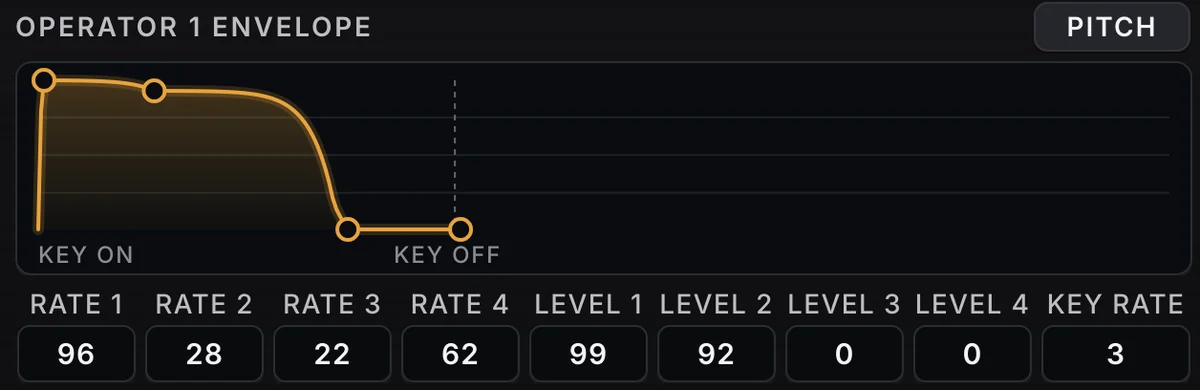
Because every operator has its own envelope, the brightness can move independently of the loudness. Give a modulator an envelope that falls quickly while its carrier rings on, and each note starts bright and mellows: the sound of a struck bar or a plucked string. Give a modulator a slow rise and the sound opens up after the attack, like a brass swell. Add velocity sensitivity to the modulator and playing harder is brighter, as on a real instrument.
Algorithms
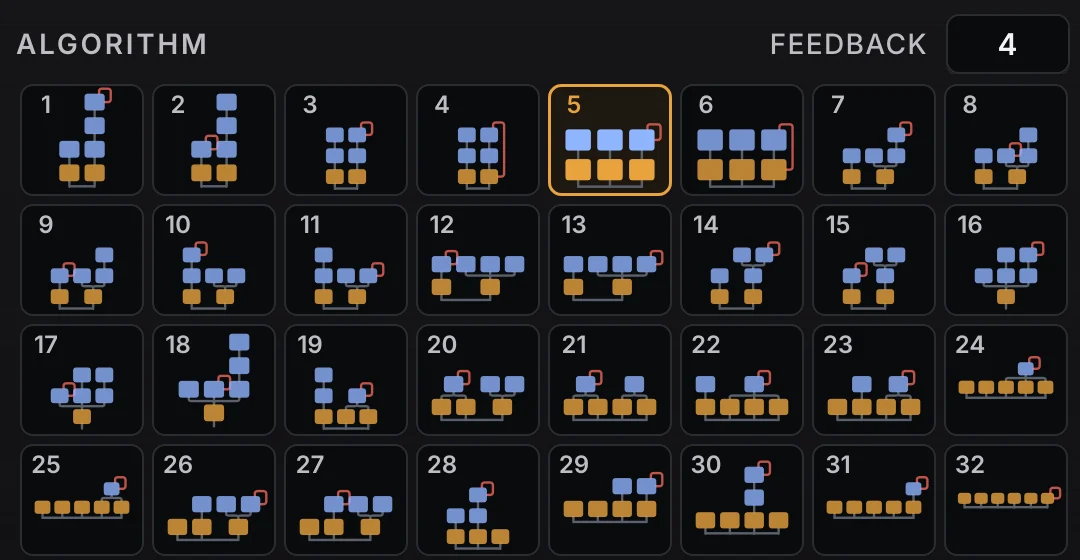
An algorithm is how the six operators are wired. Pairs, one modulator on one carrier, are the easiest place to start: each is a small instrument, and three pairs layer three of them, which is how a classic FM electric piano is built. Stacks, a modulator on a modulator, make denser spectra for brass and growls. Six carriers side by side make an additive organ. Feedback lets one operator modulate itself, turning its sine towards a sawtooth.
- Too bright: lower a modulator’s LEVEL, or BRIGHTNESS on the PLAY page.
- Too quiet: raise a carrier’s LEVEL.
- Harsh high notes: keyboard level scaling that turns the modulators down to the right.
- A bell: modulators at a ratio that isn’t a whole number, with envelopes that fall slowly.
Clean or vintage
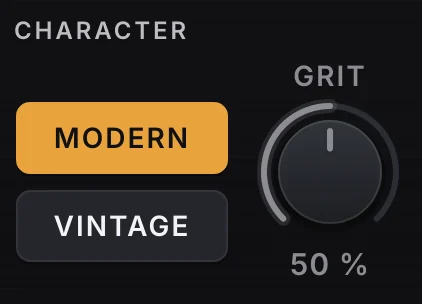
The FM of the 80s was computed with coarse tables, stepped envelopes and no oversampling, and those limits are part of its sound: a fine grain and a sparkle of aliasing on bright high notes. VEIRA FM Six offers both. MODERN computes the voices at twice the rate with a guard against aliasing; VINTAGE uses the era’s method, with GRIT setting the converter’s grain. The two play at the same level and line up to the sample, so switching is a fair comparison.
Where to start
Load a preset and play: Soft Tines or Bright Tines for a tine piano, Glass Bell or Tubular Chime for bells, Solid Bass or Slap Bass for a bass, Brass Stab for stabs, Glass Pad for a pad, Drawbar Organ for an organ. Shape it on the PLAY page, then open the EDIT page and change one modulator’s LEVEL to hear what it does. To build from nothing, start with Templates ▸ Two Operator Start. Read the page of VEIRA FM Six for every control. For a modern wavetable synthesizer, VEIRA Black Synth; for the tine piano on its own, with four knobs, VEIRA Keys.