VEIRA FM Six

The sound of classic six-operator FM under VEIRA’s own name and face: six sine operators in 32 algorithms, the 0 to 99 values FM programmers know, a clean MODERN engine or the grain of 80s digital FM, and 73 original presets.

$149.99, a one-time purchase with free updates

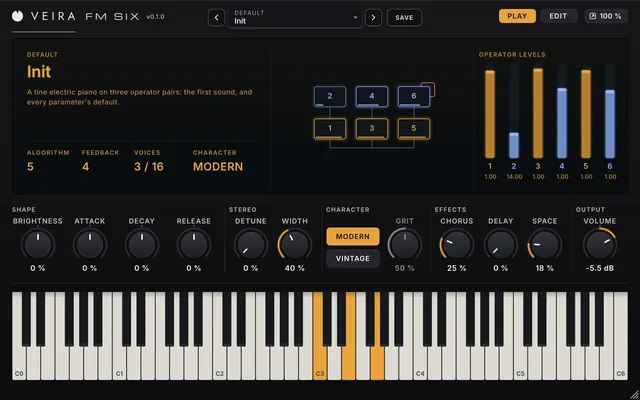
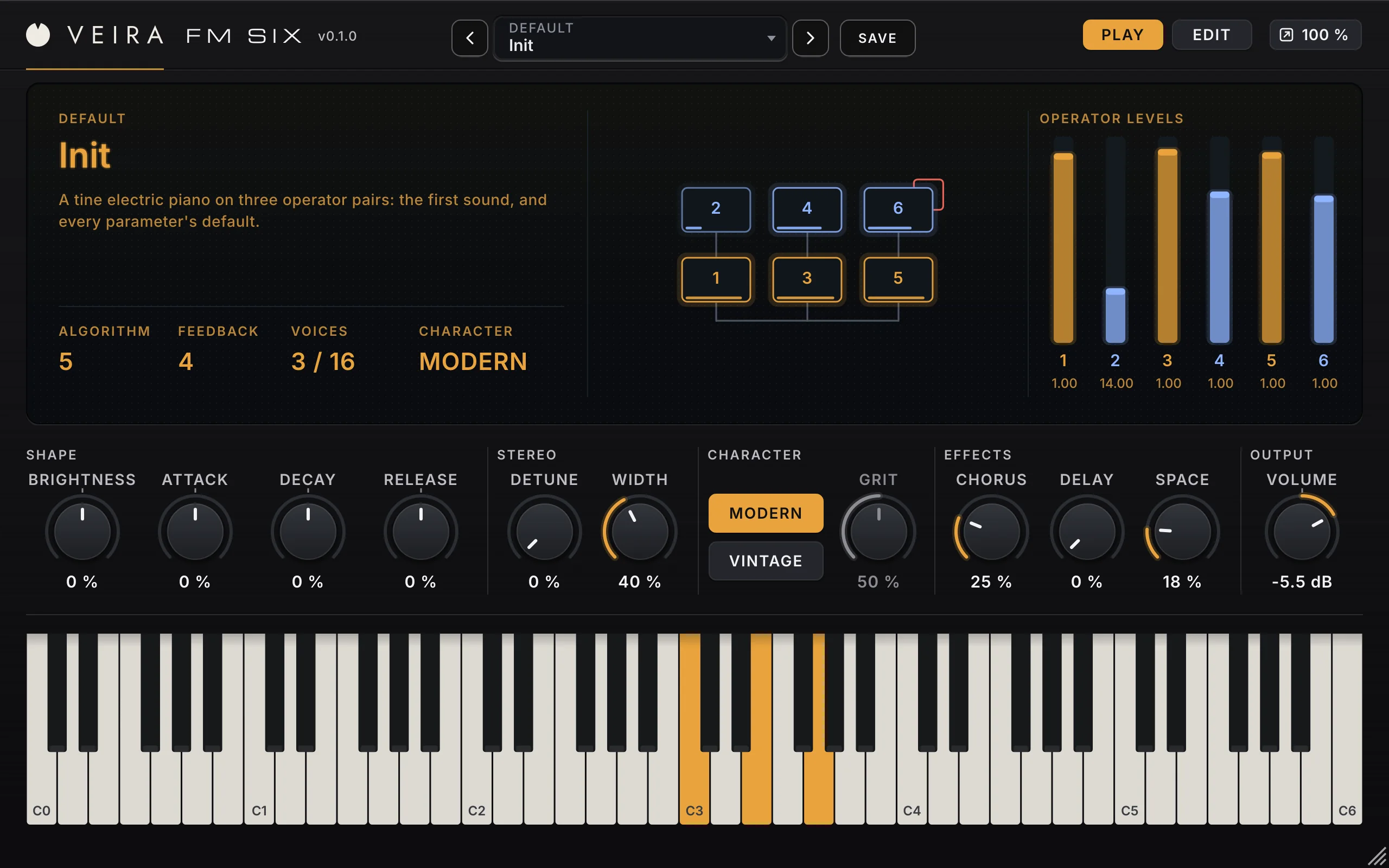
VEIRA FM Six’s PLAY page with the preset Init and a chord held: the amber display with the preset’s name and note, the algorithm drawn live and six operator level meters; the SHAPE, STEREO, CHARACTER, EFFECTS and OUTPUT knobs; and a keyboard from C0 to C6.

VEIRA FM Six is a six-operator FM synthesizer with the sound of classic 80s digital FM: glassy tine pianos, bells and mallets, punchy basses, bright brass, plucks, organs and pads. Six sine waves bend each other’s phase in one of 32 algorithms, and because every operator has its own envelope, a sound’s brightness strikes, rings and mellows as a real instrument’s does. It is written from the published mathematics of FM, with the 0 to 99 values FM programmers know, and drawn on an 80s-inspired face of VEIRA’s own.

The PLAY page shows the sound live and shapes any preset with BRIGHTNESS, ATTACK, DECAY, RELEASE, DETUNE and WIDTH, then CHORUS, DELAY and SPACE. The EDIT page holds every operator, the algorithms, the envelopes and the keyboard scaling as curves you drag, the LFO and the controllers. MODERN plays it clean and oversampled; VINTAGE brings back the stepped grain and aliasing of the era, with GRIT. Its 73 original factory presets come in eleven folders, levelled to about the same loudness.

A tour of VEIRA FM Six

VEIRA FM Six’s PLAY page with the preset Init and a chord held: the amber display with the preset’s name and note, the algorithm drawn live and six operator level meters; the SHAPE, STEREO, CHARACTER, EFFECTS and OUTPUT knobs; and a keyboard from C0 to C6.
  1. The whole of VEIRA FM Six

    VEIRA FM Six makes the glassy pianos, bells, punchy basses, brass and pads of classic six-operator FM. Six sine waves bend each other’s phase in one of 32 algorithms, each with its own envelope, so a sound’s brightness moves as you play. The PLAY page shapes any preset with a few macros and effects; the EDIT page holds every operator, with the envelopes and the keyboard scaling drawn as curves you drag. MODERN is clean and free of aliasing; VINTAGE brings back the grain of 80s digital FM.

  2. The display

    The preset, the algorithm live and every operator’s level.

  3. The macros

    Shape any preset without touching an operator.

  4. Character

    Clean and modern, or the grain of 80s digital FM.

  5. The keyboard

    Play with the mouse, and see the notes.

What VEIRA FM Six does for you

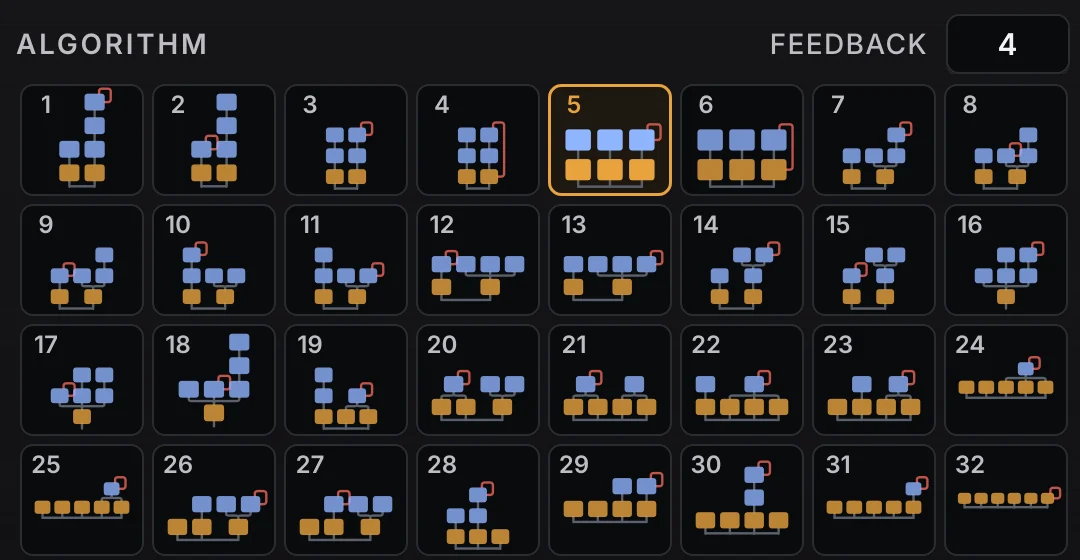
ALGORITHM: the 32 algorithms as small diagrams, carriers in amber and modulators in blue with the feedback loop in red, algorithm 5 outlined; FEEDBACK 4.

Classic six-operator FM

Six sine operators in 32 algorithms, from one long stack to six carriers side by side, with feedback on one loop, four-rate envelopes, velocity and keyboard scaling, a pitch envelope and an LFO, all with the familiar 0 to 99 values. Written from the published mathematics of FM: no code, table or patch is taken from any instrument. Each algorithm is drawn as it is wired, carriers in amber and modulators in blue.

  • 6 operators
  • 32 algorithms
  • 0 to 99 values
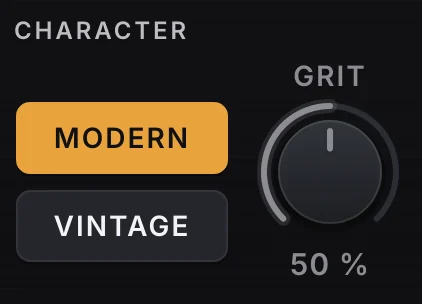
CHARACTER: MODERN lit above VINTAGE, and the GRIT knob at 50 %, dimmed in MODERN.

MODERN or VINTAGE

MODERN computes the voices at twice the rate with a guard against aliasing: with modulators at full index, everything that isn’t a true partial is 67 dB or more down at 48 kHz. VINTAGE uses the era’s method, coarse log tables, stepped envelopes, no oversampling and a converter whose grain GRIT sets, from 13.5 bits to 10. The two play at the same level within 0.31 dB and line up to the sample.

  • Clean, oversampled
  • 80s grain with GRIT
  • Same level and timing
The PLAY page’s controls: BRIGHTNESS, ATTACK, DECAY and RELEASE at 0 %; DETUNE 0 % and WIDTH 40 %; MODERN lit, VINTAGE and GRIT 50 %; CHORUS 25 %, DELAY 0 % and SPACE 18 %; VOLUME −5.5 dB.

Shape any preset from the PLAY page

BRIGHTNESS moves every modulator’s level, ATTACK, DECAY and RELEASE every operator’s envelope, DETUNE spreads the operators apart and WIDTH places each note in the stereo field, without touching an operator. CHORUS, DELAY and SPACE finish the sound, and VOLUME has a soft limit that is exactly linear up to −3 dBFS and never reaches 0 dBFS.

  • Six macros
  • Chorus, delay, space
  • Never clips
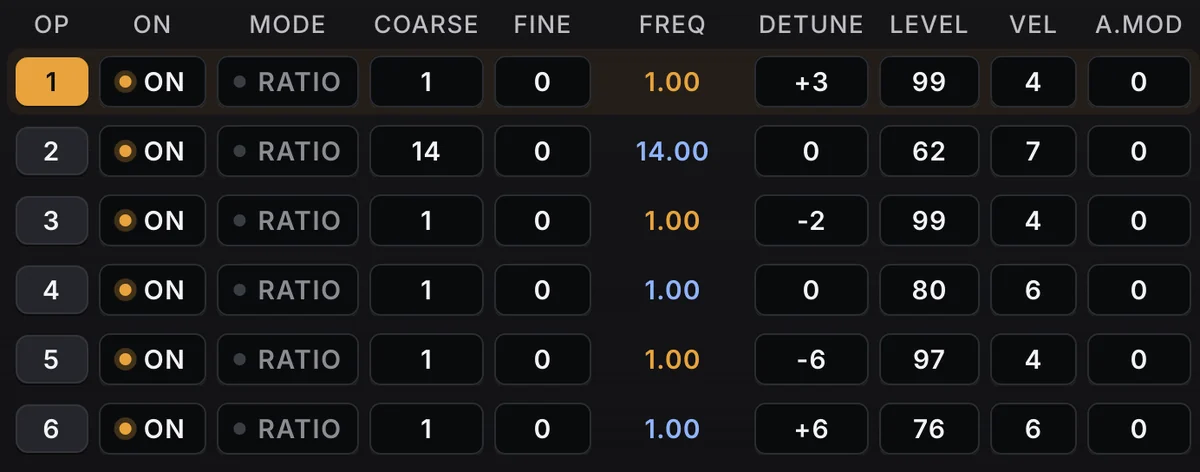
The EDIT page’s operators: six rows with ON, RATIO, COARSE, FINE, FREQ, DETUNE, LEVEL, VEL and A.MOD; operator 1 chosen, operator 2 at a ratio of 14.00.

Every operator, in full

The EDIT page lists the six operators side by side: on or off, RATIO or FIXED, COARSE, FINE and the frequency that results, DETUNE, LEVEL, VELOCITY and A.MOD. Eight LEVEL steps halve an operator’s output, so a modulator’s level is a brightness you can set by number, and its velocity response makes harder playing brighter.

  • Ratio or fixed
  • Velocity on every operator
  • 177 parameters
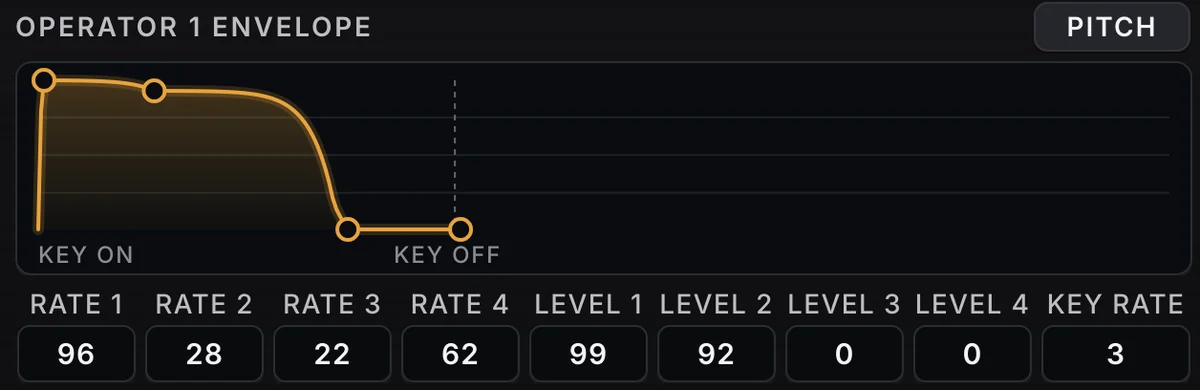
Operator 1’s envelope as a curve with four handles and the key’s release dashed, with RATE 1 to 4, LEVEL 1 to 4 and KEY RATE, and the PITCH key.

Envelopes you can see and drag

The chosen operator’s envelope is drawn as a smooth curve from the engine’s own timings, with four handles: drag up and down for a level, left and right for a rate. Beside it, the keyboard level scaling is a curve over the keyboard with its break point and two depths. PITCH shows the pitch envelope in the same place.

  • Four rates, four levels
  • Drawn from the engine
  • Keyboard scaling curves
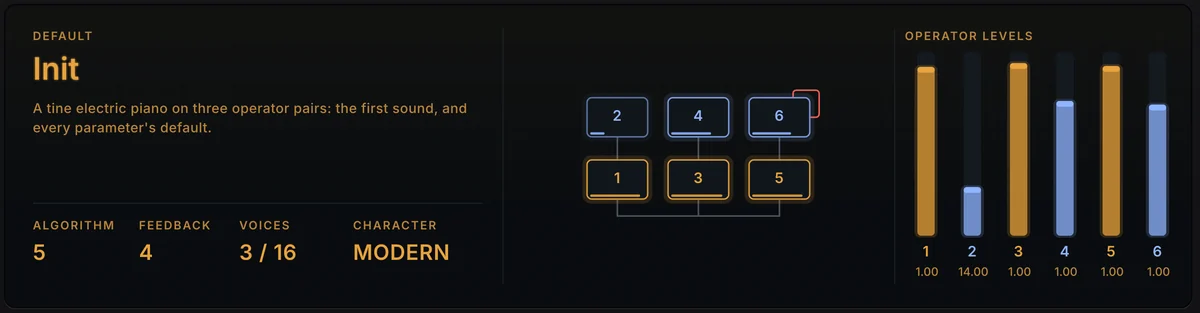
The display: DEFAULT, Init and its note; ALGORITHM 5, FEEDBACK 4, VOICES 3 / 16 and CHARACTER MODERN; algorithm 5 drawn as three pairs, modulators 2, 4 and 6 over carriers 1, 3 and 5; the six operator level meters with their ratios.

Measured against the theory

Sidebands match their Bessel functions to better than 0.002, feedback matches self-modulation theory within 0.004, and C1 to C8 are within 0.0013 cent of equal temperament. Envelope speeds are within 0.7 % of the design, and stolen voices fade over 4 ms, so nothing clicks. The display shows the algorithm live and every operator’s level as it plays.

  • Sidebands within 0.002
  • Tuned within 0.0013 cent
  • No clicks
The preset browser showing Default: Init, with previous, next and SAVE.

73 original presets

Default, Keys, Bells & Mallets, Bass, Brass & Stabs, Pads & Strings, Plucks & Guitars, Organs, Leads, Effects and Templates: from Soft Tines, Glass Bell and Solid Bass to Brass Stab, Glass Pad, Nylon Pluck, Drawbar Organ, Saw Lead and Laser Fall, and four templates to build from. Each was designed for VEIRA FM Six and levelled, every one within 3.9 LU of the median.

  • 11 folders
  • Levelled
  • A note on each

Get VEIRA FM Six

Pay once and it’s yours, with every future update included.

VEIRA FM Six

The sound of classic six-operator FM under VEIRA’s own name and face: six sine operators in 32 algorithms, the 0 to 99 values FM programmers know, a clean MODERN engine or the grain of 80s digital FM, and 73 original presets.

  • Yours to keep: pay once, no subscription
  • Every future update, free for life
  • VST3, AU, Standalone on up to 3 computers
  • Changed your mind? Cancel within 14 days (refunds)
USD

One-time payment, in your cart.

Welcome offer

Get 10% off your first order

Leave your email and we’ll send you a code for 10% off your first order, on any plugins. One code per person.

Specifications

Type
Six-operator FM synthesizer: MIDI in, no audio input; stereo or mono output
Engine
Six sine operators, 32 algorithms, feedback 0 to 7; per operator RATIO or FIXED, COARSE, FINE, DETUNE, LEVEL, VELOCITY, A.MOD, four rates and four levels, rate scaling and keyboard level scaling
Modulation
A pitch envelope (±4 octaves), an LFO (six waves, 0.06 to 47 Hz, delay, key sync), the mod wheel and aftertouch to pitch, amplitude and EG bias
Voices
1 to 32 (16), Poly or Mono with portamento and glissando; bend up to 12 semitones; stolen voices fade over 4 ms
Character
MODERN: computed at twice the rate at 44.1 and 48 kHz, aliasing guarded; VINTAGE: log tables, stepped envelopes, no oversampling, a converter of 13.5 to 10 bits (GRIT)
Macros
BRIGHTNESS, ATTACK, DECAY and RELEASE (±100 %), DETUNE and WIDTH
Effects
CHORUS, DELAY (20 to 1500 ms), SPACE (0.5 to 7 s), VOLUME −36 to +6 dB with a soft limit over −3 dBFS
Measured
Sidebands within 0.002 of their Bessel functions; C1 to C8 within 0.0013 cent of equal temperament; MODERN’s aliasing 67 dB or more down at 48 kHz at full index; both characters within 0.31 dB of each other
Latency
31 samples at 44.1 and 48 kHz, none at 88.2 kHz and above, reported
Parameters
177, all automatable
Presets
73 factory presets in 11 folders, plus your own
Window
1280 x 800 at 100 %, resizable from 75 to 200 % or to fit the screen (button, corner grip or Cmd/Ctrl + and −), opens at 100 %, saved with the session
Formats
VST3, AU, Standalone
macOS
macOS 11 or later, Apple silicon or Intel (universal). VST3, AU and Standalone.
Windows
Windows 10 or later, 64-bit. VST3 and Standalone.
Pro Tools
Pro Tools (AAX) versions are built and tested, and arrive once they’re signed for Pro Tools.
Latest version
0.1.0, released November 16, 2026 · What’s new
Read more on the blog: FM synthesis from the first operator

Questions? 9 answers about VEIRA FM Six

Works well with

VEIRA Black Synth

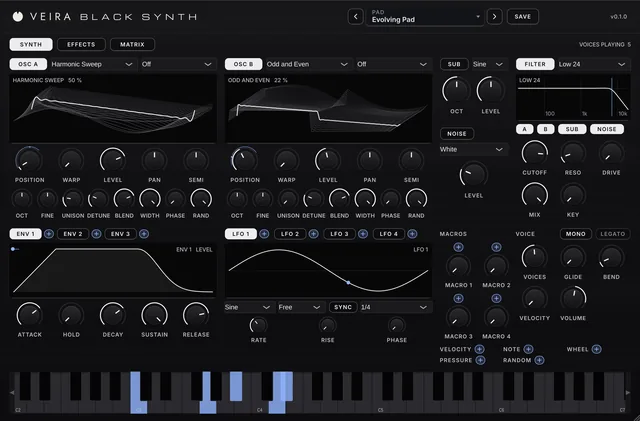
VEIRA’s first instrument: a modern wavetable synthesizer, all black. Two wavetable oscillators with unison and warp, sub, noise, an eight-type filter, three envelopes, four LFOs, a drag-and-drop modulation matrix and five effects.

$249.99

VEIRA Analog One

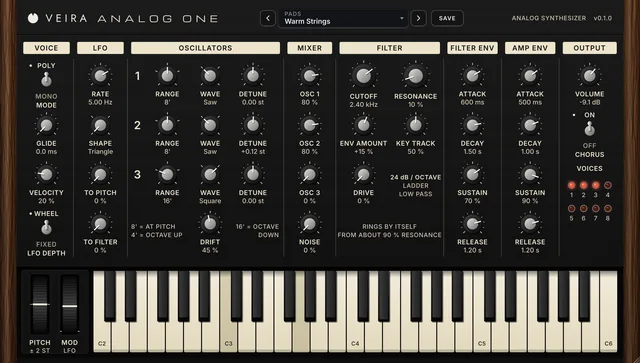
A simple analog synthesizer on one page: three oscillators and noise, a 24 dB ladder filter, two envelopes, an LFO and a chorus, MONO with glide or POLY with eight voices, and a keybed with pitch and mod wheels.

$99.99

VEIRA Keys

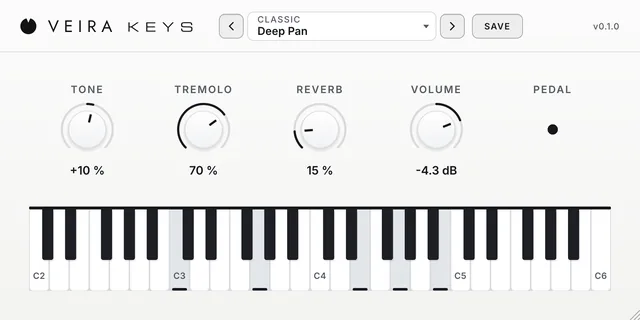
A free electric piano, as clean and lean as it gets: one synthesized electric tine piano, four knobs and real pedals on a flat white face. The lean sibling of VEIRA Clean Piano.

Free