Writing for a string section
How to write and play strings with VEIRA Strings: ranges and registers, solo lines and slurs, sections and the ensemble across the keyboard, dynamics on the mod wheel, and the articulations for each part.
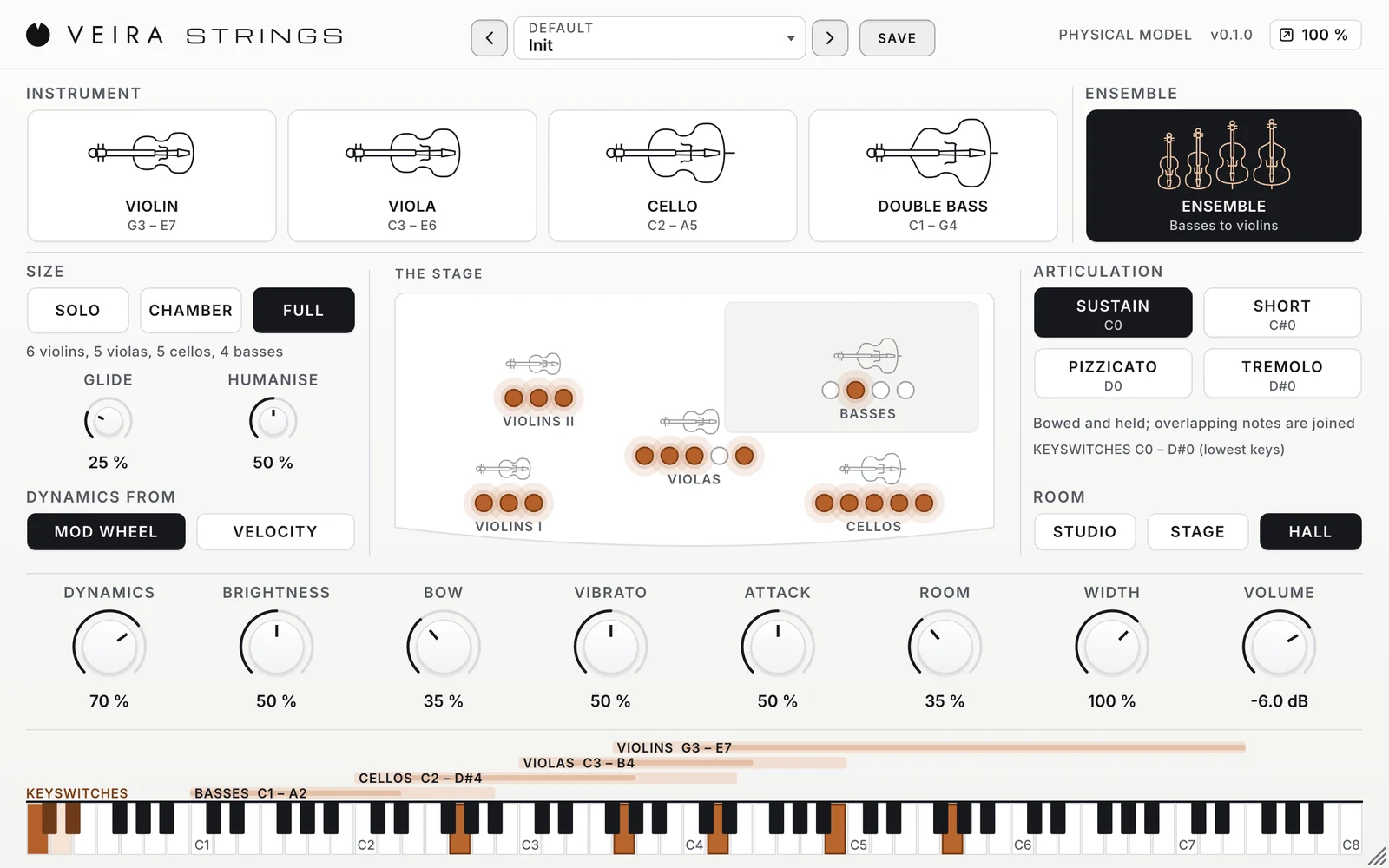
Strings carry more music than any other section: the bed under a ballad, the theme of a film, the rhythm under a pop chorus. They sound real when they are written and played the way string players play, which comes down to a few habits. VEIRA Strings is a string section you play from a keyboard, every player a physical model of a bowed string. This is how to write for it.
Ranges and registers
Every instrument has a range, and inside it a register where it sounds its best. Write the violin from G3 upwards, the viola from C3, the cello from C2 and the double bass from C1, and keep most of each part in the middle of its range rather than at the extremes. VEIRA Strings draws each range over its keyboard strip, the best register darker, so you can see at a glance whether a part sits where the instrument sings.

One line, slurred
A solo string line sounds like a player when its notes are joined. In SOLO, a note played while another is held is slurred on the same bow: the finger moves and the bow goes on. So play legato where the phrase is one breath, and lift between notes you want bowed afresh. GLIDE sets how long the finger takes, a little for clean legato, more for an expressive slide, and a leap wider than a fifth changes bow by itself.
Sections and the ensemble
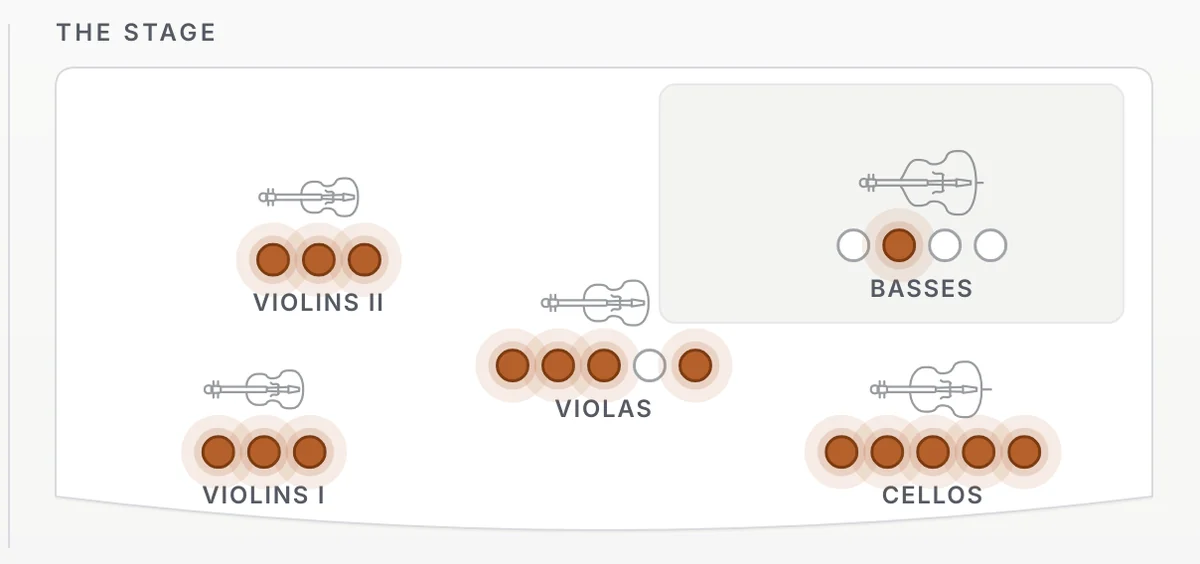
A section is not one instrument made louder: it is many players, each a little out of step with the others in tuning, timing and vibrato. That is where the breadth of real strings comes from, and VEIRA Strings plays every player on their own bowed string. For a whole arrangement, the ENSEMBLE puts basses, cellos, violas and violins across the keyboard, each fading into the next, so two hands play the orchestra:
- Keep the bass line low, around E1 to G2, where the basses and cellos share it.
- Put the harmony in the middle, where violas and cellos meet.
- Give the melody to the top, from about middle C to C6, where the violins sing.
- Voice chords widely across both hands, as you would write them for real players.
Dynamics are played
Nothing gives programmed strings away like a flat dynamic. Real players swell into long notes and taper the ends of phrases, and the tone changes as they do: louder is brighter, as the bow bites harder and moves towards the bridge. Ride the mod wheel as you play, up into the long notes and down at the ends of phrases, and record it with the notes. For short, rhythmic parts, play the accents with your velocity instead.
The right articulation
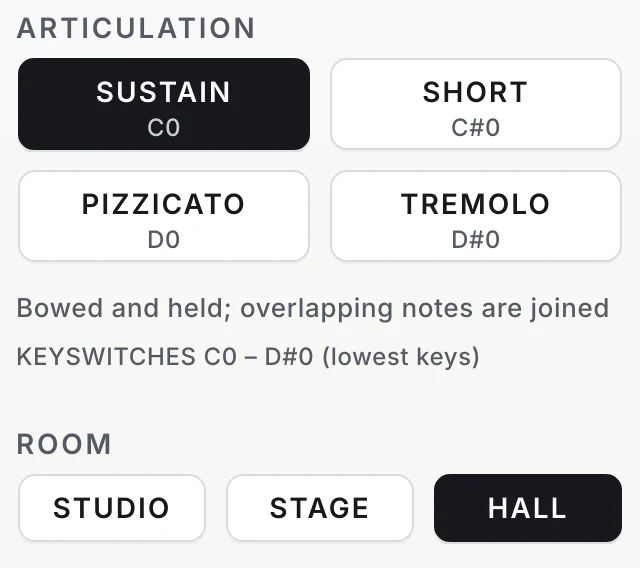
Each part has its stroke. Long lines and pads are SUSTAIN; rhythmic figures and ostinatos are SHORT, a stroke that leaves the string; light accompaniments and walking basses are PIZZICATO, plucked and ringing until you let go; suspense and storms are TREMOLO, the bow hurrying back and forth, each player at their own speed. Switch them in a part with the keyswitches C0 to D#0, recorded just before the notes they belong to.
Where to start
Load a preset close to the job: Solo Violin or Solo Cello for a melody, Ballad Strings or Soft Strings for a bed under a song, Full Strings for the orchestra, String Quartet for chamber writing, Pizzicato Strings or Spiccato Strings for rhythm, Tremolo Tension for suspense and Epic Unison for the big theme. Read the page of VEIRA Strings for every control. For the brass section beside it, modelled the same way, VEIRA Brass; for a hall around the whole orchestra, VEIRA Space.