VEIRA Vocal Studio

An all-in-one creative vocal plugin: a voice shifter with pitch, formant, unison and tuning, six modules with six styles each, from dynamics and character to delay, reverb and chops on the beat, and a mono voice that comes out in stereo.

$149.99, a one-time purchase with free updates

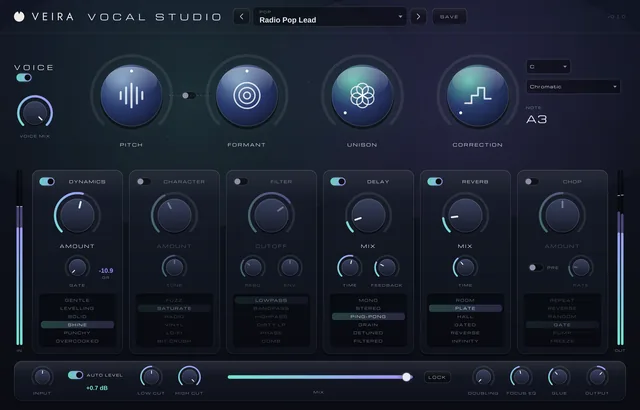
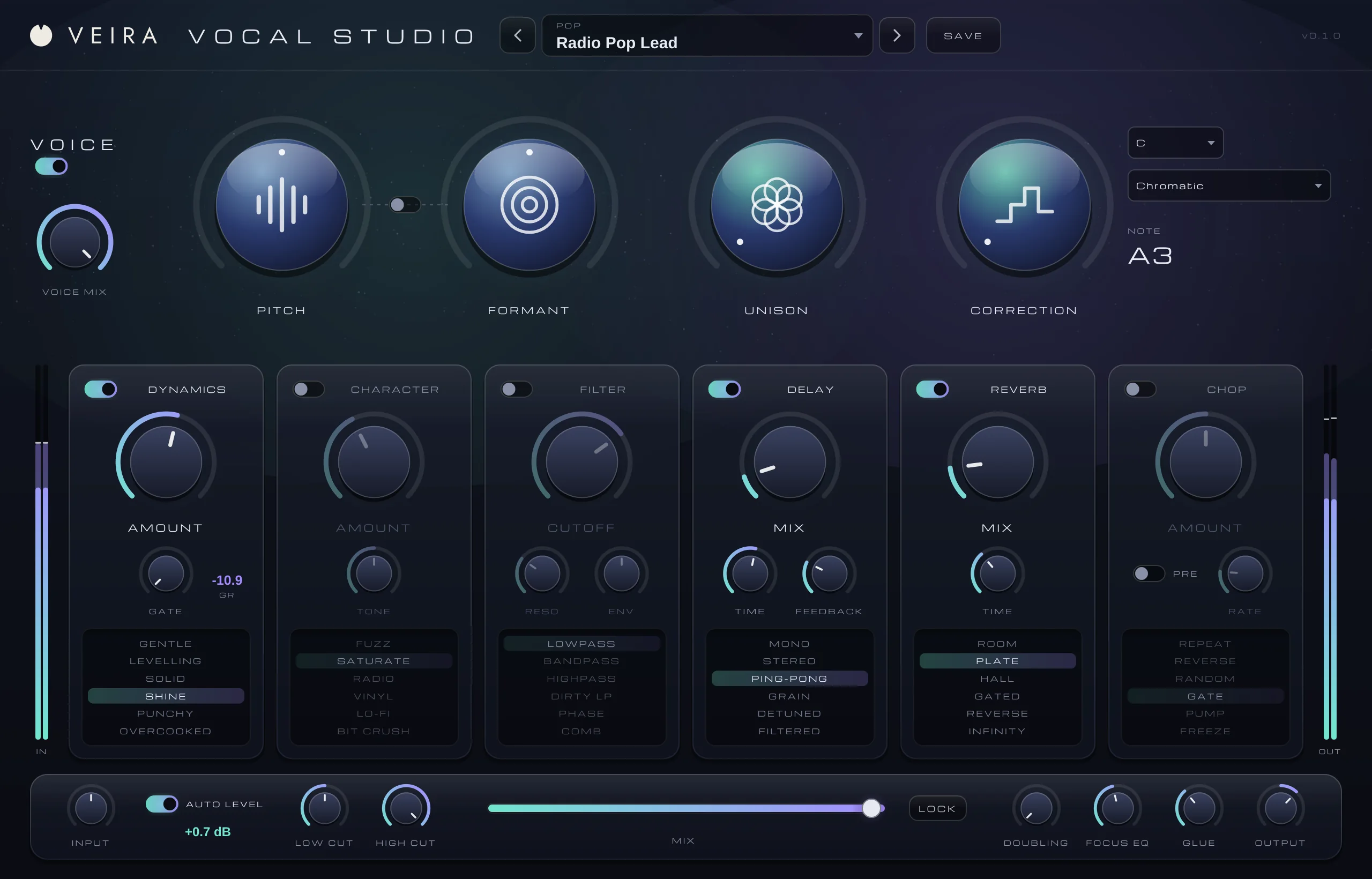
VEIRA Vocal Studio with the preset Radio Pop Lead while a vocal plays: the VOICE section with the PITCH, FORMANT, UNISON and CORRECTION orbs, KEY, SCALE and the NOTE readout; the six module cards DYNAMICS, CHARACTER, FILTER, DELAY, REVERB and CHOP, each with a power switch, a big knob, small knobs and six styles; the IN and OUT meters; and the global bar with INPUT, AUTO LEVEL, LOW CUT, HIGH CUT, MIX, LOCK, DOUBLING, FOCUS EQ, GLUE and OUTPUT.

VEIRA Vocal Studio is one window for everything you might do to a recorded voice, from a clean, polished lead to a chipmunk, a robot, a telephone, a wall of harmonies or a stutter on the beat. The VOICE section moves the pitch and the formant apart or together, adds unison copies and pulls the voice to a key and scale, gently or hard. Six modules follow, DYNAMICS, CHARACTER, FILTER, DELAY, REVERB and CHOP, each with a power switch, one big knob and six styles to pick by name, and a global bar levels the voice going in and adds doubling, focus and glue at the end. A mono voice goes out in stereo.

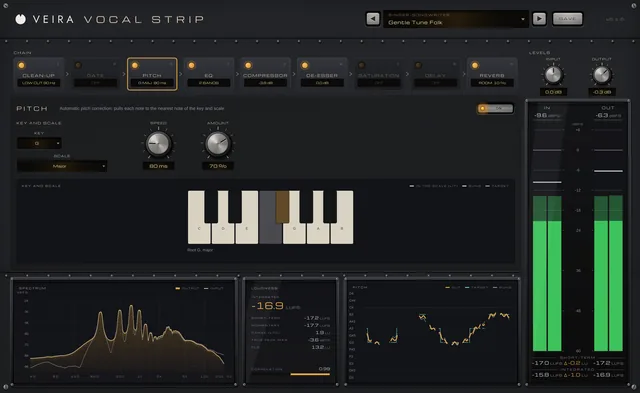
It is the creative counterpart to VEIRA Vocal Strip. The strip is a mixing channel strip: nine modules in any order, each with its full set of controls and its own display, for getting a recorded vocal ready for the mix. The studio is built to make something of a voice: a voice shifter with pitch, formant, unison and tuning, and six style-based modules that go from a polished lead to a chopped, crushed, filtered or endlessly reverberant one. AUTO LEVEL makes every take behave the same, DELAY and CHOP follow the song’s tempo, and the latency is constant, so switching modules never moves the track.

A tour of VEIRA Vocal Studio

VEIRA Vocal Studio with the preset Radio Pop Lead while a vocal plays: the VOICE section with the PITCH, FORMANT, UNISON and CORRECTION orbs, KEY, SCALE and the NOTE readout; the six module cards DYNAMICS, CHARACTER, FILTER, DELAY, REVERB and CHOP, each with a power switch, a big knob, small knobs and six styles; the IN and OUT meters; and the global bar with INPUT, AUTO LEVEL, LOW CUT, HIGH CUT, MIX, LOCK, DOUBLING, FOCUS EQ, GLUE and OUTPUT.
  1. The whole of VEIRA Vocal Studio

    VEIRA Vocal Studio is one window for everything you might do to a recorded voice. The VOICE section moves its pitch and its formant apart or together, adds unison copies around it and pulls it to a key and scale, gently or hard. Six modules follow, DYNAMICS, CHARACTER, FILTER, DELAY, REVERB and CHOP, each with a power switch, one big knob and six styles to pick by name. AUTO LEVEL brings every take to the same working level before the modules and gives the gain back at the end, DELAY and CHOP follow the song’s tempo, and DOUBLING, FOCUS EQ and GLUE finish the voice. Insert it on a mono track and the voice comes out in stereo.

  2. The voice

    PITCH and FORMANT, apart or linked, UNISON around the voice, CORRECTION to the key and scale, and the note being sung.

  3. Six modules

    Each with a power switch, one big knob, one or two small knobs and six styles to pick by name.

  4. Dynamics

    Six compressors in one card, a gate, and the gain reduction right now.

  5. Echoes and space

    Six delays in notes of the song’s tempo, and six spaces from VEIRA Space’s engine.

  6. The global bar

    Level and clean-up going in, AUTO LEVEL’s gain, MIX with LOCK, and doubling, focus and glue going out.

What VEIRA Vocal Studio does for you

The VOICE section: the VOICE switch and VOICE MIX, the PITCH and FORMANT orbs with the LINK switch between them, the UNISON and CORRECTION orbs, the KEY and SCALE menus and the NOTE readout showing A3.

The voice itself is a control

PITCH moves the voice up or down by up to an octave without changing its speed. FORMANT makes it bigger or smaller without changing the note: down is a giant, up is a child. The two are separate operations on the voice’s own periods, so you can move one and keep the other where it was, or switch LINK on and get the chipmunk and the slowed, screwed voice as if a tape were sped up or slowed down. UNISON adds up to four detuned copies around the voice, 12 to 31 ms behind it, spread left and right. VOICE MIX blends the shifted voice with the natural one, which is how a fifth or an octave becomes a harmony. Measured: +7 st on a sung 220 Hz gives 328.8 Hz; FORMANT ±6 st moves the voice’s timbre a third of an octave each way with the note unchanged.

  • ±12 semitones
  • Formant apart from pitch
  • Unison, four copies
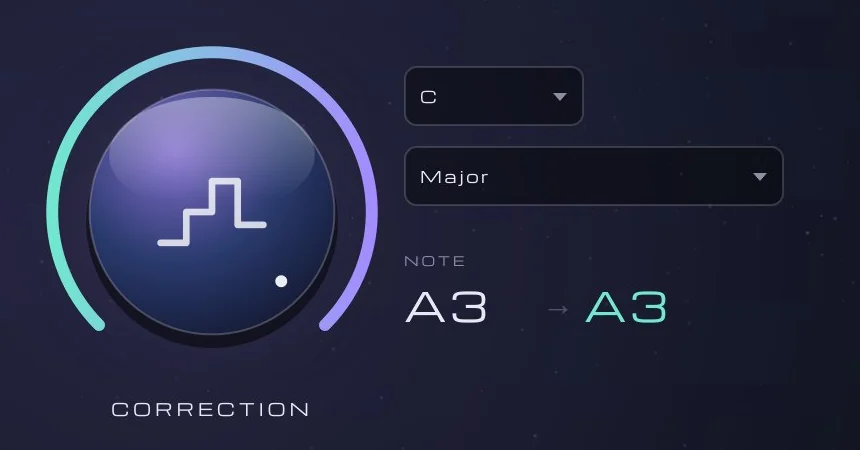
The CORRECTION orb at 100 % with the preset Hard Tune Major, KEY C, SCALE Major, and the NOTE readout showing the note sung, an arrow and the note it goes to: A3 to A3.

In tune, gently or hard

CORRECTION pulls the voice to the notes of KEY and SCALE (Chromatic, Major, Minor, Major Pentatonic or Minor Pentatonic) with one knob. From 0 to 25 % it takes more of the way to the note, with a slow glide that leaves slides and vibrato alone; above 25 % it goes all the way and the glide shortens, from 225 ms to instant at 100 %, the hard-tuned, robotic effect. The NOTE readout shows the note being sung and the note it goes to, so you can check the key before the chorus. It shares VEIRA Vocal Strip’s tuner: a note sung 40 cents flat lands within 2 cents at 100 %.

  • 5 scales
  • One knob, how far and how fast
  • Within 2 cents
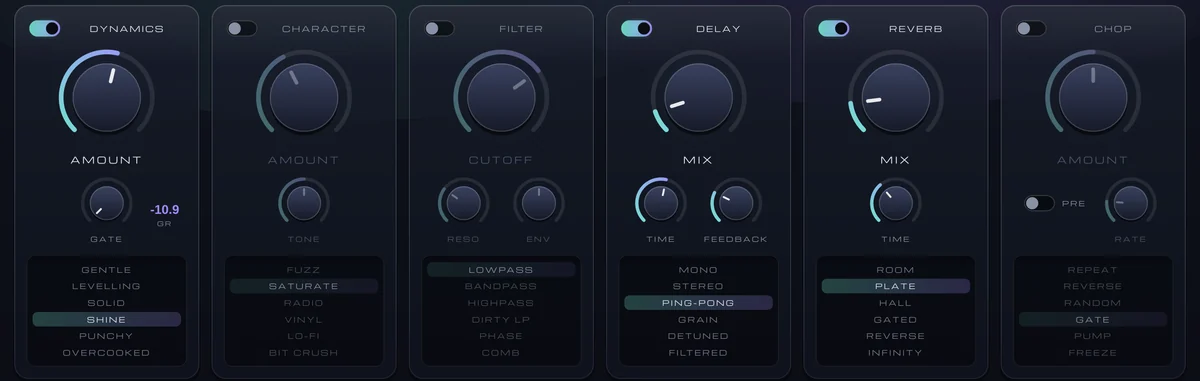
The six module cards: DYNAMICS on with Shine, CHARACTER off, FILTER off, DELAY on with Ping-Pong, REVERB on with Plate and CHOP off, each with its power switch, big knob, small knobs and list of six styles.

Six modules, six styles each

DYNAMICS, CHARACTER, FILTER, DELAY, REVERB and CHOP are laid out alike: a power switch, one big knob (AMOUNT, CUTOFF or MIX), one or two small knobs and a list of six styles you pick by name: Levelling, Shine or Overcooked; Fuzz, Radio or Vinyl; Dirty LP, Phase or Comb; Ping-Pong, Grain or Detuned; Plate, Gated, Reverse or Infinity; Repeat, Random or Freeze. Each style is tuned so the big knob does what you expect at every setting. Switching a module crossfades over 20 ms, and the latency never changes, so you can try every style while the song plays.

  • 36 styles
  • One big knob each
  • Switch while playing
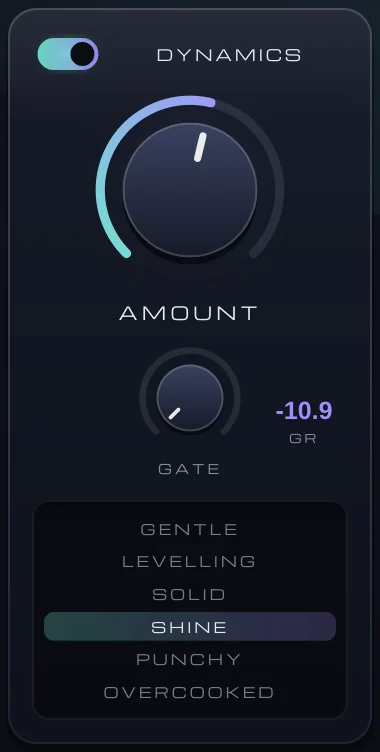
The DYNAMICS card: the power switch on, AMOUNT, GATE with the GR readout showing 10.9 dB of reduction, and the styles Gentle, Levelling, Solid, Shine (chosen), Punchy and Overcooked.

Dynamics that know the level

AUTO LEVEL measures the voice and brings it to a working level of −18 dBFS RMS before the modules, within ±18 dB, slowly and only while the voice is there, then takes the same gain back at the end, in time with the voice. So DYNAMICS needs one knob: AMOUNT lowers the threshold from the peaks only to 20 dB under the working level, and each of the six compressors, Gentle, Levelling, Solid, Shine, Punchy and Overcooked, gives back what it takes, so the knob changes the hold on the voice, not its loudness (within 0.7 dB at 0, 50 and 100 %). GATE quiets the gaps between phrases, and a GR readout shows the reduction. A quiet take and a loud one get the same treatment, and each comes out at its own level.

  • AUTO LEVEL, ±18 dB
  • Six compressors, one knob
  • GR readout
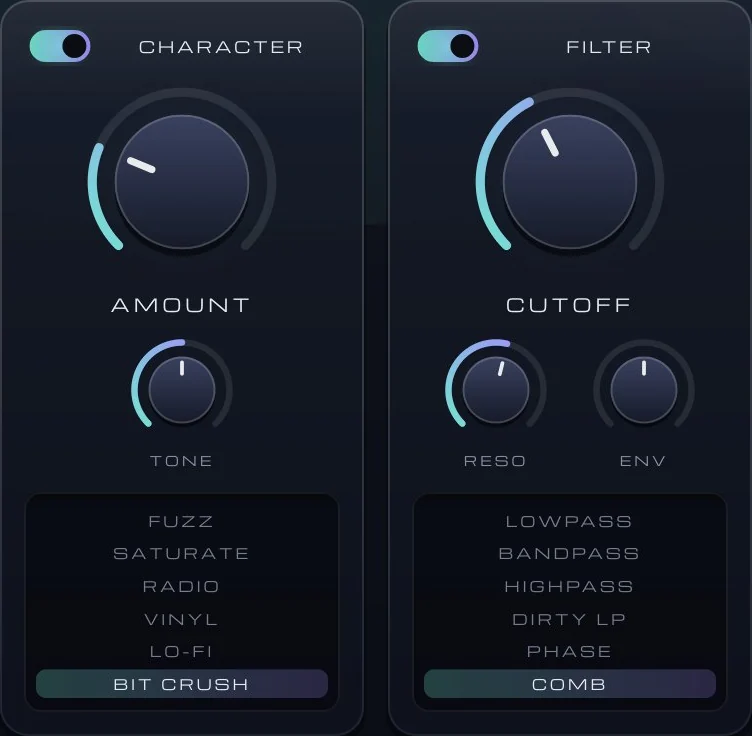
The CHARACTER and FILTER cards with the preset Robot Voice: AMOUNT and TONE with Bit Crush chosen; CUTOFF, RESO and ENV with Comb chosen.

Colour and filters

CHARACTER is six colours, Fuzz, Saturate, Radio, Vinyl, Lo-Fi and Bit Crush, with AMOUNT and a TONE tilt. The curves run at four times the sample rate, so even the fuzz doesn’t alias into hiss, and a slow level match keeps the loudness where it was, so AMOUNT changes the colour, not the level. FILTER is six filters, Lowpass, Bandpass, Highpass, a driven Dirty LP, a Phase sweep and a pitched Comb, with CUTOFF swept in octaves from 40 Hz to 18 kHz, RESO, and ENV, which lets the voice’s own level open or close the filter by up to four octaves: a wah that opens on every word.

  • 4x oversampled
  • Level-matched
  • Envelope follower, ±4 octaves
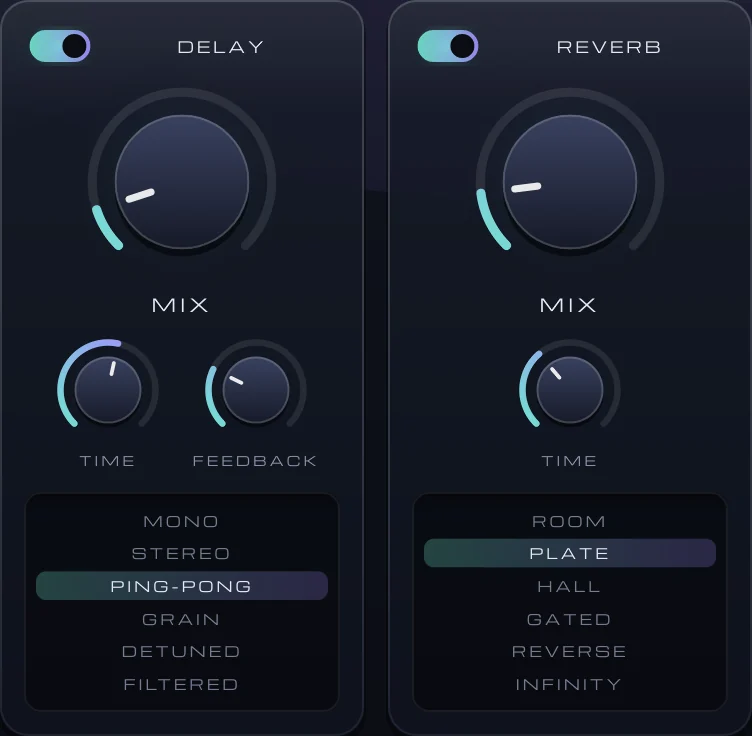
The DELAY and REVERB cards: DELAY’s MIX, TIME and FEEDBACK with Ping-Pong chosen; REVERB’s MIX and TIME with Plate chosen.

Echoes and space on the song’s tempo

DELAY’s TIME is a note value at your DAW’s tempo, from 1/32 to a whole note with dotted and triplet values, and the delay glides when the tempo changes. Six delays: Mono, Stereo, Ping-Pong, Grain (each repeat scattered into grains), Detuned (each pass 12 cents off, bouncing) and Filtered (a slowly sweeping band-pass: the dub echo). REVERB is VEIRA Space’s engine, set up for a voice: Room, Plate, Hall, Gated, Reverse, which swells up into the end of each phrase, and Infinity, a cathedral that hardly decays. Both keep the voice in front: at MIX 100 % it is only 3 to 4.6 dB down, never gone.

  • 1/32 to 1/1, dotted and triplet
  • VEIRA Space’s engine
  • The voice never disappears
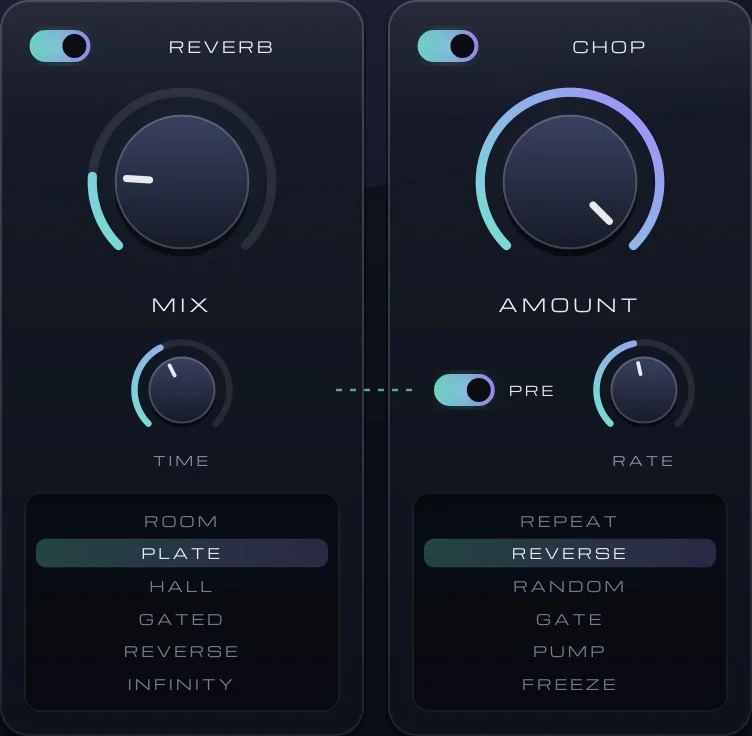
The REVERB and CHOP cards with the preset Reverse Chops: CHOP’s AMOUNT, PRE on with its thread to the REVERB card, RATE, and the styles Repeat, Reverse (chosen), Random, Gate, Pump and Freeze.

Chops on the beat

CHOP cuts the voice into slices of RATE’s length, from 1/32 to 1/1, and does something to each one in time with the song: Repeat (every other slice replays the one before: the stutter), Reverse, Random (as it is, repeated, reversed or silent, by chance), Gate (a sixteen-step pattern), Pump (a sidechain duck on every step) and Freeze (every fourth slice held and looped). While your DAW plays, the slices are locked to its bars and set back by the plugin’s latency, so they land on the beat once the DAW makes it up; stopped, CHOP runs on at the tempo. PRE moves CHOP in front of the DELAY and REVERB, so a reversed slice leaves a plate behind it and a frozen one becomes a drone.

  • Locked to the bar
  • PRE: tails ring on
  • 3 ms slice edges
The global bar: INPUT, AUTO LEVEL with its gain readout at +0.7 dB, LOW CUT, HIGH CUT, the MIX slider at 100 % with LOCK, DOUBLING, FOCUS EQ, GLUE and OUTPUT.

A mono voice in stereo, at its own level

Insert VEIRA Vocal Studio on a mono track and the voice comes out in stereo: UNISON’s copies, DOUBLING (a second take made from the first, 18 and 26 ms behind and 8 cents sharp and flat, left and right), the stereo delays and the reverb spread it across the field. FOCUS EQ brings the voice forward with one knob (up to +5 dB at 3.2 kHz, −3 dB at 320 Hz, +2.5 dB of air), GLUE is a gentle 2:1 compressor on the whole result, level-matched, and MIX blends everything with the dry voice, kept in time. LOCK keeps MIX where you set it while you try presets. With every module off, or MIX at 0 %, the output is the input, delayed, bit for bit.

  • Mono in, stereo out
  • FOCUS EQ and GLUE
  • MIX with LOCK
The preset browser showing Pop: Radio Pop Lead, with previous, next and SAVE.

80 presets, each one measured

Thirteen folders: Lead Vocals, Pop, Hip-Hop & Rap, R&B & Soul, Backing & Doubles, Tuned & Robotic, Pitch & Formant, Lo-Fi & Character, Filter FX, Delay Throws, Spaces, Chop & Glitch and Podcast & Voice. Each was run on the real plugin on a sung vocal that suits its folder, at 120 BPM, with OUTPUT set so it comes out within 0.5 dB of the input’s loudness and no peak over −1 dBFS. AUTO LEVEL is on in all of them, so on the same voice 12 dB down the lead presets come out within about 1 dB and compress the same amount. Each note says what to set first; the tuned ones say to set KEY and SCALE to the song’s.

  • 13 folders
  • Within 0.5 dB
  • The same on a quiet take

Get VEIRA Vocal Studio

Pay once and it’s yours, with every future update included.

VEIRA Vocal Studio

An all-in-one creative vocal plugin: a voice shifter with pitch, formant, unison and tuning, six modules with six styles each, from dynamics and character to delay, reverb and chops on the beat, and a mono voice that comes out in stereo.

  • Yours to keep: pay once, no subscription
  • Every future update, free for life
  • VST3, AU, Standalone on up to 3 computers
  • Changed your mind? Cancel within 14 days (refunds)
USD

One-time payment, in your cart.

Welcome offer

Get 10% off your first order

Leave your email and we’ll send you a code for 10% off your first order, on any plugins. One code per person.

Specifications

Type
Creative vocal plugin: a VOICE section (pitch, formant, unison, correction) and six style-based modules (DYNAMICS, CHARACTER, FILTER, DELAY, REVERB, CHOP) with a global bar
Voice
PITCH and FORMANT −12 to +12 semitones, LINK, UNISON 0 to 100 % (up to four copies, 12 to 31 ms behind the voice, ±8 and ±14 cents), CORRECTION 0 to 100 %, KEY C to B, SCALE Chromatic, Major, Minor, Major Pentatonic or Minor Pentatonic, VOICE MIX. A pitch-synchronous shifter on the mid (75 Hz to 1 kHz tracked); pitch and formant are independent
Voice (measured)
+7 semitones on a sung 220 Hz gives 328.8 Hz; FORMANT ±6 semitones moves the timbre’s centroid from 775 Hz to 1,080 and 545 Hz with the note unchanged; a note sung 40 cents flat lands within 2 cents at CORRECTION 100 %
Correction
0 to 25 %: how far, from nothing to all the way; 25 to 100 %: how fast, the glide from 225 ms to instant at 100 %
Dynamics
AMOUNT 0 to 100 % (the threshold from −14 to −38 dBFS against the −18 dBFS working level), GATE 0 to 100 % (off, then up to a −30 dBFS threshold); Gentle 2:1, Levelling 3:1, Solid 4:1, Shine 3:1 with up to +6 dB over 8 kHz, Punchy 4:1, Overcooked 20:1 driven at 70 % wet; a make-up per style, so the loudness stays within 0.7 dB at 0, 50 and 100 %
Character
AMOUNT and TONE (a ±6 dB tilt around 1 kHz); Fuzz, Saturate, Radio (400 Hz to 3.5 kHz), Vinyl, Lo-Fi, Bit Crush; 4x oversampled and level-matched
Filter
CUTOFF 40 Hz to 18 kHz in octaves, RESO, ENV −100 to +100 % (up to four octaves from the voice’s level); Lowpass, Bandpass, Highpass (12 dB/oct), Dirty LP (24 dB/oct ladder), Phase (six stages, 0.3 Hz), Comb (40 Hz to 4 kHz)
Delay
MIX, TIME 1/32 to 1/1 with dotted and triplet values at the host’s tempo, FEEDBACK 0 to 95 %; Mono, Stereo, Ping-Pong, Grain, Detuned (±12 cents), Filtered; repeats band-limited to 150 Hz to 8 kHz; the voice −4.6 dB at MIX 100 %
Reverb
VEIRA Space’s engine: MIX, TIME 0.3 to 8 s; Room, Plate, Hall, Gated, Reverse, Infinity (about 20 s, with shimmer); 15 ms pre-delay, 150 Hz to 12 kHz; the voice −3 dB at MIX 100 %
Chop
AMOUNT, RATE 1/32 to 1/1, PRE (before the delay and reverb); Repeat, Reverse, Random, Gate (16 steps), Pump, Freeze; locked to the host’s bars and set back by the latency, free-running at the tempo when stopped; 3 ms slice edges
Global bar
INPUT −24 to +24 dB; AUTO LEVEL (toward −18 dBFS RMS, ±18 dB, given back at the end); LOW CUT off to 600 Hz and HIGH CUT 2 kHz to off, 12 dB/oct; MIX 0 to 100 % with LOCK; DOUBLING (±8 cents, 18 and 26 ms, left and right); FOCUS EQ (up to +5 dB at 3.2 kHz, −3 dB at 320 Hz, +2.5 dB over 10 kHz); GLUE (2:1, level-matched); OUTPUT −24 to +12 dB
Latency
2,943 samples at 48 kHz (61 ms), 2,706 at 44.1 kHz, 5,855 at 96 kHz, 11,678 at 192 kHz, reported to your DAW and constant whichever modules are on; with every module off, at MIX 0 % and bypassed, the input delayed by the latency, bit for bit. Built for playback and mixing, not for monitoring while recording
Metering
IN and OUT peak and RMS with peak hold; the NOTE readout (the note sung and the note CORRECTION goes to); the GR readout; AUTO LEVEL’s gain
Presets
80 factory presets in 13 folders (Lead Vocals, Pop, Hip-Hop & Rap, R&B & Soul, Backing & Doubles, Tuned & Robotic, Pitch & Formant, Lo-Fi & Character, Filter FX, Delay Throws, Spaces, Chop & Glitch, Podcast & Voice), plus your own
Channels
Mono, stereo, or mono in and stereo out
CPU (measured)
About 15 to 16 % of one core of a 2-core cloud machine with everything on (stereo, 48 kHz)
Formats
VST3, AU, Standalone
macOS
macOS 11 or later, Apple silicon or Intel (universal). VST3, AU and Standalone.
Windows
Windows 10 or later, 64-bit. VST3 and Standalone.
Pro Tools
Pro Tools (AAX) versions are built and tested, and arrive once they’re signed for Pro Tools.
Latest version
0.3.0, released November 17, 2026 · What’s new
Read more on the blog: Creative vocal effects: doubles, harmonies, formant shifts and unison · Mixing backing vocals and doubles: stacks, octaves and harmonies behind the lead

Questions? 7 answers about VEIRA Vocal Studio

Works well with

VEIRA Vocal Strip

A whole vocal chain in one console: nine modules in any order, from clean-up and pitch correction to compression, de-essing, echo and reverb, each with its own display.

$149.99

VEIRA Vocal Rider

Rides a vocal’s fader for you, the way an engineer rides it through a song: set where the vocal should sit, and one console fader moves up and down to keep it there, within the limits you set.

$39.99

VEIRA Space

An algorithmic reverb that takes the ringing out and leaves the space.

$149.99