Creative vocal effects: doubles, harmonies, formant shifts and unison
How to make a vocal sound doubled, add a simple harmony, change a voice’s size with formant shifting and widen it with unison, and how to keep each effect musical in a mix.
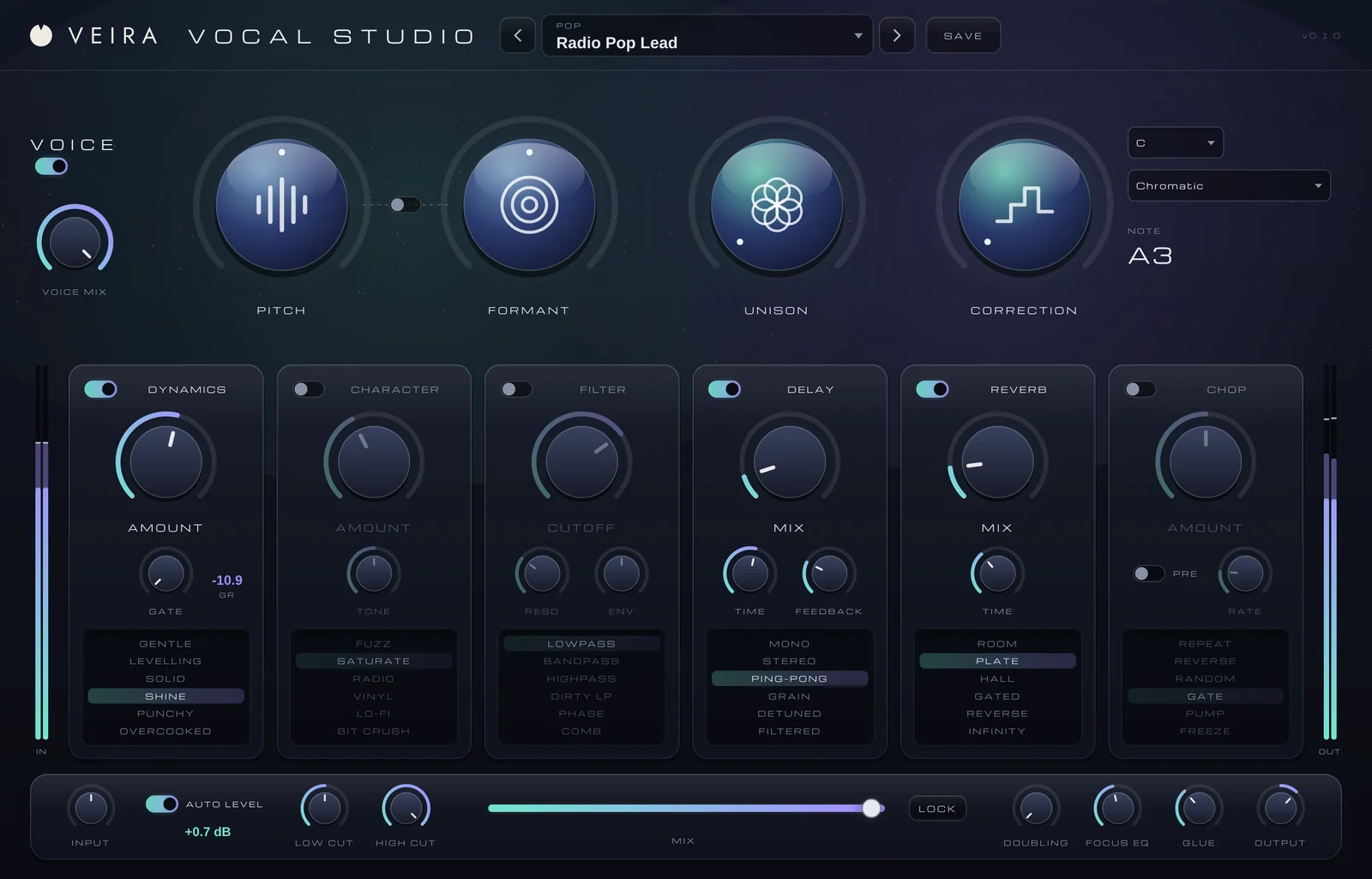
A single vocal take can become a lot more than one voice. Doubling makes it thicker, a shifted copy can sing a harmony, moving the formant makes the singer sound bigger or smaller, and unison copies spread it across the speakers. These effects are all over modern pop, hip-hop and electronic music, and they come from the same few ideas: copies of the voice, slightly delayed, slightly detuned or shifted, and placed in stereo.
Doubles: the sound of two takes
The classic double is a singer recording the same part twice. The two takes never line up exactly: they drift a few milliseconds apart and a few cents out of tune, and that small difference is what makes the sound thick. You can imitate it from a single take by delaying a copy by roughly 10 to 30 ms, detuning it by a few cents and panning it away from the original. Keep the copy quieter than the lead and treat it as support: a double as loud as the lead starts to sound like a chorus effect.
Harmonies from one voice
Shift a copy of the voice by a musical interval, blend it in, and you have a harmony. Octaves, up or down, are the safest, because they fit any chord. A fifth, 7 semitones, is the next common choice: it sounds open and strong, though on a few notes of a scale it falls outside the key. Thirds sound sweeter but change between major and minor with the chord, so a fixed shift only works while the harmony stays put; that’s where tuning the voice to the song’s key and scale helps.
Pitch and formant are two different things
The pitch of a voice is the note it sings. The formant is the shape of its resonances, which tells the ear how big the singer is. Shifting pitch the old way, by speeding up a tape, moves both together: up gives the chipmunk voice, down the slowed, heavy one. Shifting them separately opens up more options:
- Pitch up, formant kept: a harmony that still sounds like the same singer.
- Formant down, pitch kept: a bigger, darker voice singing the same note.
- Formant up, pitch kept: a smaller, younger voice, useful for character parts.
- Both moved together: the sped-up or slowed-down tape sound, on purpose.
Unison and stereo width
Unison stacks several slightly detuned, slightly delayed copies around the voice and spreads them left and right. It turns a mono vocal into a wide wall, which works well on hooks, backing parts and ad-libs. Use it with some restraint on a lead: the center of the voice should stay focused, and it’s worth checking the mix in mono to make sure the copies don’t smear the words.
Doing it with VEIRA Vocal Studio
VEIRA Vocal Studio puts all of this in its VOICE section. PITCH moves the voice up or down by up to an octave without changing its speed, and FORMANT makes it bigger or smaller without changing the note. The two work separately, or switch LINK on and they move together, as if a tape were sped up or slowed down. VOICE MIX blends the shifted voice with the natural one, which is how a fifth or an octave becomes a harmony.

UNISON adds up to four detuned copies around the voice, 12 to 31 ms behind it, spread left and right. CORRECTION pulls the voice to the notes of KEY and SCALE with one knob, gently with a slow glide or hard for the robotic effect, and the NOTE readout shows the note being sung and the note it goes to.

In the global bar, DOUBLING makes a second take from the first, 18 and 26 ms behind and 8 cents sharp and flat, left and right, so a voice on a mono track comes out in stereo.

MIX blends everything with the dry voice, kept in time, and LOCK keeps MIX where you set it while you try presets.