VEIRA Octaver

Natural octave voices above and below a singer. The formants stay where they are, so the octave above is never a chipmunk and the octave below is never a monster: they sound like singers doubling the part an octave apart.

$29.99, a one-time purchase with free updates

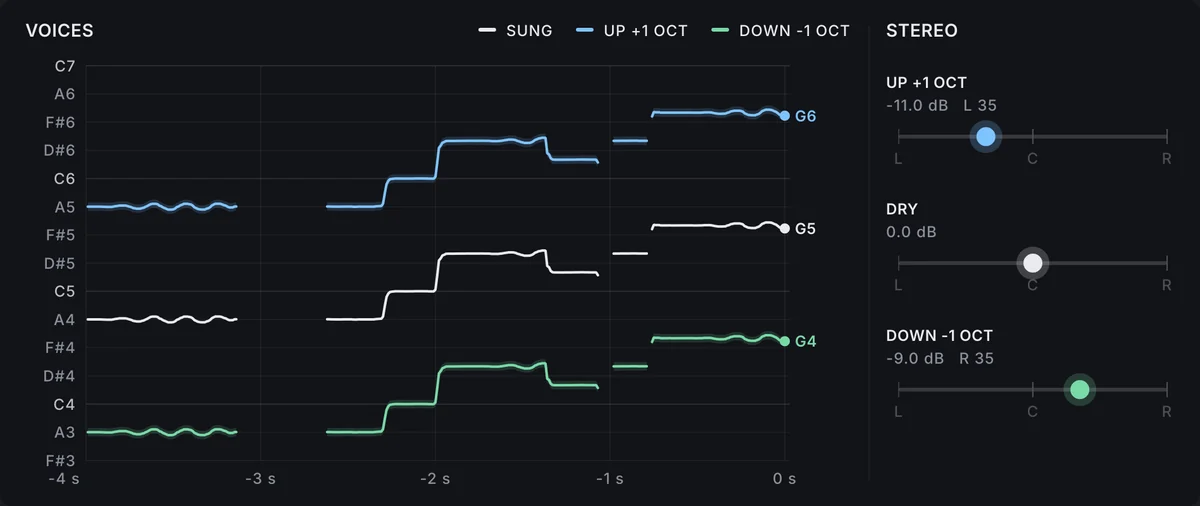
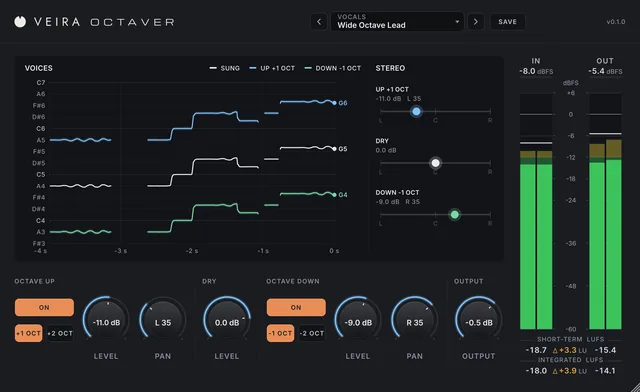
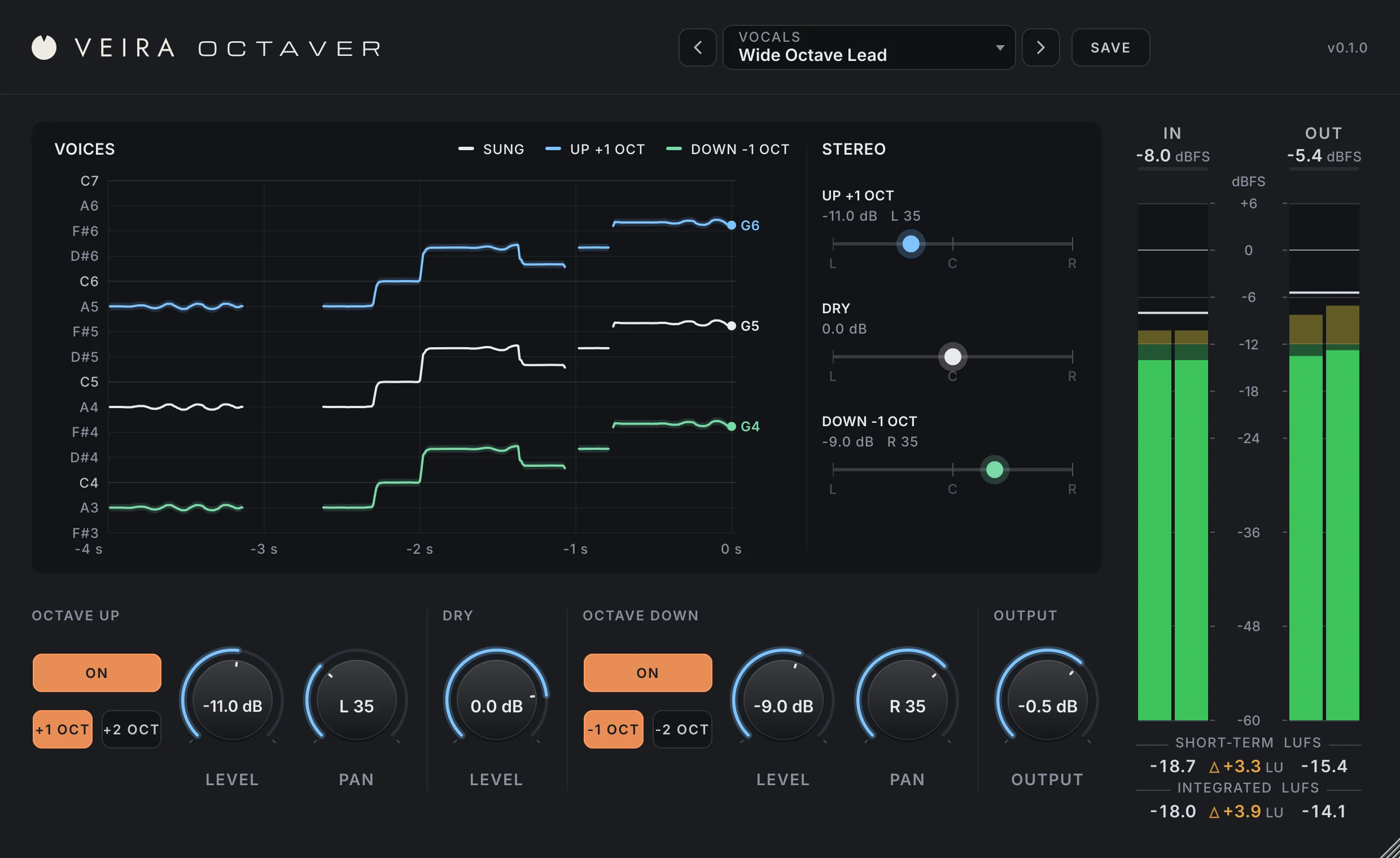
VEIRA Octaver with the Vocals preset Wide Octave Lead while a woman sings: the VOICES display with the sung line from A4 up to G5, the octave above from A5 to G6 and the octave below from A3 to G4 over the last four seconds, the STEREO panel with UP +1 OCT at −11.0 dB L 35, DRY at 0.0 dB and DOWN −1 OCT at −9.0 dB R 35, the OCTAVE UP, DRY, OCTAVE DOWN and OUTPUT controls, and the IN and OUT meters with loudness.

VEIRA Octaver is a vocal octaver: put it on a vocal track and it sings along with the voice, an octave or two above it, below it, or both. OCTAVE UP and OCTAVE DOWN each have ON, a choice of one or two octaves, LEVEL and PAN, and DRY sets the singer’s own voice. Only the pitch moves: the formants stay where they are, so the octave above is never a chipmunk and the octave below is never a monster. They sound like singers doubling the part an octave apart, and each is level-matched to the voice, so 0 dB means as loud as the singer.

It needs one note at a time: a singer, a rapper, a single-note guitar, bass or synth line. Consonants, breaths and chords pass through the octave voices quietly and unshifted, so the words stay clean, and the detector covers 72 Hz to 1000 Hz, so bass notes below about D2 get no octave. The VOICES display draws the pitch sung with the octaves around it, the STEREO panel shows where each voice sits, and the latency is a constant 29.1 ms, reported to your DAW. The 37 factory presets in 8 folders run from a quiet low double to giants and ghost choirs. Buy it once and VEIRA Manager installs it, like every plugin from VEIRA.

A tour of VEIRA Octaver

VEIRA Octaver with the Vocals preset Wide Octave Lead while a woman sings: the VOICES display with the sung line from A4 up to G5, the octave above from A5 to G6 and the octave below from A3 to G4 over the last four seconds, the STEREO panel with UP +1 OCT at −11.0 dB L 35, DRY at 0.0 dB and DOWN −1 OCT at −9.0 dB R 35, the OCTAVE UP, DRY, OCTAVE DOWN and OUTPUT controls, and the IN and OUT meters with loudness.
  1. The whole of VEIRA Octaver

    VEIRA Octaver sings along with a voice, an octave or two above it, below it, or both. OCTAVE UP and OCTAVE DOWN each have ON, a choice of one or two octaves, LEVEL and PAN, and DRY sets the singer’s own voice. Only the pitch moves: the formants, the resonances that make a voice sound like that singer, stay where they are, and each octave is level-matched to the dry voice, so 0 dB means as loud as the singer. The VOICES display draws the pitch sung over the last four seconds with the octaves above and below it, and a STEREO panel shows where each voice sits. The latency is a constant 29.1 ms, reported to your DAW.

  2. Voices

    The pitch sung over the last four seconds, with the octave above and the octave below it, on a scale of note names.

  3. Stereo

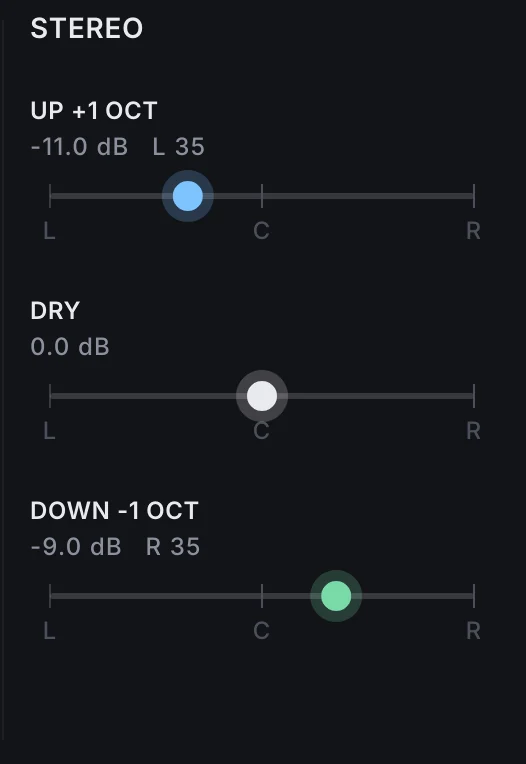
    Where UP, DRY and DOWN sit between left and right, with their levels and pans.

  4. Octave up

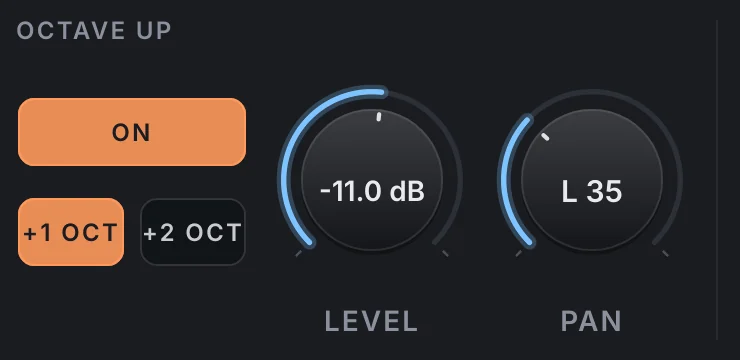
    ON, one or two octaves above, LEVEL and PAN of the voice above.

  5. Octave down

    ON, one or two octaves below, LEVEL and PAN of the voice below.

  6. In and out

    Peak and RMS for the input and the output, with short-term and integrated loudness.

What VEIRA Octaver does for you

The VOICES display and the STEREO panel with Wide Octave Lead: the sung line with the octave above it and the octave below it, the notes G6, G5 and G4 at the right, and UP at L 35, DRY in the centre and DOWN at R 35.

Octaves that keep the singer’s tone

OCTAVE UP and OCTAVE DOWN sing along with the voice, an octave or two above and below it. The formants, the resonances of the throat and mouth that make a voice sound like that person, stay where they are, so the octave above is never a chipmunk and the octave below is never a monster: they sound like singers doubling the part an octave apart. Measured on sung vowels, the octaves keep the first two formants within 10 % of the singer’s own.

  • Formants kept
  • Within 10 % on vowels
  • Above and below
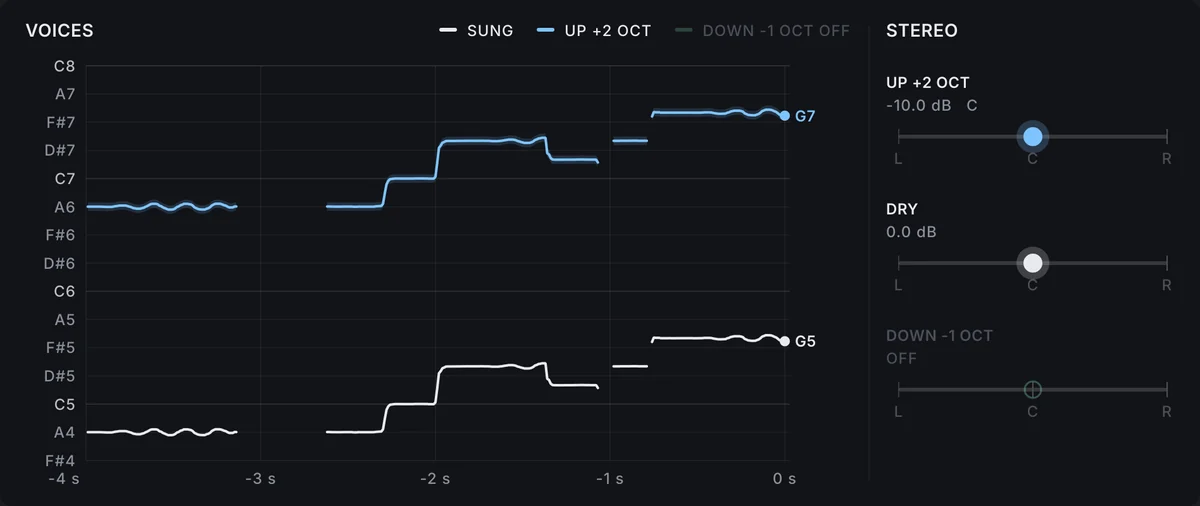
OCTAVE UP alone at +2 OCT and −10.0 dB: the octave above runs two octaves over the sung line, from A6 to G7, the legend reads DOWN −1 OCT OFF, and the STEREO panel shows UP +2 OCT in the centre and DOWN as OFF.

One or two octaves, each way

+1 OCT or +2 OCT for the voice above, −1 OCT or −2 OCT for the voice below, each with its own ON. One octave up adds lift, two a thin, glassy layer; one octave down adds weight, two a deep shadow. The octaves follow the singer’s own period, so they track vibrato and slides, stay within a cent of the octave on sung vowels, and always land on the same note name as the voice.

  • ±1 or ±2 octaves
  • Within a cent
  • Follows vibrato
The OCTAVE UP section: ON lit, +1 OCT chosen, LEVEL at −11.0 dB and PAN at L 35.

0 dB means as loud as the voice

Each octave voice is level-matched to the dry voice: their K-weighted loudness over the sung parts keeps it there, within ±12 dB, gliding smoothly and holding through consonants and pauses. So at 0 dB LEVEL an octave sits at the singer’s loudness on any vowel and any note, within 0.1 dB on sustained vowels, and −6 dB means 6 dB under it. LEVEL runs from −inf to +6 dB, with −12 dB in the middle of the knob’s travel.

  • Level-matched
  • −inf to +6 dB
  • Within 0.1 dB on vowels
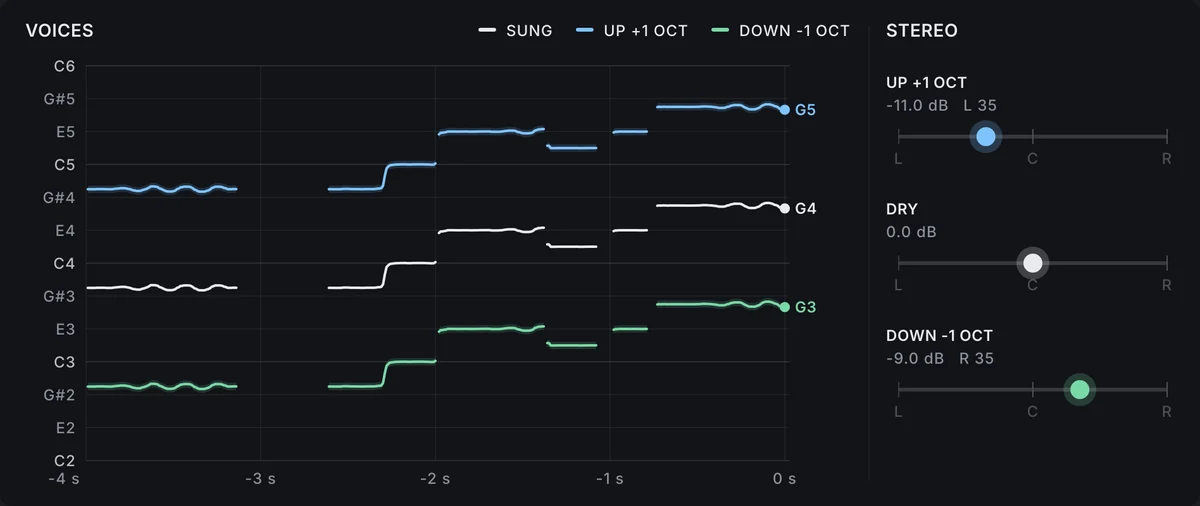
The STEREO panel: UP +1 OCT at −11.0 dB L 35, DRY at 0.0 dB in the centre and DOWN −1 OCT at −9.0 dB R 35, each a dot between L, C and R.

Each voice in its place

PAN places each octave from L 100 to R 100. On a mono vocal track into stereo, the dry voice sits in the centre and the octaves spread around it. The pan law is constant power with 0 dB on each side in the centre, so a voice sounds equally loud wherever it is. The STEREO panel shows UP, DRY and DOWN between left and right with their levels and pans, and reads MONO OUT when the output is mono.

  • L 100 to R 100
  • Constant power
  • Mono into stereo
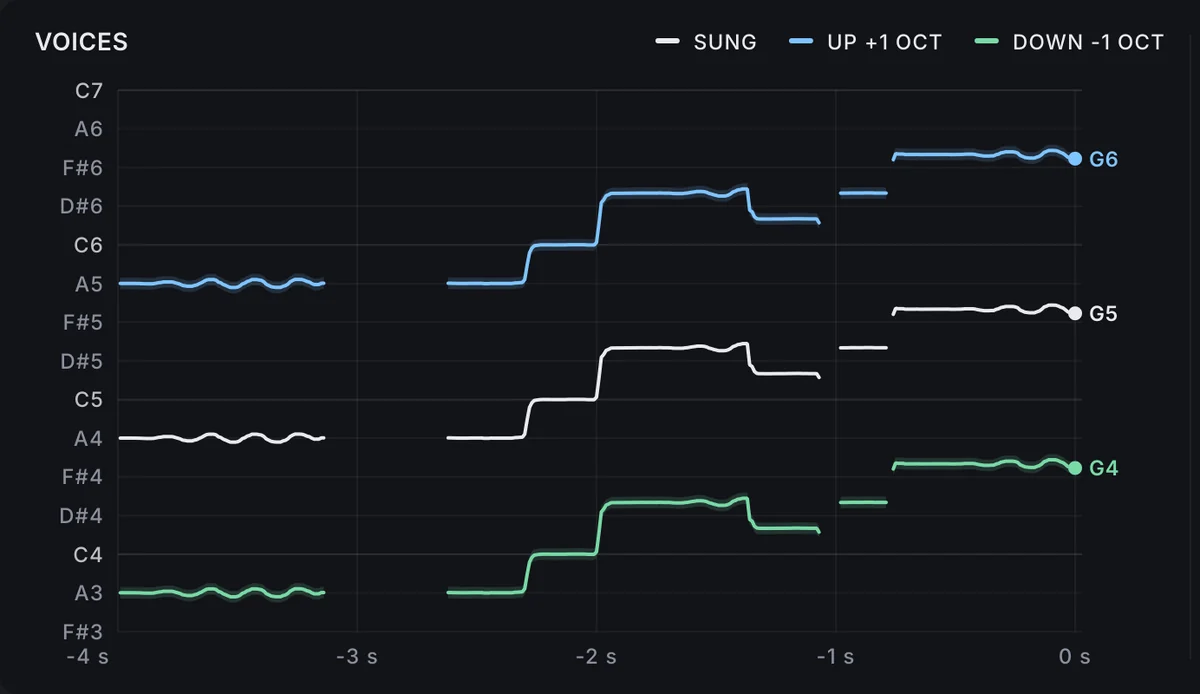
The VOICES display: the sung line in white, the octave above in blue and the octave below in green over the last four seconds, with gaps where the singer breathes, on a scale of note names from F#3 to C7.

Consonants stay with the singer

Consonants, breaths and noise have no pitch, so the octave voices let them through unshifted, about 12 dB down, the way engineers cut the consonants out of doubled vocals: the dry voice carries every word, and an octave never doubles an s. On a chord the detector mostly finds no pitch, so the octaves fall back to that quiet copy instead of garbling. On the VOICES display those moments are gaps in the lines.

  • About 12 dB down
  • Unshifted
  • No garbling on chords
The same phrase sung by a man, an octave lower, with Wide Octave Lead: the scale has moved down, the sung line runs from A3 to G4, the octave above from A4 to G5 and the octave below from A2 to G3.

See the voices

The VOICES display draws the pitch sung over the last four seconds, with the octave above and the octave below in their own colours, on a scale of note names that follows what is sung: it grows at once for a higher or lower note and shrinks back two seconds later. While the voice sounds, each line ends on a dot with the note it is singing now.

  • The last 4 seconds
  • Note names
  • Follows the range
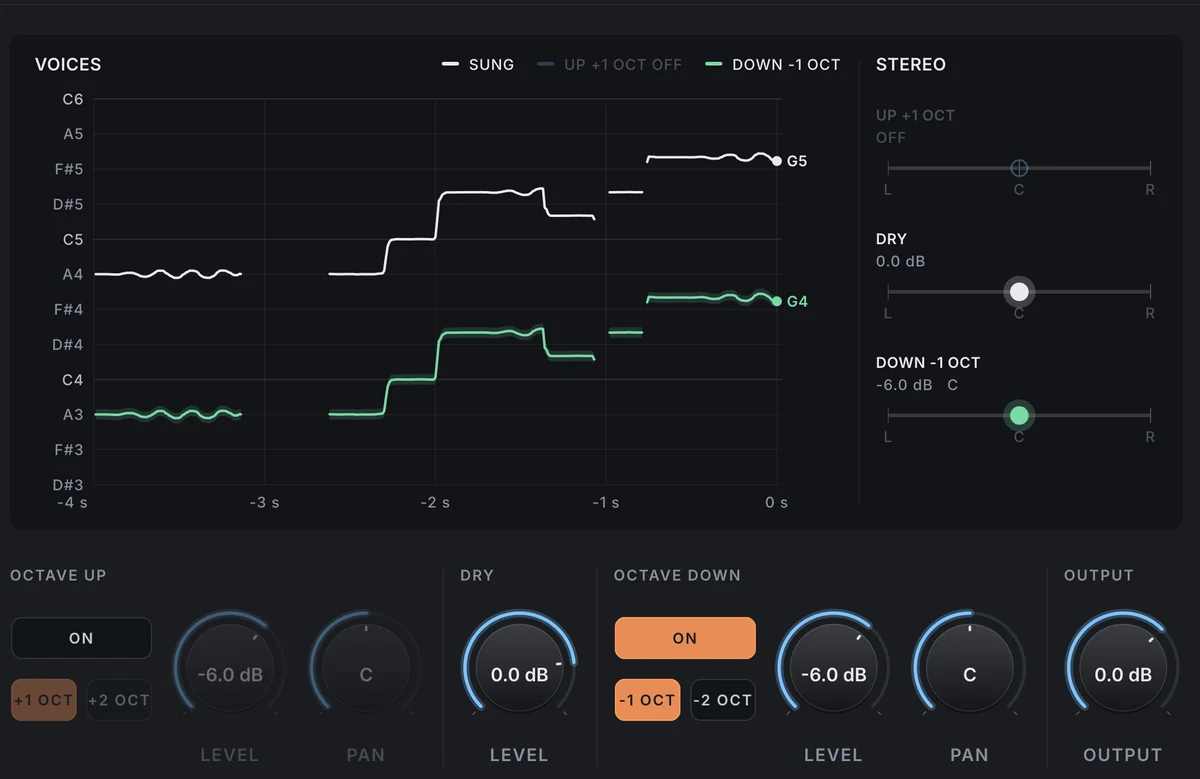
The Init preset: the OCTAVE UP section veiled with its ON button off and the legend reading UP +1 OCT OFF, OCTAVE DOWN on at −1 OCT and −6.0 dB with its line under the sung line, and the STEREO panel showing UP as OFF.

One switch from Init

Init has OCTAVE DOWN on, one octave down at −6 dB in the centre: a low double under the voice. OCTAVE UP waits, off, at +1 OCT and −6 dB, so one click adds the octave above. A section that is off dims, so you see which voices are playing. Every switch and level glides over 20 ms: no clicks switching ON or changing the octave mid-note, also while automated.

  • 20 ms glides
  • No clicks
  • Dims when off
The controls: OCTAVE UP on at +1 OCT, LEVEL −11.0 dB and PAN L 35; DRY at 0.0 dB; OCTAVE DOWN on at −1 OCT, LEVEL −9.0 dB and PAN R 35; and OUTPUT at −0.5 dB.

Constant latency, reported to your DAW

The latency is 29.1 ms (1398 samples at 48 kHz, 1290 at 44.1 kHz), always the same and reported to your DAW, which plays the track that much earlier. The dry voice and the host’s bypass are delayed to match, so the track stays in time; with both octaves off, the output is the input, delayed, bit for bit. DRY runs from −inf to +6 dB, OUTPUT from −24 to +12 dB, and with both voices on it uses about 4 to 6 % of one core of a 2-core cloud machine.

  • 29.1 ms
  • Reported to the host
  • Bit for bit with octaves off
The preset browser showing Vocals: Wide Octave Lead, with previous, next and SAVE.

37 presets in 8 folders, each one measured

Default, Vocals, Backing Vocals, Rap & Spoken, Guitar, Bass, Synths & Keys and Creative FX. Every preset makes at least one octave, and each was run through the real plugin on its folder’s material, a mono track into stereo peaking at −8 dBFS: its loudness change stays within 1 dB of what its levels add up to, and its peaks at −3.2 dBFS or under. The Bass presets are for lines from D2 up. The window resizes from 75 to 200 %.

  • 8 folders
  • Measured through the plugin
  • Save your own

Get VEIRA Octaver

Pay once and it’s yours, with every future update included.

VEIRA Octaver

Natural octave voices above and below a singer. The formants stay where they are, so the octave above is never a chipmunk and the octave below is never a monster: they sound like singers doubling the part an octave apart.

  • Yours to keep: pay once, no subscription
  • Every future update, free for life
  • VST3, AU, Standalone on up to 3 computers
  • Changed your mind? Cancel within 14 days (refunds)
USD

One-time payment, in your cart.

Welcome offer

Get 10% off your first order

Leave your email and we’ll send you a code for 10% off your first order, on any plugins. One code per person.

Specifications

Type
A vocal octaver: two octave voices, above and below, that keep the singer’s formants
Source
One voice or monophonic instrument; consonants, breaths, noise and chords pass through the octave voices unshifted, about 12 dB down
Pitch range
72 Hz to 1000 Hz (just under D2 to B5); lower bass notes get no octave
Octave up
ON (default off), +1 OCT or +2 OCT, LEVEL −inf to +6 dB (default −6.0 dB), PAN L 100 to R 100 (default C)
Octave down
ON (default on), −1 OCT or −2 OCT, LEVEL −inf to +6 dB (default −6.0 dB), PAN L 100 to R 100 (default C)
Dry, output
DRY −inf to +6 dB (default 0.0 dB); OUTPUT −24 to +12 dB (default 0.0 dB)
Accuracy
Within 0.8 cents on sung vowels; formants within 10 %; each voice at 0 dB within 0.1 dB of the dry voice on sustained vowels
Display
VOICES: the pitch sung over the last 4 s with the octave voices, on a scale of note names; STEREO: each voice’s place, level and pan
Latency
29.1 ms (1398 samples at 48 kHz, 1290 at 44.1 kHz), constant and reported to the host; the dry voice and the bypass are delayed to match
Metering
IN and OUT peak and RMS; short-term and integrated LUFS
Presets
37 factory presets in 8 folders (Default, Vocals, Backing Vocals, Rap & Spoken, Guitar, Bass, Synths & Keys, Creative FX), plus your own
Channels
Mono to mono, mono to stereo, stereo to stereo (the octaves are made from the sum of the channels)
Window
1240 x 760 at 100 %, resizable from 75 to 200 %, saved with the session
CPU (measured)
About 4 to 6 % of one core of a 2-core cloud machine with both voices on (48 kHz)
Formats
VST3, AU, Standalone
macOS
macOS 11 or later, Apple silicon or Intel (universal). VST3, AU and Standalone.
Windows
Windows 10 or later, 64-bit. VST3 and Standalone.
Pro Tools
Pro Tools (AAX) versions are built and tested, and arrive once they’re signed for Pro Tools.
Latest version
0.1.0, released October 31, 2026 · What’s new
Read more on the blog: Octave doubles on a vocal: weight below, lift above, and why the formants matter · Mixing backing vocals and doubles: stacks, octaves and harmonies behind the lead

Questions? 10 answers about VEIRA Octaver

Works well with

VEIRA Vocal Studio

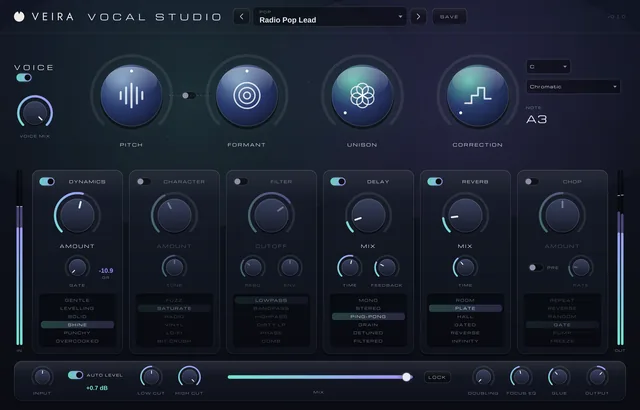
An all-in-one creative vocal plugin: a voice shifter with pitch, formant, unison and tuning, six modules with six styles each, from dynamics and character to delay, reverb and chops on the beat, and a mono voice that comes out in stereo.

$149.99

VEIRA Vocal Reverb

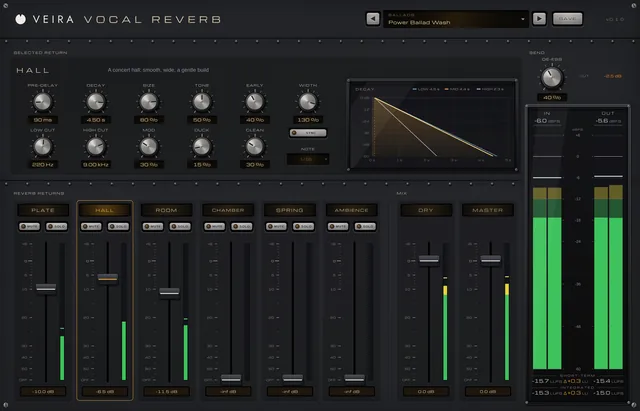
Six vocal reverbs on console faders: plate, hall, room, chamber, spring and ambience, each a complete reverb from VEIRA Space, with a de-esser on the send so the s sounds never splash into the tails.

$149.99

VEIRA Vocal Strip

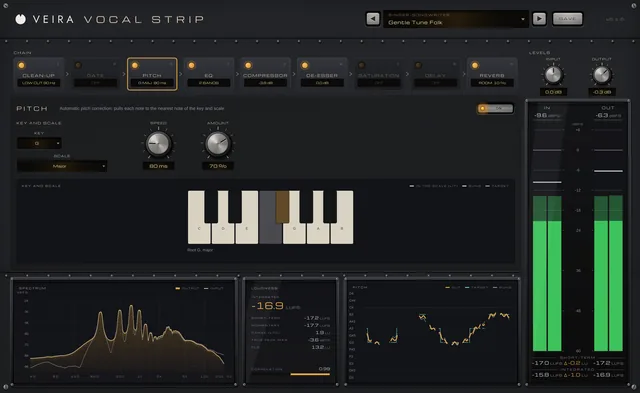
A whole vocal chain in one console: nine modules in any order, from clean-up and pitch correction to compression, de-essing, echo and reverb, each with its own display.

$149.99