VEIRA Mastering Analyzer

A mastering analyzer built as a rack unit: eight live screens, with loudness against your destination’s target and your master’s tonal balance, dynamics and width against targets learned from your own reference songs.

$49.99, a one-time purchase with free updates

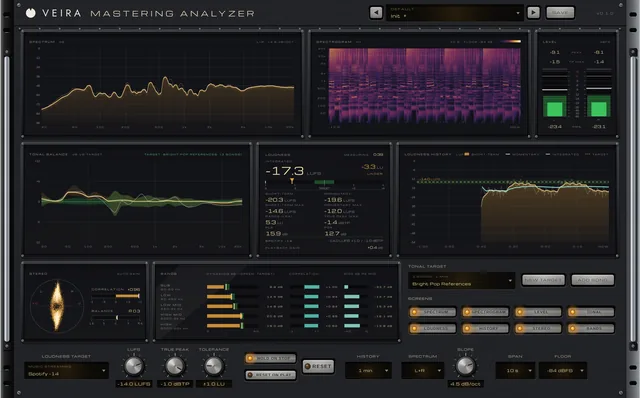
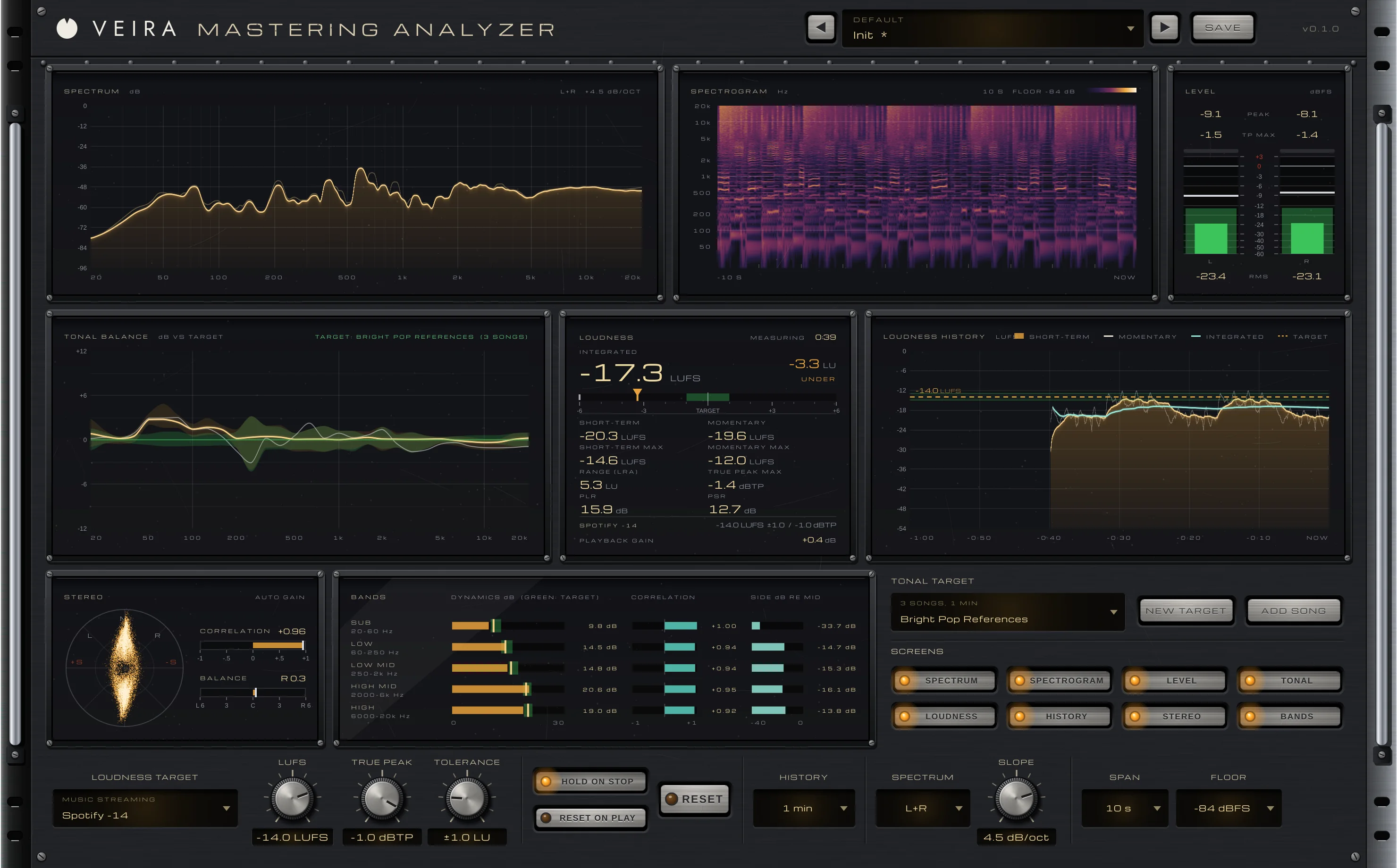
VEIRA Mastering Analyzer measuring a song against the Spotify -14 target and a tonal target learned from three bright pop references: a black rack unit with SPECTRUM, SPECTROGRAM and LEVEL across the top, TONAL BALANCE against the target’s green range, LOUDNESS reading −17.3 LUFS, 3.3 LU under, and LOUDNESS HISTORY in the middle, STEREO and the five BANDS below with the TONAL TARGET window and the SCREENS switches, and the loudness target, measurement and view controls along the bottom.

VEIRA Mastering Analyzer is a meter built as a 19-inch rack unit: a black front panel with eight instrument screens behind glass, all live at once, while the sound passes through untouched. Along the top are the spectrum, a spectrogram and the level; in the middle, the tonal balance, the loudness against your destination’s target and the loudness history; below, the stereo image and five frequency bands. It shares VEIRA Metering Suite’s loudness engine and its 19 targets, and goes further for mastering.

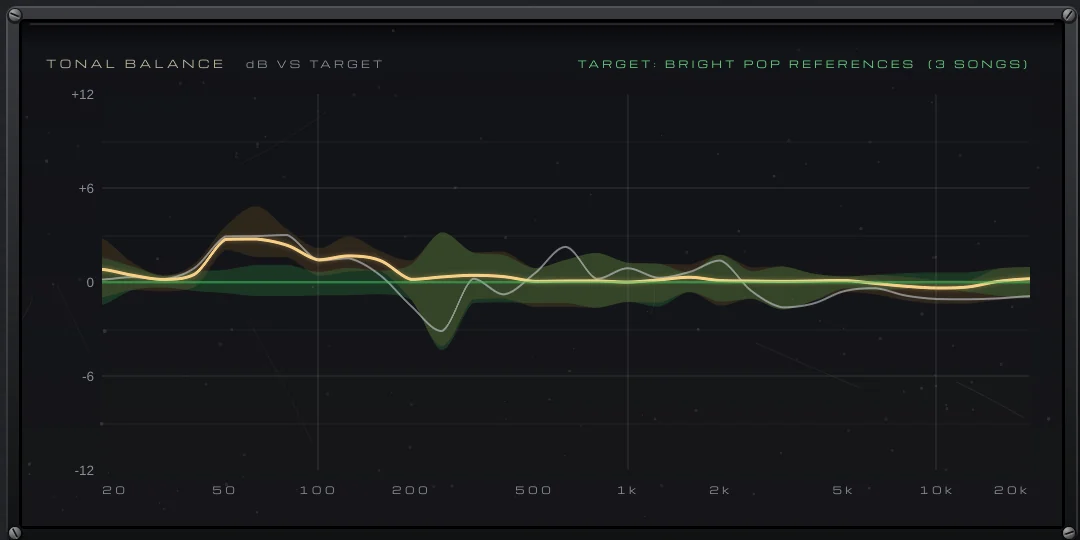
What it adds is a comparison with music you choose. Play a reference song, press NEW TARGET, and the analyzer learns its tonal balance relative to its loudness, and the dynamics of its five bands; add more songs to make the target steadier. Your master is then shown against it, band by band: where it has more or less than your references, and whether the difference is bigger than their own variation. The spectrogram shows when things happen, and the five bands show how much punch and width each part of the spectrum keeps.

A tour of VEIRA Mastering Analyzer

VEIRA Mastering Analyzer measuring a song against the Spotify -14 target and a tonal target learned from three bright pop references: a black rack unit with SPECTRUM, SPECTROGRAM and LEVEL across the top, TONAL BALANCE against the target’s green range, LOUDNESS reading −17.3 LUFS, 3.3 LU under, and LOUDNESS HISTORY in the middle, STEREO and the five BANDS below with the TONAL TARGET window and the SCREENS switches, and the loudness target, measurement and view controls along the bottom.
  1. The whole of VEIRA Mastering Analyzer

    VEIRA Mastering Analyzer is a meter built as a 19-inch rack unit: eight instrument screens behind glass, all live at once, and the sound passes untouched. Teach it a tonal target from songs you love, and it shows your master’s tonal balance against theirs, third octave by third octave, relative to the loudness, so a loud master and a quiet reference compare. Five bands show how much dynamics and width each part of the spectrum keeps. A spectrogram shows the spectrum over time, and the loudness is measured against 19 streaming, broadcast, film, podcast and game standards, with the playback gain a service would apply.

  2. Tonal balance

    Your master against the tonal target learned from your references, third octave by third octave.

  3. Loudness

    Integrated loudness against the destination’s target, with every other reading and the playback gain.

  4. Five bands

    Dynamics, correlation and width from the sub to the top, against your references’ range.

  5. The spectrogram

    The spectrum over time, newest at the right, the level as colour.

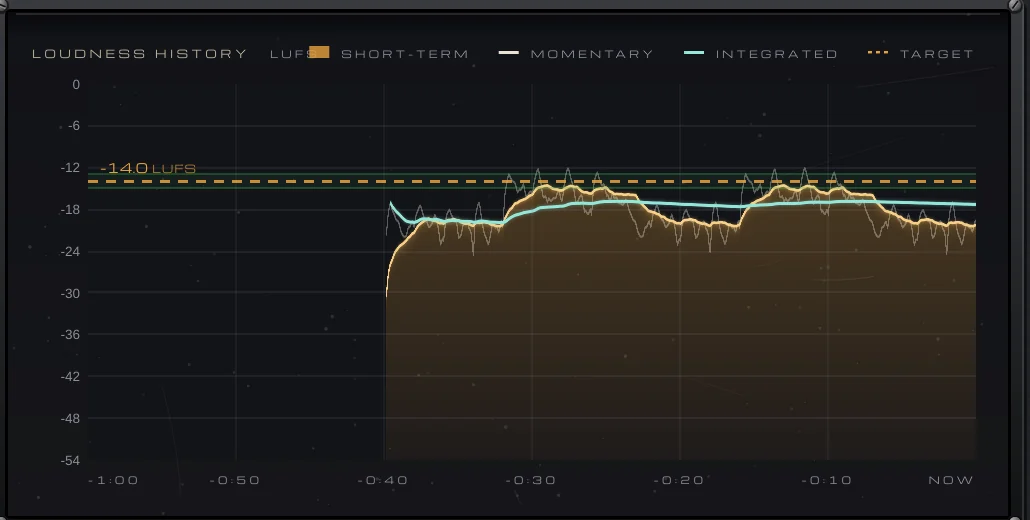
  6. Loudness history

    Short-term, momentary and integrated loudness over up to an hour, against the target.

What VEIRA Mastering Analyzer does for you

TONAL BALANCE against the target Bright Pop References (3 songs): the programme’s average as an amber line over the references’ green range, with the last 3 seconds as a light line.

Tonal targets from your own references

Play a song you love, press NEW TARGET, and the analyzer learns its tonal balance: for each of 31 third octaves, how loud it is relative to the song’s loudness, moment by moment, and how much that varies. Add more songs with ADD SONG for a steadier target. Your master is then drawn against it: above the references’ range, below it, or inside, so you know where to reach for the EQ and where the difference is just the music. Targets are saved as files, and the one in use travels with the session.

  • 31 third octaves
  • Relative to the loudness
  • As many songs as you like
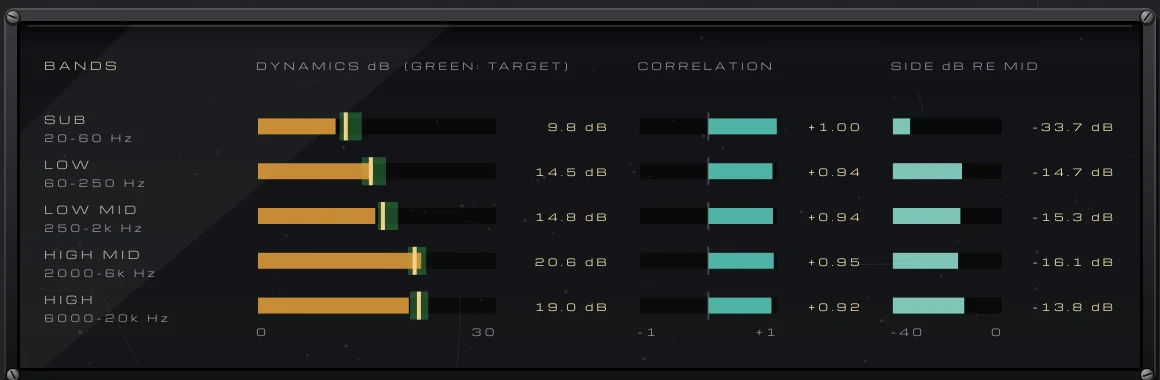
BANDS: SUB, LOW, LOW MID, HIGH MID and HIGH, each with its DYNAMICS bar against the target’s green range, its CORRELATION and its SIDE level against the mid.

Dynamics and width in five bands

BANDS splits the sound into SUB, LOW, LOW MID, HIGH MID and HIGH and measures each on its own. DYNAMICS is the band’s crest factor, its peak over its RMS, over the last 3 seconds, with your references’ range beside it, so you see a squashed low end or an uncontrolled one at a glance. CORRELATION and SIDE show how mono-safe and how wide each band is, so a wide sub bass can’t hide behind a healthy overall reading.

  • Crest factor per band
  • Correlation and side
  • Against your references
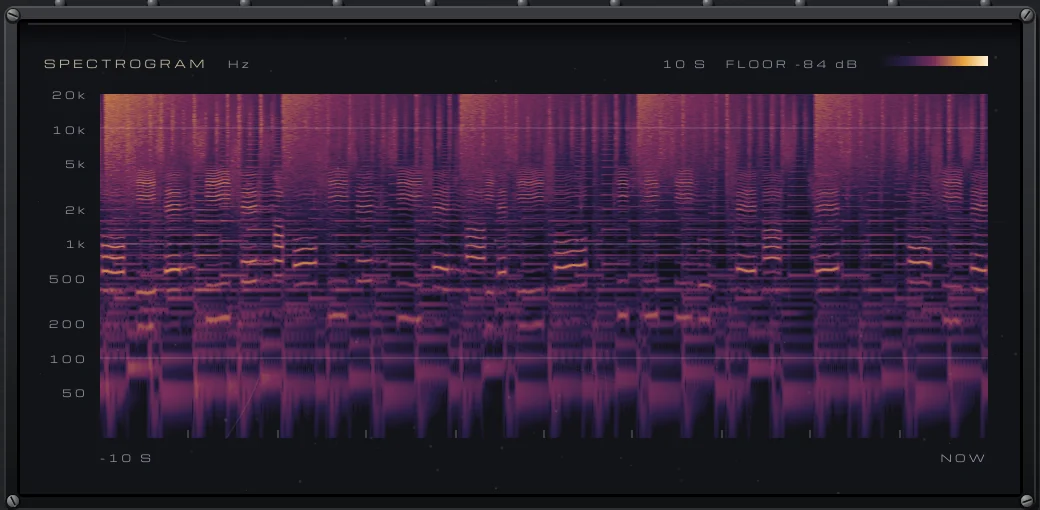
The SPECTROGRAM over the last 10 seconds, frequency up from 20 Hz to 20 kHz, the notes and drum hits in plum and amber.

A spectrogram beside the spectrum

The SPECTROGRAM draws the spectrum over time, newest at the right, with the level as colour from FLOOR through plum and amber to white. A resonance that rings is a line that lasts, a hi-hat that’s too loud only in the chorus is a patch that comes and goes, and the low end of the verse and the chorus compare at a glance. SPAN shows 5 to 40 seconds and FLOOR −60 to −96 dBFS; the SPECTRUM beside it, from an 8192-point FFT, shows L+R, L / R or M / S, tilted by SLOPE.

  • 5 to 40 s
  • Floor to −96 dBFS
  • Hover for the frequency
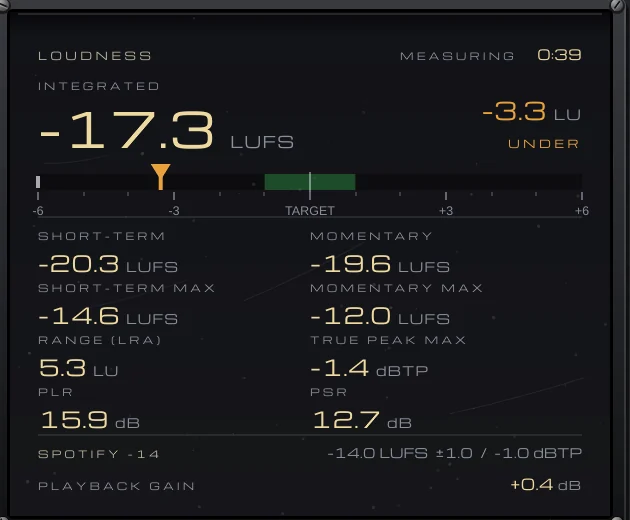
The LOUDNESS screen: integrated −17.3 LUFS, 3.3 LU under the target, short-term and momentary with their maxima, LRA 5.3 LU, true peak max −1.4 dBTP, PLR 15.9 dB, PSR 12.7 dB and a playback gain of +0.4 dB on Spotify.

Loudness against your destination

Choose where the master is going from 19 standards, Spotify, Apple Music, YouTube, Tidal, EBU R 128, ATSC A/85, Netflix, Apple Podcasts, games and more, or set your own. The LOUDNESS screen shows the integrated loudness with ON TARGET, OVER or UNDER, short-term and momentary with their maxima, loudness range, true peak, PLR and PSR, and the PLAYBACK GAIN a streaming service would apply, or whether a delivery PASSES. It’s VEIRA Metering Suite’s loudness engine: BS.1770-4, EBU Tech 3341 and 3342, 8x true peak.

  • 19 standards or Custom
  • Playback gain
  • 8x true peak
LOUDNESS HISTORY over the last minute: the short-term loudness filled, the momentary and integrated lines, and the −14 LUFS target as a dashed line.

The whole song at a glance

LOUDNESS HISTORY draws the short-term loudness over 30 seconds to 60 minutes, with the momentary and the integrated loudness and the target’s tolerance, so a chorus that pokes out or a mix flat as a ruler is plain to see. HOLD ON STOP waits while the transport is stopped, so a song played in parts adds up to one measurement, RESET ON PLAY measures takes one by one, and offline bounces are always measured.

  • 30 s to 60 min
  • HOLD ON STOP
  • Offline bounces measured
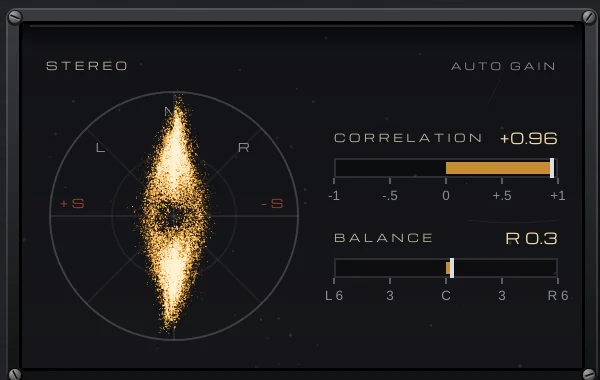
STEREO: a tall vectorscope shape, CORRELATION +0.96 and BALANCE R 0.3.

Level and stereo

LEVEL shows each channel’s sample peak with a hold, its 300 ms RMS and its true-peak maximum, and lights up when the true peak passes the target’s limit. STEREO is a vectorscope with auto gain, with CORRELATION and BALANCE over 300 ms: a tall shape leaning neither way is a healthy mix, and a flat one is a warning before mono playback finds it.

  • Peak, RMS, true peak
  • Vectorscope
  • Correlation and balance
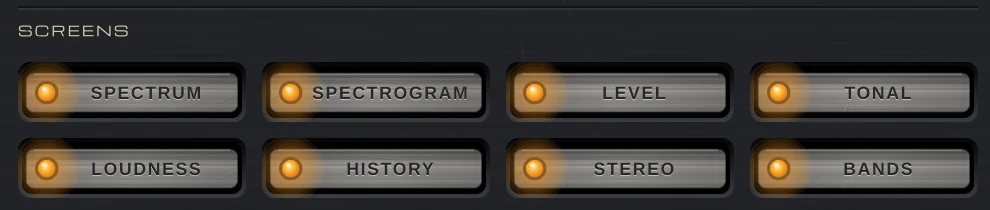
The SCREENS switches: SPECTRUM, SPECTROGRAM, LEVEL, TONAL, LOUDNESS, HISTORY, STEREO and BANDS, all lit.

A rack unit with eight screens

The front panel is a black-anodised, brushed 19-inch rack unit with bare aluminium ears and chrome handles, the eight screens in instrument windows behind glass, all live at once. Each screen has its switch under SCREENS: one switched off goes dark and costs nothing, while the measurements keep running. Every curve is drawn at the display’s full resolution, and hovering over a screen explains it and reads the point under the pointer.

  • Eight screens at once
  • Switch any off
  • Hover read-outs
The preset browser with Default: Init, previous, next and SAVE.

Untouched sound, 26 presets

The analyzer changes nothing: the output is the input, bit for bit, with no latency, at any buffer size, so it sits last on the master after the limiter. Its 26 presets in 6 folders, Music Streaming, Mastering, Broadcast, Film & Games and Podcast & Speech, set the loudness target and the views for a destination in one go. A tonal target is yours, so loading a preset never changes it.

  • Bit-exact, no latency
  • 6 folders
  • Save your own

Get VEIRA Mastering Analyzer

Pay once and it’s yours, with every future update included.

VEIRA Mastering Analyzer

A mastering analyzer built as a rack unit: eight live screens, with loudness against your destination’s target and your master’s tonal balance, dynamics and width against targets learned from your own reference songs.

  • Yours to keep: pay once, no subscription
  • Every future update, free for life
  • VST3, AU, Standalone on up to 3 computers
  • Changed your mind? Cancel within 14 days (refunds)
USD

One-time payment, in your cart.

Welcome offer

Get 10% off your first order

Leave your email and we’ll send you a code for 10% off your first order, on any plugins. One code per person.

Specifications

Type
Mastering analyzer in a rack unit: eight screens (spectrum, spectrogram, level, tonal balance, loudness, loudness history, stereo, bands); the audio passes untouched
Tonal balance
31 third octaves, 20 Hz to 20 kHz (6th-order Butterworth band-pass), relative to the short-term loudness, every 100 ms over 3 s; the programme’s average and spread against a tonal target’s
Tonal targets
Learned from your own reference songs (at least 10 s each, any number of songs); saved as .veiratarget files; the target in use is saved with the session
Bands
SUB 20–60 Hz, LOW 60–250 Hz, LOW MID 250 Hz–2 kHz, HIGH MID 2–6 kHz, HIGH 6–20 kHz: crest factor over 3 s, correlation and side level over 1 s
Loudness
Momentary, short-term and integrated per ITU-R BS.1770-4 / EBU R 128, loudness range (EBU Tech 3342), true peak (8x oversampling), PLR and PSR; 19 targets or Custom, with playback gain or a delivery verdict
Spectrum and spectrogram
Spectrum: 8192-point FFT, 1/6 octave, L+R, L / R or M / S, SLOPE 0 to 6 dB/oct. Spectrogram: 4096-point FFT of the mono sum, SPAN 5 to 40 s, FLOOR −60 to −96 dBFS
Level and stereo
Sample peak with a 2 s hold, 300 ms RMS and true-peak maximum per channel; vectorscope with auto gain, correlation and balance over 300 ms
History
Short-term, momentary and integrated loudness over 30 s to 60 min, against the target and its tolerance
Latency
None; the output is the input, bit for bit, at any block size
Presets
26 factory presets in 6 folders (Music Streaming, Mastering, Broadcast, Film & Games, Podcast & Speech), plus your own
CPU (measured)
About 2.5 % of one core for the measurements (stereo, 48 kHz); a switched-off screen costs nothing
Formats
VST3, AU, Standalone
macOS
macOS 11 or later, Apple silicon or Intel (universal). VST3, AU and Standalone.
Windows
Windows 10 or later, 64-bit. VST3 and Standalone.
Pro Tools
Pro Tools (AAX) versions are built and tested, and arrive once they’re signed for Pro Tools.
Latest version
0.2.0, released October 30, 2026 · What’s new
Read more on the blog: Checking a master before release: what to look at and why · Checking a mix and handing it off to mastering

Questions? 7 answers about VEIRA Mastering Analyzer

Works well with

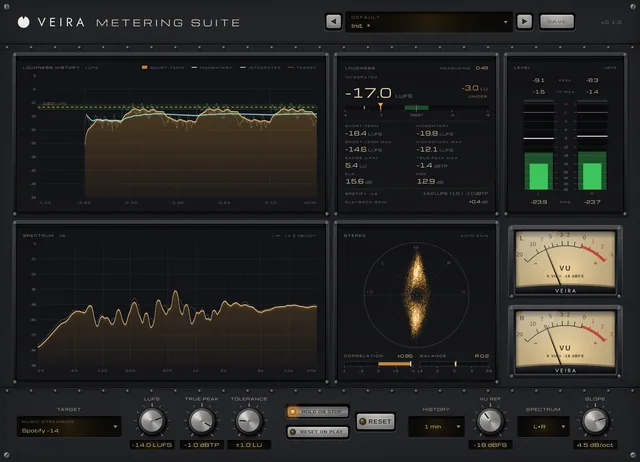
VEIRA Metering Suite

A complete meter that tells you if your mix is ready for where it’s going.

$39.99

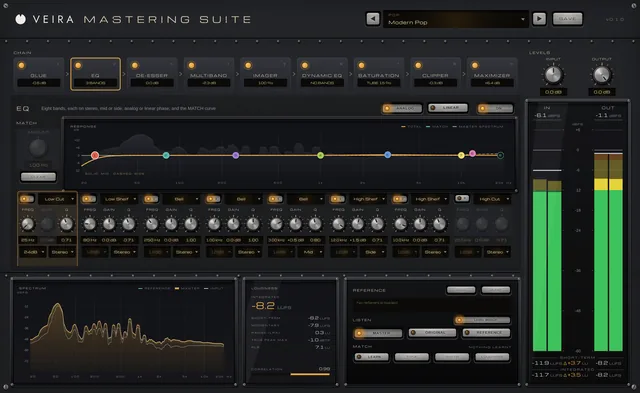
VEIRA Mastering Suite

A whole mastering console in one plugin: nine modules in any order, a true-peak maximizer always last, and a reference track to match.

$189.99

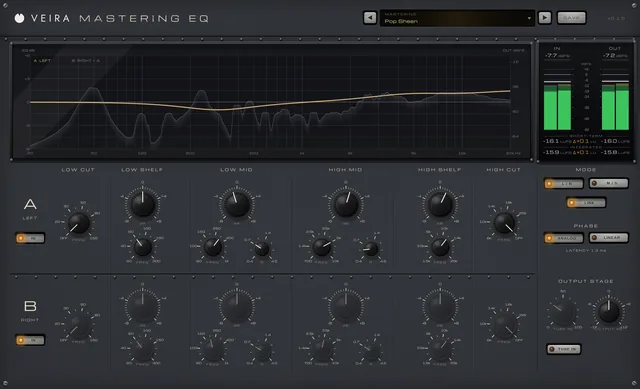
VEIRA Mastering EQ

A stepped, two-channel mastering equalizer in a mastering-console panel: every control clicks to a fixed position, so a setting can be written down and recalled exactly, with left/right or mid/side, a linear-phase mode and a tube output stage.

$149.99