VEIRA Mastering EQ

A stepped, two-channel mastering equalizer in a mastering-console panel: every control clicks to a fixed position, so a setting can be written down and recalled exactly, with left/right or mid/side, a linear-phase mode and a tube output stage.

$149.99, a one-time purchase with free updates

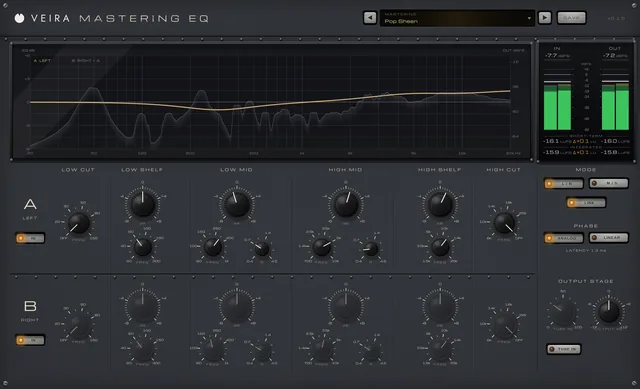
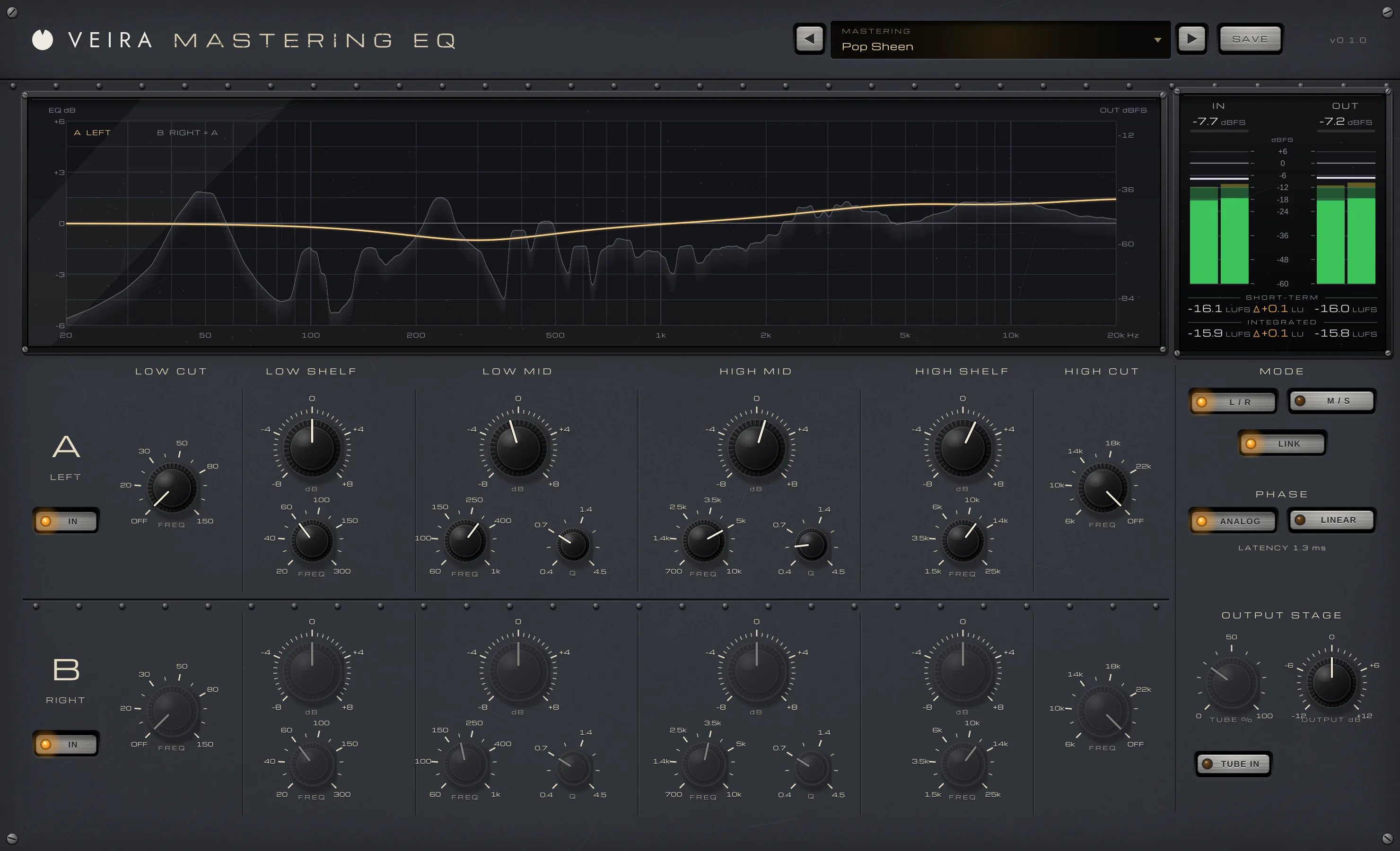
VEIRA Mastering EQ with the Pop Sheen preset while a song plays: THE CURVE across the top with channel A’s curve over the spectrum of the output, the meter bridge with IN and OUT levels and loudness on the right, then two channel strips, A LEFT above and B RIGHT below, each with LOW CUT, LOW SHELF, LOW MID, HIGH MID, HIGH SHELF and HIGH CUT on black stepped knobs, LINK on so channel B is dimmed, and MODE, PHASE and the OUTPUT STAGE in the right-hand column.

VEIRA Mastering EQ is a stepped, two-channel equalizer built the way the classic mastering consoles were. Each channel has six bands, LOW CUT, LOW SHELF, LOW MID, HIGH MID, HIGH SHELF and HIGH CUT, and every control clicks to a fixed position: twelve frequencies per band, gains in 0.5 dB steps and eight Q values. A setting can be written on a recall sheet and set again exactly, and the two channels can be matched by eye. MODE makes them left and right, or mid and side, and LINK makes one EQ for both.

PHASE chooses how the curve is made: ANALOG, minimum-phase filters matched to the analog shape with no latency of their own, or LINEAR, the very same curve with no phase shift, for low cuts and mid/side work on a master, at about 100 ms of latency. After the EQ, TUBE IN switches in a triode-like stage whose colour, mostly second harmonic, grows with the level. THE CURVE draws the engine’s own response over the spectrum of the music, and the meter bridge shows the loudness in and out, so every move can be compared with bypass at matched level.

A tour of VEIRA Mastering EQ

VEIRA Mastering EQ with the Pop Sheen preset while a song plays: THE CURVE across the top with channel A’s curve over the spectrum of the output, the meter bridge with IN and OUT levels and loudness on the right, then two channel strips, A LEFT above and B RIGHT below, each with LOW CUT, LOW SHELF, LOW MID, HIGH MID, HIGH SHELF and HIGH CUT on black stepped knobs, LINK on so channel B is dimmed, and MODE, PHASE and the OUTPUT STAGE in the right-hand column.
  1. The whole of VEIRA Mastering EQ

    VEIRA Mastering EQ is built the way mastering engineers like their equalizers: two channels of six bands, every control stepped. Twelve frequency positions per band, gains from −8 to +8 dB in 0.5 dB steps and eight Q values, so a setting can be written on a recall sheet and set again exactly. The two channels are LEFT and RIGHT, or MID and SIDE, and LINK makes one EQ for both. PHASE gives you ANALOG filters with no latency of their own, or LINEAR phase with the very same curve and no phase shift. A tube output stage adds colour that grows with the level, and the curve on screen is the engine’s own, accurate to 0.01 dB.

  2. The curve

    Each channel’s EQ, A and B, as the engine computes it, over the spectrum of the output; click the scale to zoom.

  3. Six stepped bands

    LOW CUT, two broad shelves, two bells and HIGH CUT, every control clicking to a fixed position.

  4. Mode, link and phase

    L/R or M/S, LINK for one EQ on both channels, and ANALOG or LINEAR phase with the latency it reports.

  5. The output stage

    TUBE IN and TUBE for a triode’s colour, and OUTPUT to match the level with bypass.

  6. Level and loudness

    IN and OUT, in peak, RMS and loudness, with OUT − IN in LU for a fair comparison.

What VEIRA Mastering EQ does for you

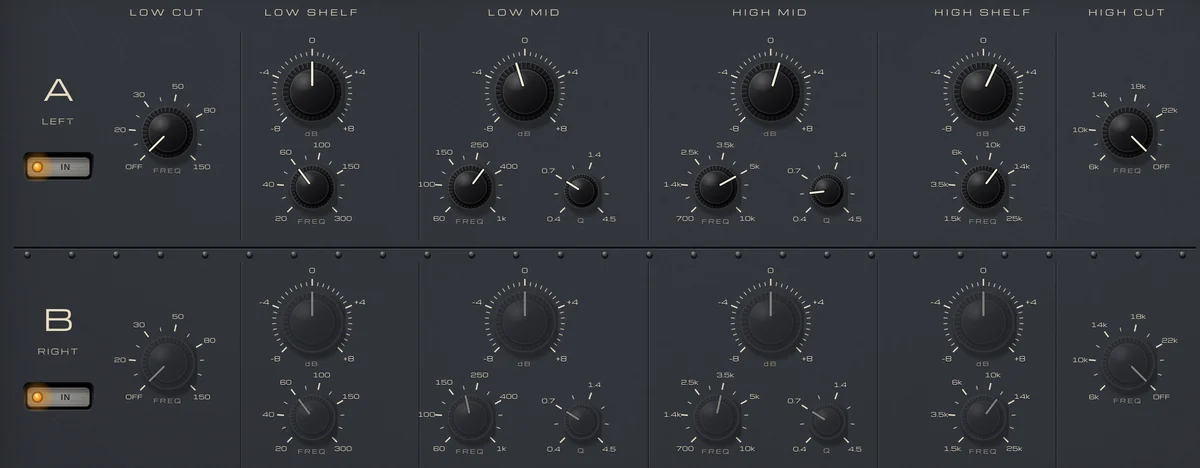
Both channel strips: A LEFT above and B RIGHT below, each with LOW CUT, LOW SHELF, LOW MID, HIGH MID, HIGH SHELF and HIGH CUT on stepped knobs with engraved scales.

Stepped, like the mastering desks

Every knob clicks to a fixed position, as on the classic mastering consoles: twelve frequencies per band, gains from −8 to +8 dB in 0.5 dB steps and eight Q values from 0.4 to 4.5. Write “HIGH SHELF 12 kHz, +1.5” on the recall sheet and the next session sounds the same; set the same positions on both channels and they match to the last decimal. The positions are the ones mastering engineers reach for: 30 Hz rumble, 250 to 300 Hz mud, 3 to 5 kHz presence, 12 to 16 kHz air.

  • 12 positions per band
  • 0.5 dB steps
  • Exact recall
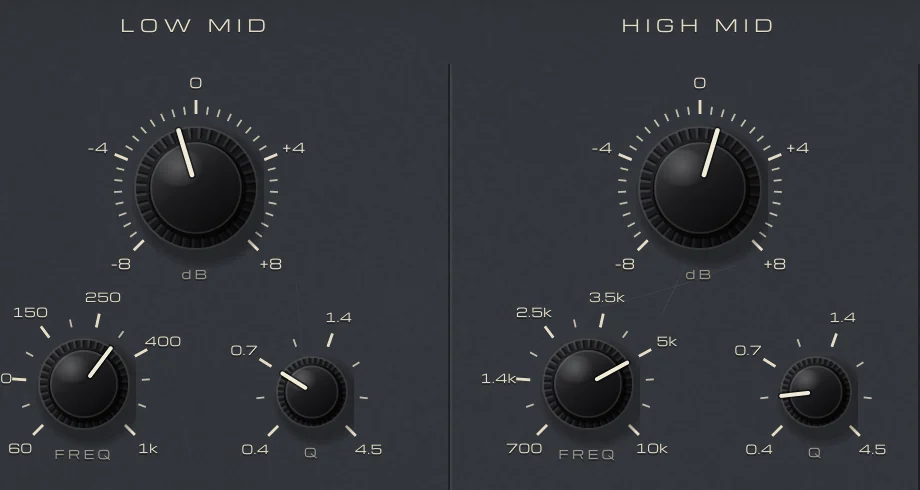
The LOW MID and HIGH MID bells of channel A: gain on top, FREQ and Q below.

Two bells, from broad to surgical

LOW MID covers 60 Hz to 1 kHz and HIGH MID 700 Hz to 10 kHz, each with eight Q steps. Q 0.4 to 1.0 are the mastering widths, broad musical lifts and dips that move a whole region; 1.4 and 2.0 deal with one resonant note; 3.0 and 4.5 are surgical, narrow enough to take out mains hum and barely touch the bass around it. A cut is the exact mirror image of a boost of the same size and width.

  • Q 0.4 to 4.5
  • 60 Hz to 10 kHz
  • Cut mirrors boost
Channel A: its name and IN, then LOW CUT, LOW SHELF, LOW MID, HIGH MID, HIGH SHELF and HIGH CUT.

Broad shelves and clean cuts

The shelves are broad and gentle, as on the classic mastering desks: a shelf reaches half its gain at its frequency and its full gain about two octaves beyond, so LOW SHELF warms the low end without a bump and the top HIGH SHELF positions, 20 and 25 kHz, add air that is felt more than heard. LOW CUT (16 to 150 Hz) and HIGH CUT (6 to 27 kHz) fall at 18 dB per octave, and the HIGH CUT never rises above 0 dB, even near the top of the range at 44.1 and 48 kHz.

  • Shelves at Q 0.6
  • 18 dB/oct cuts
  • Never above 0 dB
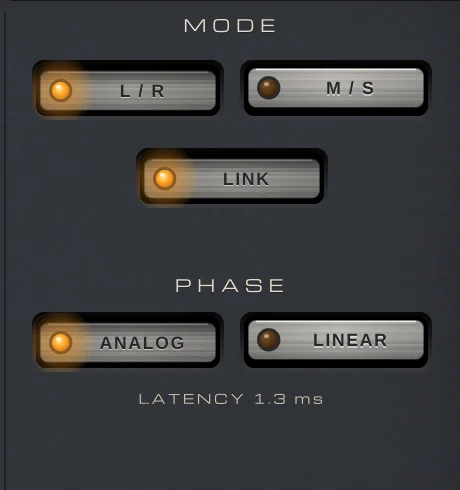
MODE with L/R lit, LINK on, PHASE with ANALOG lit, and the latency readout, 1.3 ms.

Left and right, or mid and side

MODE makes channel A the left or the middle and channel B the right or the sides. In M/S you can brighten only the width, tame a harsh guitar panned wide without dulling the vocal, or cut the lows of the sides so the low end is mono and solid on every system. LINK makes B follow A for one EQ on both, and in L/R you can correct a recording whose two sides differ. With nothing set, the trip from L/R to M/S and back is exact.

  • L/R or M/S
  • LINK for one EQ
  • Bit-exact at rest
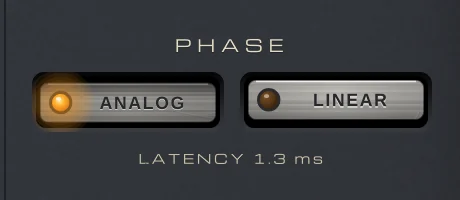
PHASE: ANALOG lit, LINEAR beside it, and LATENCY 1.3 ms.

ANALOG or LINEAR phase

ANALOG filters are minimum phase, as on an analog console, matched to the analog shape up to the top of the audio range, with no latency of their own. LINEAR applies the very same curve, within 0.07 dB of ANALOG from 25 Hz up, with no phase shift at all: the waveform keeps its shape when you cut the low end of a master, and mid and side stay exactly in time. It costs about 100 ms of latency, reported to your DAW, and switching fades out and back in, so it never clicks.

  • Within 0.07 dB
  • About 100 ms in LINEAR
  • Click-free switching
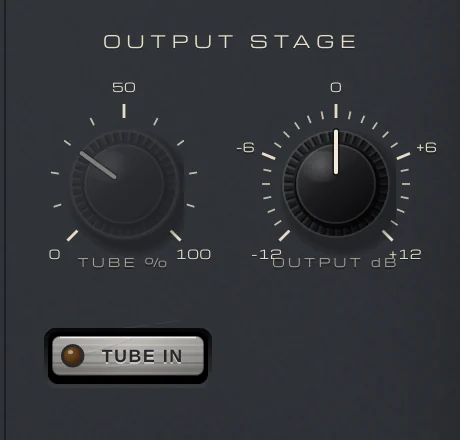
The OUTPUT STAGE: the TUBE knob in percent, the OUTPUT knob in dB and the TUBE IN button.

A tube that grows with the level

TUBE IN switches in a triode-like output stage: mostly second harmonic, some third, and like a real tube its colour grows with the level, so quiet passages pass almost clean. At 30 % a −18 dBFS tone gets about 0.25 % THD and a −6 dBFS tone about 1 %; at 100 % about 7 % at −6 dBFS, for drive as an effect. It runs at four times the sample rate so its harmonics stay clean, fades in over its first 5 %, and OUTPUT trims the level in 0.5 dB steps.

  • Mostly 2nd harmonic
  • 4x oversampled
  • 0 % is clean
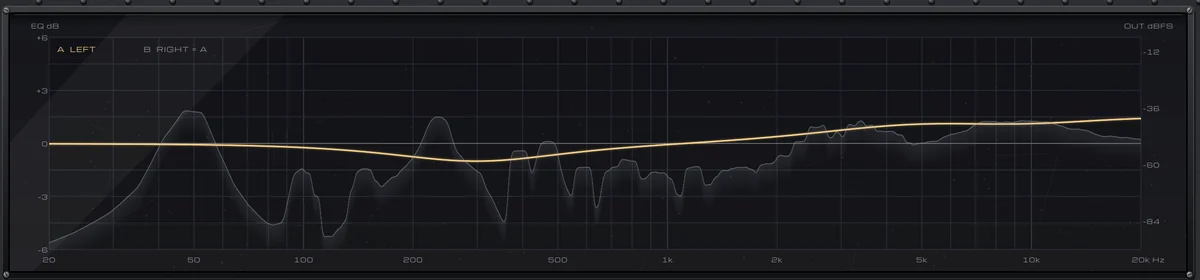
THE CURVE: channel A’s curve with Pop Sheen, a gentle dip at 300 Hz and a lift towards the top, over the spectrum of the music, with the EQ dB scale on the left and the output’s dBFS scale on the right.

A curve that tells the truth

THE CURVE draws each channel’s response, A and B, over the spectrum of the output, and it is the engine’s own design, so it matches the sound within 0.01 dB. Click the dB scale for ±3, ±6 or ±12 dB, so a 1 dB master move is easy to see, and hover anywhere to read both curves at that frequency. The meter bridge beside it measures loudness in and out and shows the difference in LU, so you compare with bypass at matched level.

  • Within 0.01 dB
  • ±3, ±6 or ±12 dB
  • OUT − IN in LU
The preset browser showing Mastering: Pop Sheen, with previous, next and SAVE.

82 presets, each one measured

Fourteen folders: Drums, Bass, Guitar, Keyboards, Strings, Brass, Woodwinds, Vocals and Mix Bus; Mastering, with 17 small, broad moves; Mid-Side, all in LINEAR; Restoration, for rumble, 50 and 60 Hz hum, dull or harsh transfers, cassette and vinyl; and Creative FX. Each was measured on the real plugin on matching material: the Mastering, Mix Bus and Mid-Side presets play within a quarter of a dB of bypass, so you can compare fairly, and each note says what to set first.

  • 14 folders
  • Matched to bypass
  • Save your own

Get VEIRA Mastering EQ

Pay once and it’s yours, with every future update included.

VEIRA Mastering EQ

A stepped, two-channel mastering equalizer in a mastering-console panel: every control clicks to a fixed position, so a setting can be written down and recalled exactly, with left/right or mid/side, a linear-phase mode and a tube output stage.

  • Yours to keep: pay once, no subscription
  • Every future update, free for life
  • VST3, AU, Standalone on up to 3 computers
  • Changed your mind? Cancel within 14 days (refunds)
USD

One-time payment, in your cart.

Welcome offer

Get 10% off your first order

Leave your email and we’ll send you a code for 10% off your first order, on any plugins. One code per person.

Specifications

Type
Stepped two-channel mastering equalizer with a tube output stage
Bands per channel
LOW CUT 16 to 150 Hz or OFF; LOW SHELF 20 to 300 Hz; LOW MID bell 60 Hz to 1 kHz; HIGH MID bell 700 Hz to 10 kHz; HIGH SHELF 1.5 to 25 kHz; HIGH CUT 6 to 27 kHz or OFF; 12 positions each
Gain and Q
−8 to +8 dB in 0.5 dB steps; bell Q 0.4, 0.55, 0.7, 1.0, 1.4, 2.0, 3.0, 4.5; shelves at Q 0.6 (half the gain at the named frequency); cuts 18 dB/oct
Channels
MODE L/R (A left, B right) or M/S (A mid, B side); LINK makes B follow A; mono or stereo tracks
Phase
ANALOG (analog-matched, minimum phase) or LINEAR (the same curve, within 0.07 dB from 25 Hz up, no phase shift); click-free switching
Latency
ANALOG 64 samples (1.3 ms at 48 kHz); LINEAR 4,672 samples (97.3 ms at 48 kHz); reported to the host
Output stage
TUBE IN and TUBE 0 to 100 % (triode-like, mostly 2nd harmonic; 30 % ≈ 1 % THD at −6 dBFS; 4x oversampled); OUTPUT −12 to +12 dB in 0.5 dB steps
Bypass
At Init (every band flat, TUBE out) the output is the input, delayed, bit for bit, in L/R and M/S
Display and metering
Both channels’ curves (the engine’s own, within 0.01 dB) over an 8192-point FFT of the output, ±3, ±6 or ±12 dB; IN and OUT peak and RMS, short-term and integrated loudness, OUT − IN in LU
Presets
82 factory presets in 14 folders (including Mastering, Mid-Side, Restoration and Creative FX), plus your own
CPU (measured)
About 1.3 % of one core in ANALOG and 2.3 % in LINEAR (stereo, 48 kHz)
Formats
VST3, AU, Standalone
macOS
macOS 11 or later, Apple silicon or Intel (universal). VST3, AU and Standalone.
Windows
Windows 10 or later, 64-bit. VST3 and Standalone.
Pro Tools
Pro Tools (AAX) versions are built and tested, and arrive once they’re signed for Pro Tools.
Latest version
0.2.0, released October 30, 2026 · What’s new
Read more on the blog: Mastering EQ: small, broad moves, left/right and mid/side

Questions? 7 answers about VEIRA Mastering EQ

Works well with

VEIRA Mastering Suite

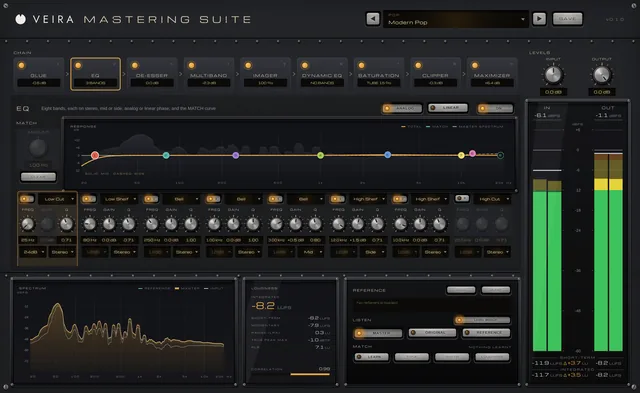
A whole mastering console in one plugin: nine modules in any order, a true-peak maximizer always last, and a reference track to match.

$189.99

VEIRA EQ

A dynamic equaliser with up to 24 bands and an analyzer you can read.

$149.99

VEIRA Mastering Analyzer

A mastering analyzer built as a rack unit: eight live screens, with loudness against your destination’s target and your master’s tonal balance, dynamics and width against targets learned from your own reference songs.

$49.99