Four colours of reverb: pristine, plate, chamber and vintage digital
Why one reverb isn’t enough: when to reach for a modern algorithmic hall, a studio steel plate, an echo chamber or an early-1980s digital rack reverb, and what each does to a sound that the others don’t.
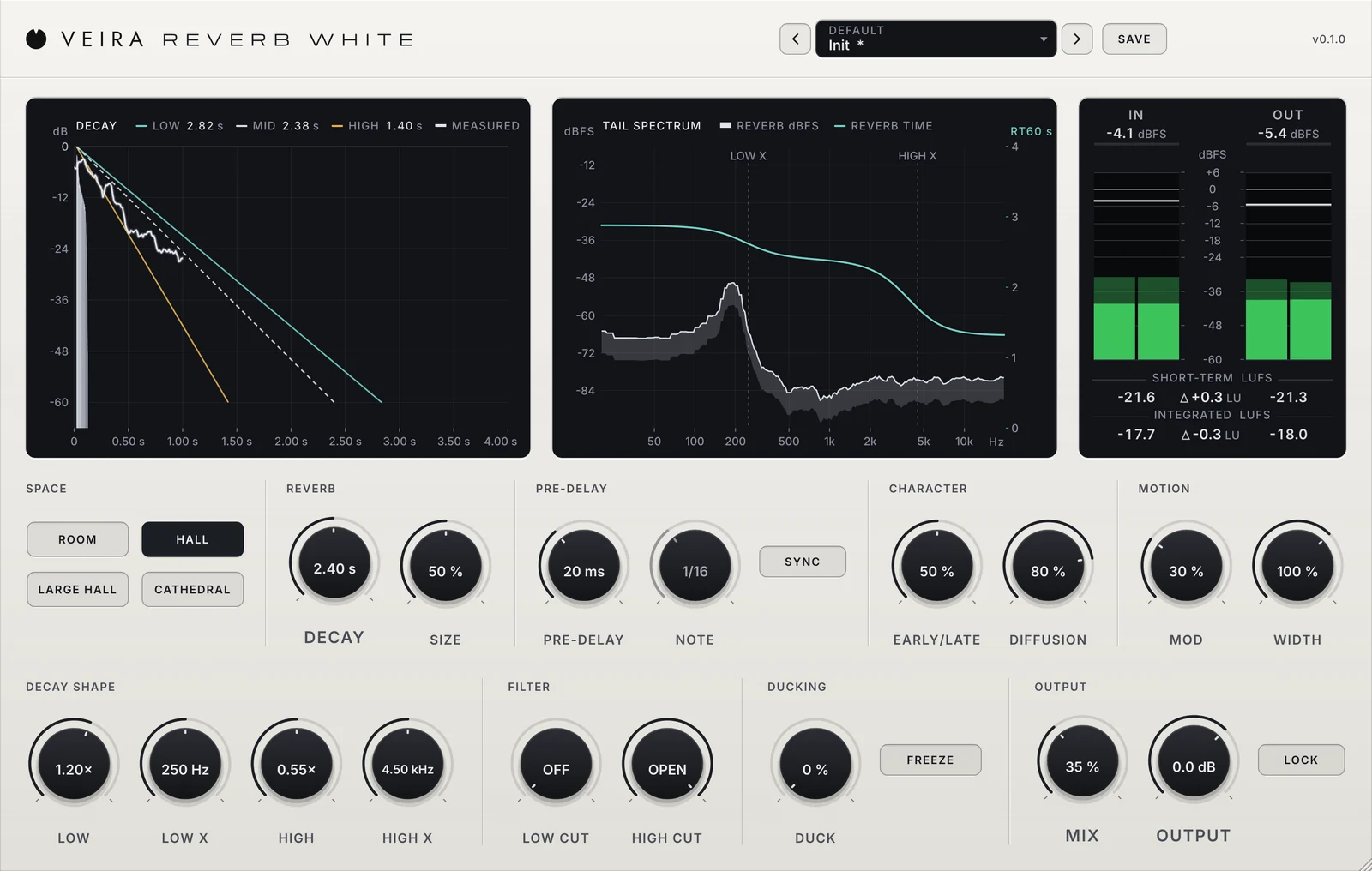
Every reverb puts a sound in a space, so why would you want more than one? Because the space itself is the sound. A modern hall is meant to be heard as a real room and nothing else; a steel plate is dense and bright from its first moment and never sounds like a room at all; an echo chamber is a real room, recorded, with the colour of its speaker and microphones; and the digital racks of the early 1980s made a lush, moving sound of their own that is part of a whole decade of records. The kind of reverb shapes the result as much as its length does.
Pristine: the modern hall
A modern algorithmic reverb builds a room from two parts: early reflections that thicken as a room’s do, and a dense tail of delay lines that feed back into each other, each losing a little on every pass. Done well, it has no colour of its own: the tail moves just enough that no note rings on, its two sides are independent so it is wide, and its length can be set per band, so the lows ring a little longer and the highs die sooner, as in a real hall. That is the reverb to reach for when a voice, a piano or an orchestra should simply sound as if it were in a beautiful space.
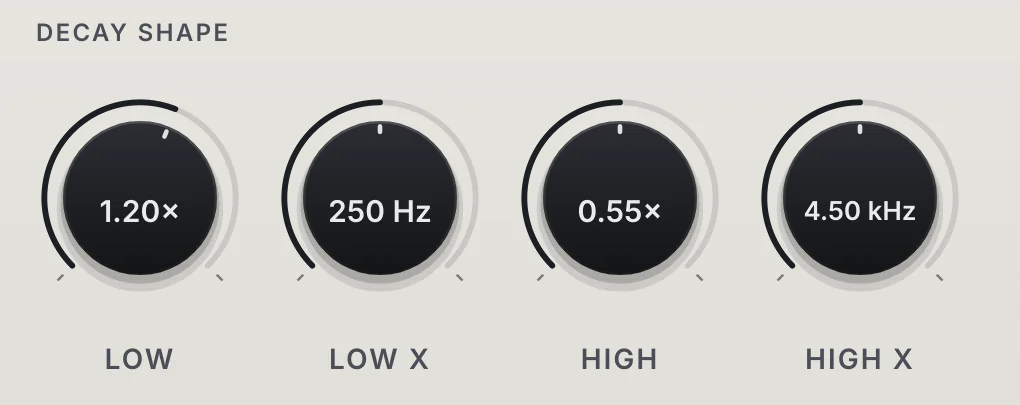
Plate: the steel sheet
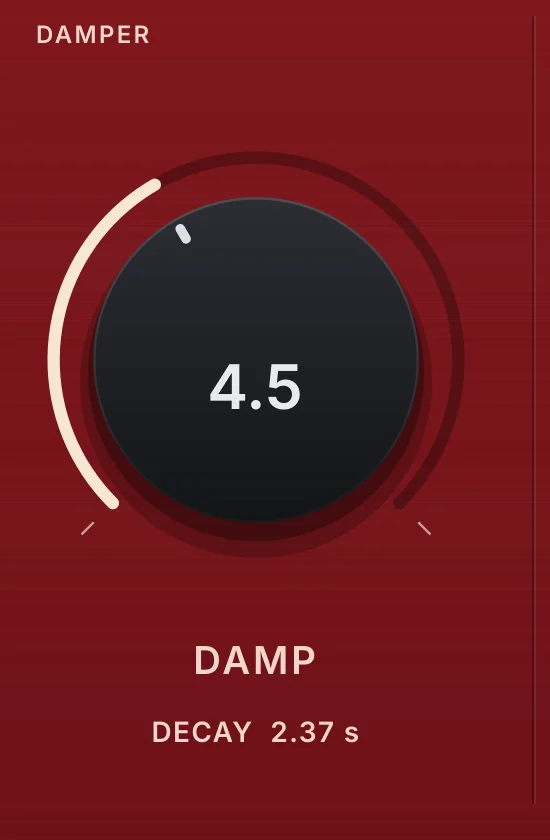
A plate reverb is a large, thin sheet of steel hung in a frame, shaken by a driver and heard through pickups, with a felt damper that sets how long it rings. It has no walls to bounce off at a distance, so there are no separate early echoes: it is a dense wash from the first millisecond. And because bending waves on steel travel faster the higher they are, every reflection reaches the pickups as a tiny falling chirp, which gives a plate its bright, shimmering top. That immediacy is why plates have sat behind vocals and snares on so many records: the reverb is right there with the sound, without the sense of a room around it.
Chamber: a real room, recorded
Before reverb came in a box, studios built rooms for it: bare, hard-walled chambers where a speaker played the send from the console and a pair of microphones picked up the room. The great 1950s-60s studio echo chambers are on countless classic records. A chamber has what no algorithm quite fakes by accident: a clear, irregular pattern of early reflections off hard walls, a tail whose lows ring longer than its mids because hard rooms soak up the top first, and the gentle colour of the speaker and the microphone chain. Where you put the microphones changes it as much as the room does.

Vintage digital: the early-1980s rack
The first digital reverbs couldn’t model a room wall by wall. Instead they passed the sound round a ring of short delays and diffusers, losing a little on each pass, and let some of the delays wander slowly so the ring wouldn’t ring. That wander is what gave them their lush, chorused tail, and their converters, with bandwidths of 10 to 16 kHz and, in the first units, 12 bits that switched range with the signal, gave them a soft top and a fine grain. The result is smooth and wide but clearly not a room, and it is the sound of a decade of ballads, snares, electric pianos and synth pads.

Pre-delay keeps the words clear
Whatever the reverb, a short gap before it starts keeps the attack of each word or hit clear of its own reverb and makes the space feel bigger. 20 to 40 ms suits most vocals; drums often want little or none. Set to a note value at the song’s tempo, a sixteenth or an eighth, the reverb starts on the grid and feels part of the groove.
Less low end, and a send
Two habits fix most reverb problems. Take the lows out of the reverb, 100 to 250 Hz on vocals and snare, so it adds space without mud. And put the reverb on an aux at 100 % wet, with several tracks sent to it: they then share one space, and you can EQ or duck the return on its own.
Doing it with the VEIRA colour reverbs
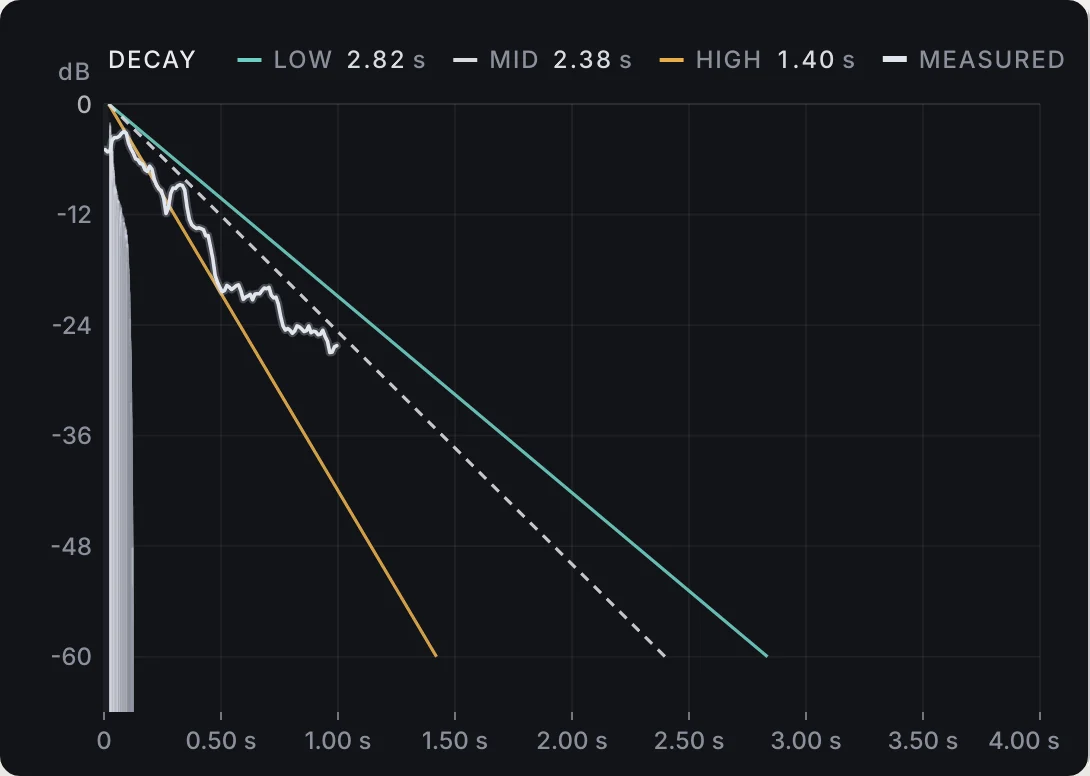
VEIRA Reverb White is the pristine one: four spaces from ROOM to CATHEDRAL, a DECAY from 0.2 to 20 s shaped per band with LOW and HIGH, DUCK and FREEZE. VEIRA Reverb Red is the classic studio steel plate, with DAMP on the damper’s old 1-to-10 scale, TENSION and BRIGHTNESS. VEIRA Reverb Gold is a studio echo chamber with four hard rooms, MIC DISTANCE, SPEAKER and MIC tone and the chain’s WARMTH. VEIRA Reverb Blue is the early-1980s digital rack reverb, with five PROGRAMs, a random wander and ERA, the converters of the era. All four have synced pre-delay and a MIX LOCK for aux returns, and each is painted like the colour compressor, limiter, EQ and gate of the same name.