VEIRA Reverb Blue

The vintage digital one of VEIRA’s four colour reverbs: the lush, chorused halls and plates of the classic early-1980s digital rack reverbs, with five PROGRAMs, a random wander and ERA, the converters of the era.

$149.99, a one-time purchase with free updates

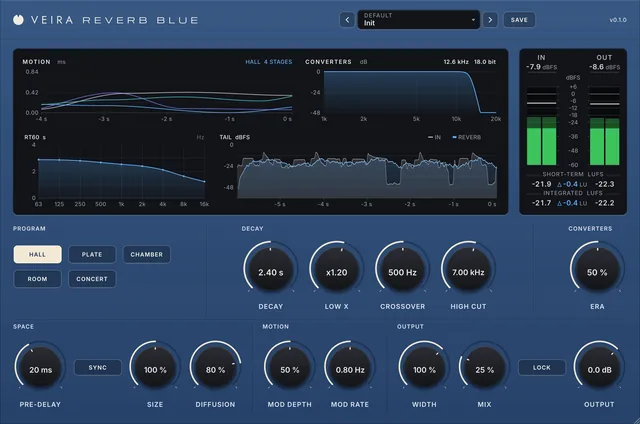
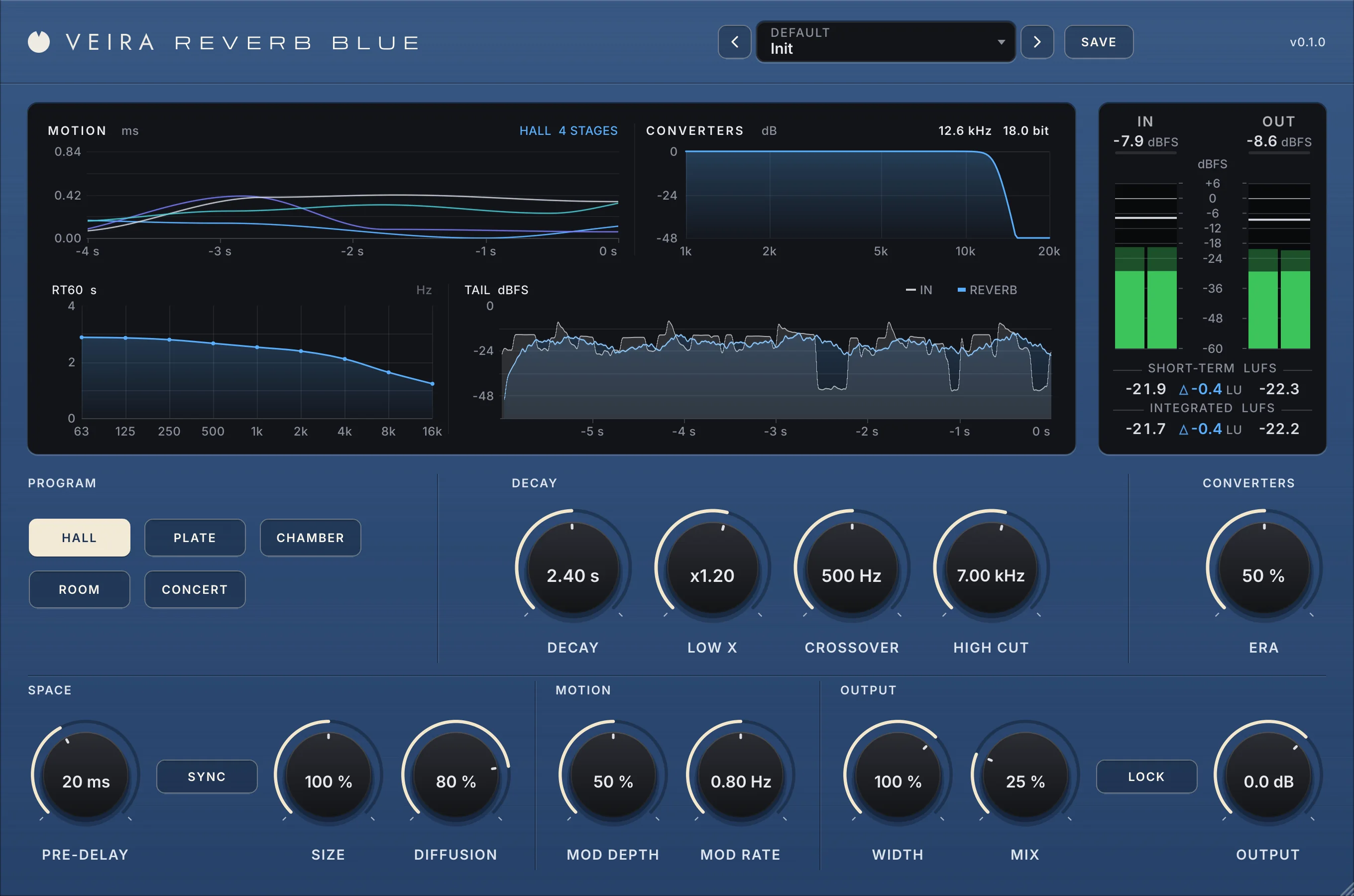
VEIRA Reverb Blue, painted 1970s steel blue, with its default HALL on a vocal with snare hits: MOTION with the wander of its four stages; CONVERTERS at 12.6 kHz and 18.0 bit; RT60 per octave; the TAIL of the input and the reverb; the IN | OUT meter bridge; and the PROGRAM, DECAY, CONVERTERS, SPACE, MOTION and OUTPUT groups.

VEIRA Reverb Blue is the vintage digital one of VEIRA’s four colour reverbs, painted 1970s steel blue: the lush, chorused halls and plates of the classic early-1980s digital rack reverbs. The sound goes round a ring of allpass diffusers and delays whose read points wander at random, so the tail choruses instead of ringing, in five programs, HALL, PLATE, CHAMBER, ROOM and CONCERT. DECAY, LOW X with CROSSOVER and HIGH CUT shape its decay the way the classic units did, darker at every pass.

ERA sets the converters, from a clean late-80s unit to the 10 kHz, 12-bit, gain-ranged sound of the first ones, with the grain kept inside the band. MOD DEPTH and MOD RATE set the wander, and PRE-DELAY or a NOTE at the song’s tempo, SIZE, DIFFUSION, WIDTH and a MIX with LOCK do the rest. MOTION draws each stage’s wander and CONVERTERS their response, and the 44 factory presets in 9 folders run from Vintage Vocal Plate and Big Eighties Snare to Electric Piano Chorus and Twelve-Bit Grit.

A tour of VEIRA Reverb Blue

VEIRA Reverb Blue, painted 1970s steel blue, with its default HALL on a vocal with snare hits: MOTION with the wander of its four stages; CONVERTERS at 12.6 kHz and 18.0 bit; RT60 per octave; the TAIL of the input and the reverb; the IN | OUT meter bridge; and the PROGRAM, DECAY, CONVERTERS, SPACE, MOTION and OUTPUT groups.
  1. The whole of VEIRA Reverb Blue

    VEIRA Reverb Blue brings back the sound of the classic early-1980s digital rack reverbs, painted 1970s steel blue: a ring of allpass diffusers and delays whose read points wander at random, so the tail choruses instead of ringing, heard through converters that go from a clean late-80s unit to the band-limited, grainy 12-bit sound of the first ones. PROGRAM, DECAY, LOW X with CROSSOVER, HIGH CUT, ERA, PRE-DELAY or a synced NOTE, SIZE, DIFFUSION, MOD DEPTH, MOD RATE, WIDTH, MIX with LOCK and OUTPUT. No latency.

  2. Motion and converters

    Each stage’s wander, and the converters ERA sets.

  3. Reverb time and tail

    The reverb time per octave, and the last six seconds of the input and the reverb.

  4. Five programs

    HALL, PLATE, CHAMBER, ROOM and CONCERT.

  5. The decay

    DECAY, LOW X at CROSSOVER, and HIGH CUT in every stage.

  6. The converters

    ERA, from a clean late-80s unit to 12 bits at 10 kHz.

  7. In and out

    IN and OUT meters with short-term and integrated loudness, and the difference in LU.

What VEIRA Reverb Blue does for you

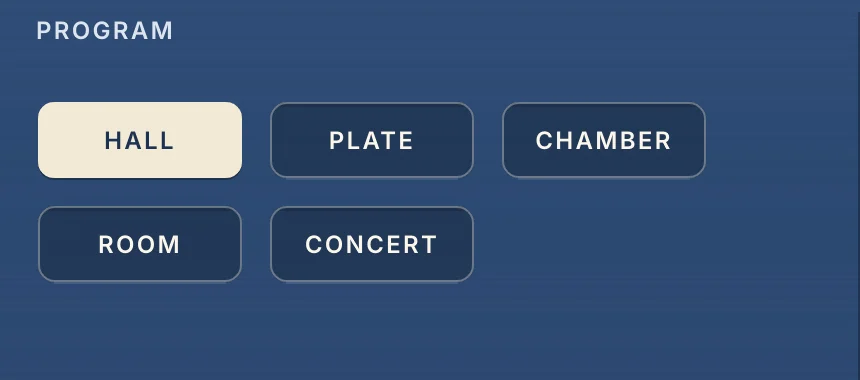
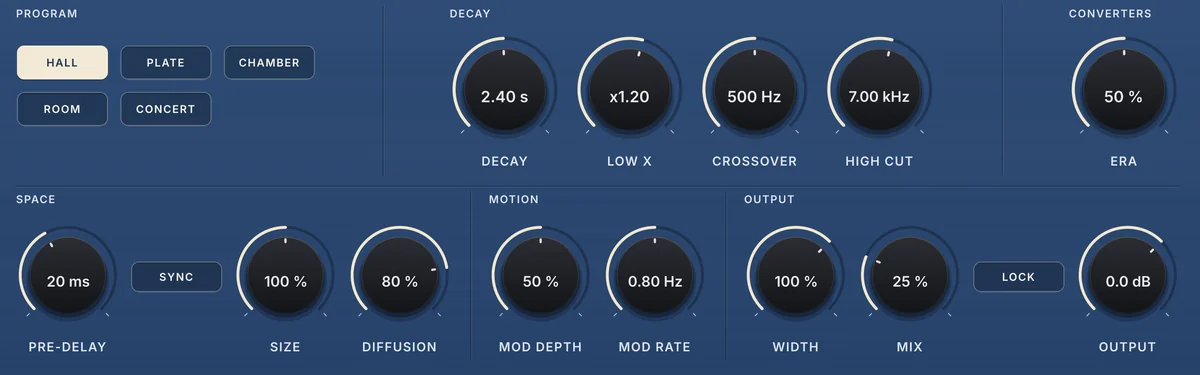
The PROGRAM buttons: HALL (selected), PLATE, CHAMBER, ROOM and CONCERT.

Five programs of the era

HALL, PLATE, CHAMBER, ROOM and CONCERT are each their own ring of stages and their own early reflections: a four-stage hall about a second round, the classic figure-of-eight plate tank with no early reflections, a dense, warm chamber, a short room, and a bigger concert ring whose delays wander too. Every program returns pink noise at about the same level, and a new program lets the old one ring out over 0.8 s, so nothing clicks.

  • HALL to CONCERT
  • Same level in each
  • No click on a change
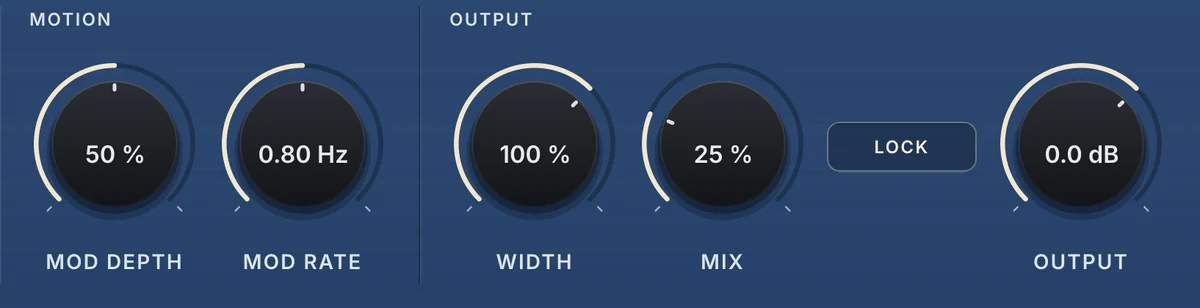
The MOTION and OUTPUT groups: MOD DEPTH at 50 %, MOD RATE at 0.80 Hz, WIDTH at 100 %, MIX at 25 %, the LOCK button and OUTPUT at 0.0 dB.

A tail that choruses, never warbles

Each stage moves to a new random target at a random time and glides there, so the movement never repeats: no LFO you can hear cycling. MOD DEPTH sets how far, MOD RATE from 0.1 to 5 Hz how often. On a held tone at 50 %, the energy the movement spreads away from it is 21 to 41 dB under the tone in four of the programs, and the wander takes 1 to 3 dB off the small rings’ most persistent peaks.

  • Random, no cycle
  • MOD RATE 0.1–5 Hz
  • Peaks down 1–3 dB
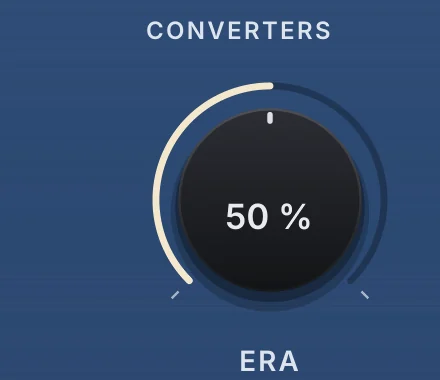
The CONVERTERS group: ERA at 50 %.

ERA: the converters

At 0 % the reverb is heard through a clean late-80s unit, 16 kHz wide and 24 bits; at 100 % through the first units’ 10 kHz bandwidth and 12-bit converters that change their range in 6 dB steps with the signal, so the grain follows the music down. The grain is made between the converters’ filters, as in the hardware, so it stays in the band and never aliases. Measured −3 dB points: 14.9, 11.8 and 9.3 kHz at 0, 50 and 100 %.

  • 16 to 10 kHz
  • 24 to 12 bits
  • Gain-ranged grain
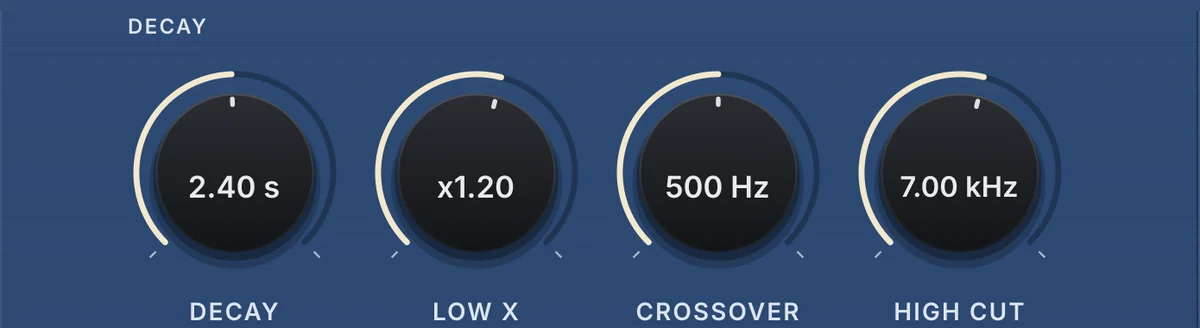
The DECAY group: DECAY at 2.40 s, LOW X at x1.20, CROSSOVER at 500 Hz and HIGH CUT at 7.00 kHz.

The decay of the classic units

DECAY sets the reverb time in the mids, 0.2 to 20 s; LOW X multiplies it below CROSSOVER, from ×0.25 to ×4; HIGH CUT darkens the tail at every pass round the ring, so the highest notes die soonest, as the classic units did. The ring itself loses nothing, so the reverb time is what the filters set: measured from 63 Hz to 8 kHz, on average within 3.4 % of the design.

  • DECAY 0.2–20 s
  • LOW X ×0.25–×4
  • On average within 3.4 %
MOTION: how far each of the HALL’s four stages has wandered over the last four seconds; CONVERTERS: the response at ERA 50 %, 12.6 kHz and 18.0 bit.

See the motion and the converters

MOTION draws how far each stage of the ring has wandered over the last four seconds, the chorusing you hear, and names the program and its stages. CONVERTERS draws the response ERA sets, with the bandwidth and word length. RT60 shows the reverb time per octave from 63 Hz to 16 kHz, and TAIL scrolls the last six seconds of the input and the reverb.

  • Each stage drawn
  • Bandwidth and bits
  • RT60 per octave
The controls of the blue face in two rows: PROGRAM, DECAY and CONVERTERS; SPACE, MOTION and OUTPUT.

Four colours of reverb, one family

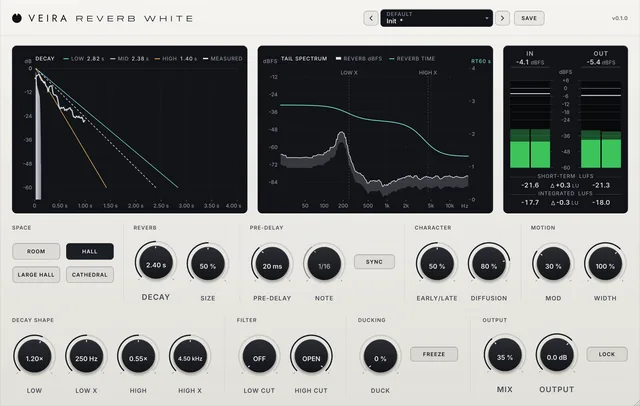
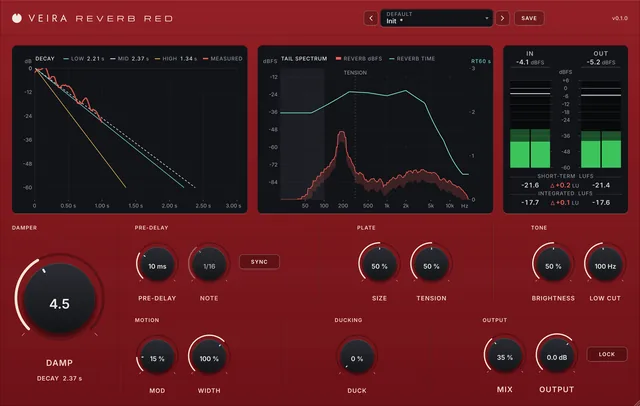
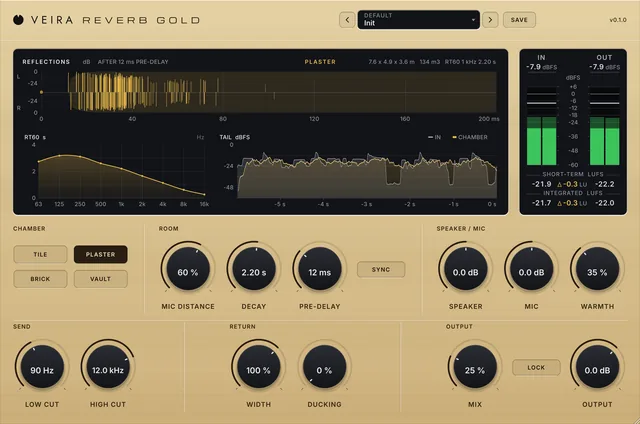
VEIRA’s four colour reverbs are painted like the colour compressors, limiters, EQs and gates: White in pearl, Red in deep lacquered red, Gold in brushed champagne and Blue in 1970s steel blue. White is the pristine modern hall, Red the classic studio steel plate, Gold the studio echo chamber and Blue the early-1980s digital rack reverb. All four have tempo-synced pre-delay, a MIX LOCK for aux returns and a tail that ends in true digital silence, and every label on the paint stands at least 4.5:1 against it.

  • White, Red, Gold, Blue
  • MIX LOCK for aux returns
  • Text at 4.5:1 or more
The preset browser showing Default: Init, with previous, next and SAVE.

44 presets in 9 folders, measured

Default, Vocals, Drums, Guitars, Keys & Synths, Strings & Orchestral, Post & Film, Creative and Mix Bus: from Vintage Vocal Plate and Big Eighties Snare to Electric Piano Chorus, Twelve-Bit Grit, Infinite Concert and three aux returns. Each was run through the plugin on matching material: every insert preset comes out within 1 LU of the dry track, and no output peaks over −4 dBFS.

  • 9 folders
  • Within 1 LU of bypass
  • Save your own

Get VEIRA Reverb Blue

Pay once and it’s yours, with every future update included.

VEIRA Reverb Blue

The vintage digital one of VEIRA’s four colour reverbs: the lush, chorused halls and plates of the classic early-1980s digital rack reverbs, with five PROGRAMs, a random wander and ERA, the converters of the era.

  • Yours to keep: pay once, no subscription
  • Every future update, free for life
  • VST3, AU, Standalone on up to 3 computers
  • Changed your mind? Cancel within 14 days (refunds)
USD

One-time payment, in your cart.

Welcome offer

Get 10% off your first order

Leave your email and we’ll send you a code for 10% off your first order, on any plugins. One code per person.

Specifications

Type
Vintage digital reverb: a ring of randomly modulated allpass stages with early taps and modelled converters
Programs
HALL, PLATE, CHAMBER, ROOM, CONCERT; SIZE 50 to 150 %; a change rings the old one out over 0.8 s
Decay
DECAY 0.20 to 20.0 s in the mids; LOW X ×0.25 to ×4.00 below CROSSOVER (100 Hz to 2 kHz); HIGH CUT 1.5 to 19.5 kHz or open, in every stage
Converters
ERA 0 to 100 %: 16 kHz and 24 bits to 10 kHz and 12 bits, gain-ranged in 6 dB steps
Pre-delay
0 to 300 ms, or with SYNC a note from 1/64 to 1/4, dotted and triplets included, up to 1 s (default 1/16)
Motion
MOD DEPTH 0 to 100 %; MOD RATE 0.10 to 5.00 Hz, random targets at random intervals, no cycle; DIFFUSION 0 to 100 %
Output
WIDTH 0 to 150 %; MIX 0 to 100 %, equal power, with LOCK; OUTPUT −24 to +12 dB
Accuracy (measured)
1 kHz within 4.3 % of DECAY in every program; 63 Hz to 8 kHz on average within 3.4 % of the design
Bandwidth (measured)
−3 dB at 14.9, 11.8 and 9.3 kHz at ERA 0, 50 and 100 %; at 100 % the grain sits 64.8 dB under a −6 dBFS return and 107 dB under a −30 dBFS one
Latency
None; at MIX 0 % the output is the input, bit for bit
Tail
Ends in true digital zeros once the ring has stayed under −180 dBFS for 2 s
Display
MOTION: each stage’s wander over 4 s; CONVERTERS: the response with bandwidth and word length; RT60 per octave; TAIL, the last 6 s of the input and the reverb
Metering
IN and OUT peak and RMS, short-term and integrated LUFS, OUT − IN in LU
Presets
44 factory presets in 9 folders (Default, Vocals, Drums, Guitars, Keys & Synths, Strings & Orchestral, Post & Film, Creative, Mix Bus), plus your own
Channels
Mono or stereo (the input is summed to mono before the reverb)
Face
1970s steel blue, with cream print and black knobs; dark screens set into the paint
Window
1360 x 900 at 100 %, resizable from 75 to 200 %, saved with the session
CPU (measured)
About 2.1 % (PLATE) to 4.2 % (CONCERT) of one core of a 2-core cloud machine (stereo, 48 kHz, ERA 70 %), twice that while an old program rings out
Formats
VST3, AU, Standalone
macOS
macOS 11 or later, Apple silicon or Intel (universal). VST3, AU and Standalone.
Windows
Windows 10 or later, 64-bit. VST3 and Standalone.
Pro Tools
Pro Tools (AAX) versions are built and tested, and arrive once they’re signed for Pro Tools.
Latest version
0.1.0, released November 2, 2026 · What’s new
Read more on the blog: Four colours of reverb: pristine, plate, chamber and vintage digital

Questions? 8 answers about VEIRA Reverb Blue

Works well with

VEIRA Reverb White

The pristine one of VEIRA’s four colour reverbs: a modern algorithmic hall and room with four spaces, a DECAY from 0.2 to 20 s that you shape per band, tempo-synced pre-delay, DUCK and FREEZE.

$149.99

VEIRA Reverb Red

The plate of VEIRA’s four colour reverbs: the classic studio steel plate, bright, dense and immediate, with the damper’s 1-to-10 DAMP scale, TENSION and BRIGHTNESS, for vocals and snare above all.

$149.99

VEIRA Reverb Gold

The warm one of VEIRA’s four colour reverbs: a studio echo chamber in the tradition of the great 1950s-60s studio echo chambers, with four hard rooms, MIC DISTANCE, SPEAKER and MIC tone and the chain’s analog WARMTH.

$149.99