VEIRA Reverb Red

The plate of VEIRA’s four colour reverbs: the classic studio steel plate, bright, dense and immediate, with the damper’s 1-to-10 DAMP scale, TENSION and BRIGHTNESS, for vocals and snare above all.

$149.99, a one-time purchase with free updates

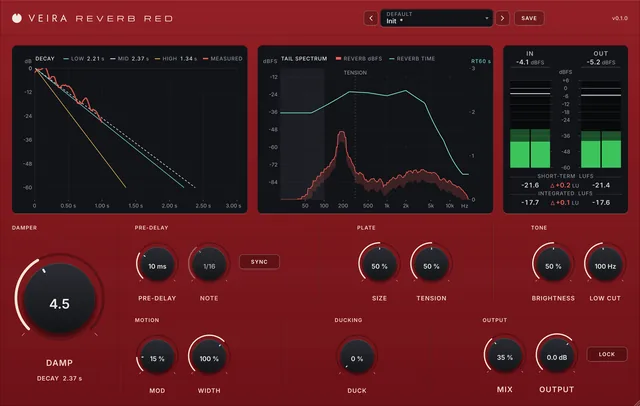
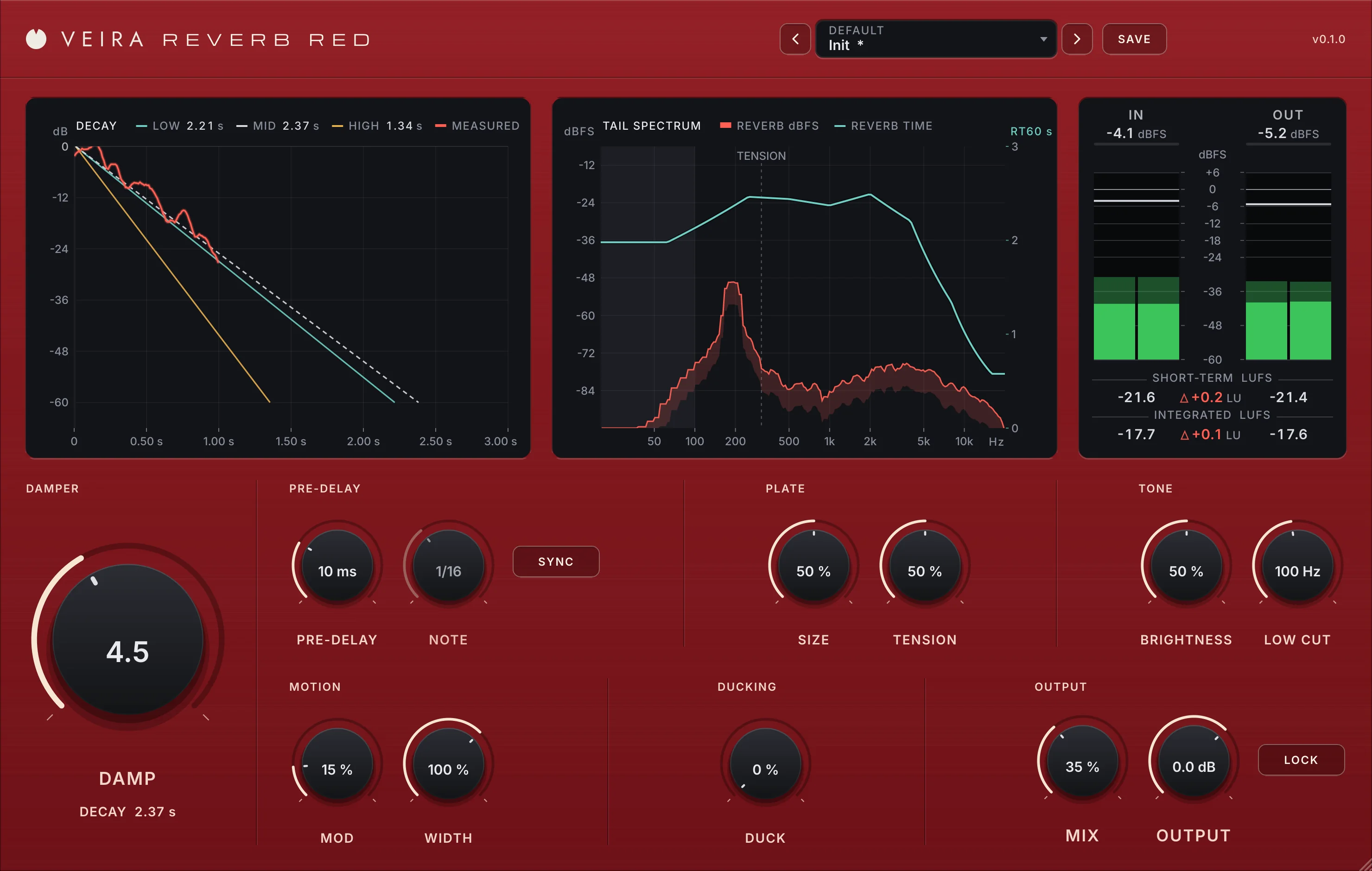
VEIRA Reverb Red, painted deep lacquered red, with its default plate on a vocal with snare hits: the DECAY display with the lows at 2.21 s, the mids at 2.37 s and the highs at 1.34 s and the measured tail; the TAIL SPECTRUM with the reverb time and the TENSION crossover; the IN | OUT meter bridge; the big DAMP knob at 4.5 with DECAY 2.37 s under it; and the PRE-DELAY, PLATE, TONE, MOTION, DUCKING and OUTPUT groups.

VEIRA Reverb Red is the plate of VEIRA’s four colour reverbs, a model of the classic studio steel plate painted deep lacquered red. On steel, bending waves travel faster the higher they are, so every reflection reaches the pickups as a falling chirp and the plate is dense from its first millisecond, with none of a room’s distinct echoes. DAMP keeps the damper’s old 1-to-10 scale, from about half a second to about five and a half, and the read-out under it gives the real reverb time.

TENSION sets how far down the chirp reaches, from a loose, singing plate to a tight, focused one, SIZE how many modes it has, and BRIGHTNESS its shimmering top. PRE-DELAY or a NOTE at the song’s tempo, LOW CUT on the plate only, MOD, WIDTH and DUCK fit it into a mix, and MIX has a LOCK for aux returns. The DECAY display and TAIL SPECTRUM show the plate’s decay per band, and the 41 factory presets in 9 folders run from Classic Vocal Plate and Snare Plate to Big 80s Snare and Endless Plate.

A tour of VEIRA Reverb Red

VEIRA Reverb Red, painted deep lacquered red, with its default plate on a vocal with snare hits: the DECAY display with the lows at 2.21 s, the mids at 2.37 s and the highs at 1.34 s and the measured tail; the TAIL SPECTRUM with the reverb time and the TENSION crossover; the IN | OUT meter bridge; the big DAMP knob at 4.5 with DECAY 2.37 s under it; and the PRE-DELAY, PLATE, TONE, MOTION, DUCKING and OUTPUT groups.
  1. The whole of VEIRA Reverb Red

    VEIRA Reverb Red models the classic studio steel plate, painted deep lacquered red: bending waves that travel faster the higher they are, so every reflection is a falling chirp and the plate is dense from its first millisecond; a damper on the old 1-to-10 scale; and the plate’s own tone, thin lows and a bright, falling top. DAMP, PRE-DELAY or a synced NOTE, SIZE, TENSION, BRIGHTNESS, LOW CUT, MOD, WIDTH, DUCK, MIX with LOCK and OUTPUT. No latency, and at MIX 0 % the input passes bit for bit.

  2. The plate’s decay

    The designed decay of three bands and the measured tail.

  3. The tail’s spectrum

    The plate’s own sound, with its reverb time and the TENSION crossover.

  4. The damper

    DAMP on the old 1-to-10 scale, with the real reverb time under it.

  5. Size and tension

    How many modes the plate has, and how far down its chirp goes.

  6. The plate’s top

    BRIGHTNESS, and a LOW CUT on the plate only.

  7. In and out

    IN and OUT meters with short-term and integrated loudness, and the difference in LU.

What VEIRA Reverb Red does for you

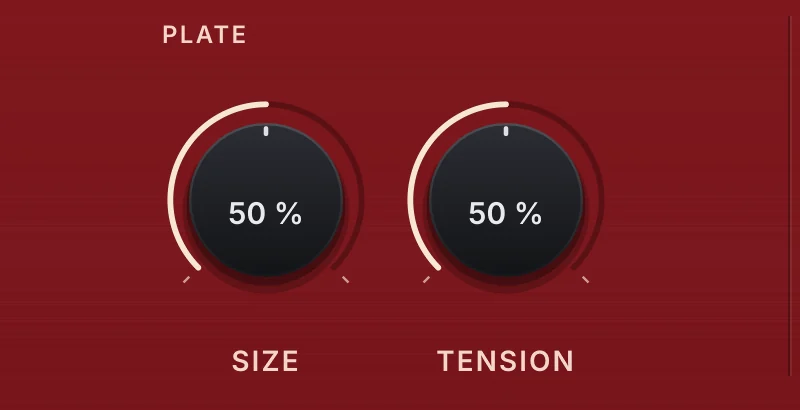
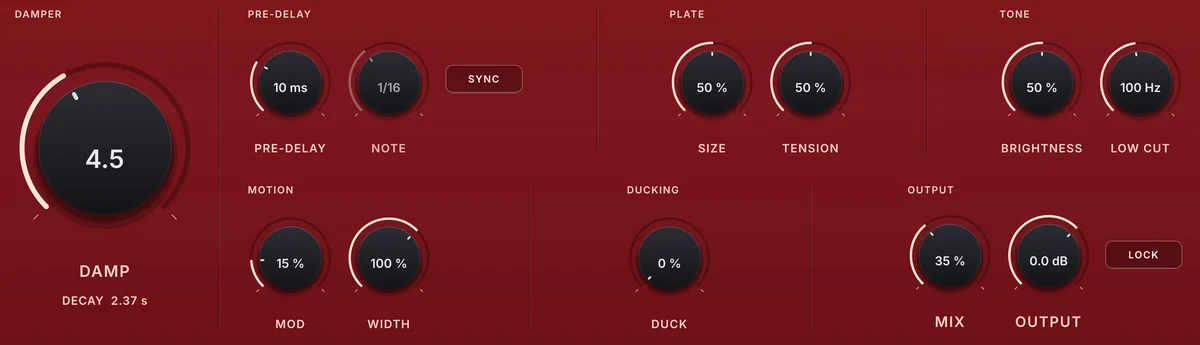
The PLATE group: SIZE at 50 % and TENSION at 50 %.

What makes a plate a plate

A plate has no room echoes: its ripples bounce off four close edges, and bending waves on steel travel faster the higher they are, so a click arrives as a falling chirp and every reflection spreads it further. Reverb Red models that dispersion along sixteen paths, so it is fully dense 10 to 15 ms after the first arrival at every SIZE and TENSION. TENSION sets where the chirp stops, from about 90 Hz on a loose plate to about 1 kHz on a tight one.

  • Dense in 10–15 ms
  • The falling chirp
  • TENSION 90 Hz–1 kHz
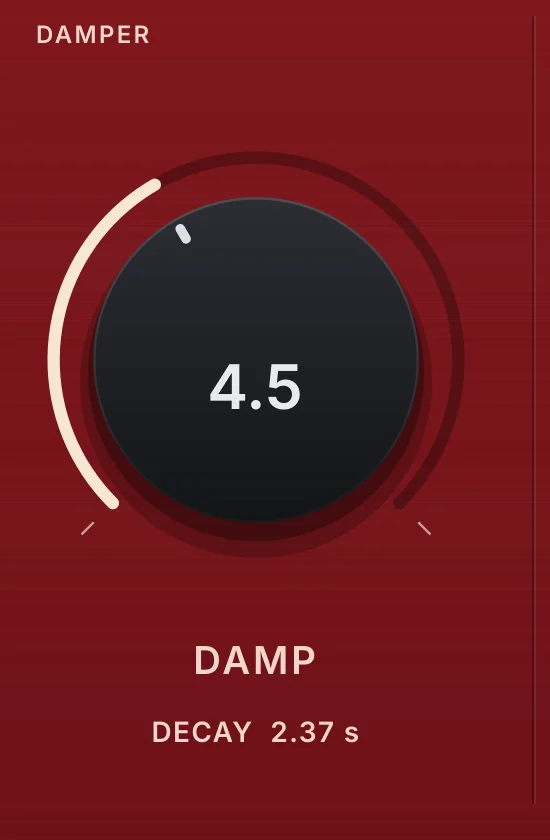
The DAMPER: the big DAMP knob at 4.5, with its read-out DECAY 2.37 s.

The damper, on its old scale

DAMP runs from 1, the pad pressed close, about half a second, to 10, the plate left to ring, about five and a half; the scale reads roughly as seconds over two, and the read-out under the big knob gives the real mid-band time. The damper works most in the low mids, as a real pad does. Measured against the design from 125 Hz to 8 kHz, the reverb time is within 7.7 %, and DAMP glides with no click.

  • DAMP 1 to 10
  • About 0.55 to 5.5 s
  • Real time read-out
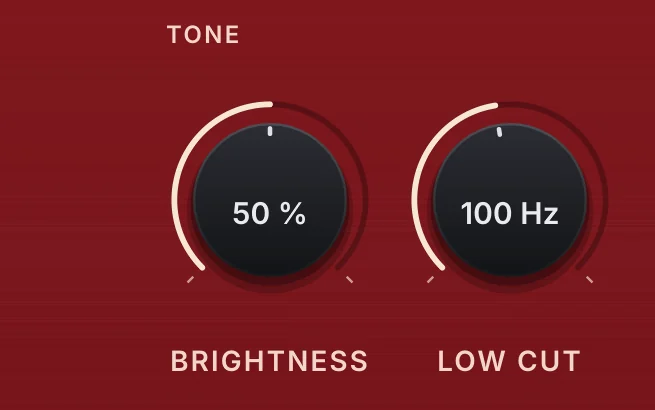
The TONE group: BRIGHTNESS at 50 % and LOW CUT at 100 Hz.

BRIGHTNESS: the plate’s top

BRIGHTNESS sets how fast the highs die against the mids, from about 0.6 to 0.95 of the mid-band time at 8 kHz, and the pickups’ tilt, a 7 kHz shelf from −6 to +3 dB: the shimmer of a new plate or the darker sound of an older one. LOW CUT, 12 dB/oct on the plate only, keeps it to sheen without mud; the dry signal is never touched.

  • 8 kHz at 0.6–0.95×
  • Shelf −6 to +3 dB
  • LOW CUT on the plate only
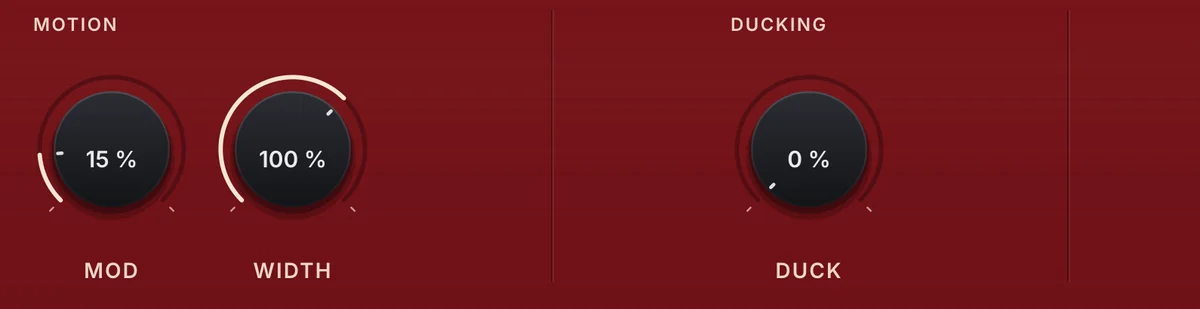
The MOTION and DUCKING groups: MOD at 15 %, WIDTH at 100 % and DUCK at 0 %.

Clear words under a big plate

DUCK keeps the plate about 16 dB down at 100 % while you sing and lets it bloom back between phrases, following the music’s own peaks, so it works at any level. MOD adds slow movement so sustained notes stay smooth, though a real plate has none, and WIDTH runs from mono to 150 % at the same level. Pre-delay goes up to 500 ms, or a note value at the song’s tempo.

  • DUCK up to 24 dB
  • WIDTH 0–150 %
  • Synced pre-delay
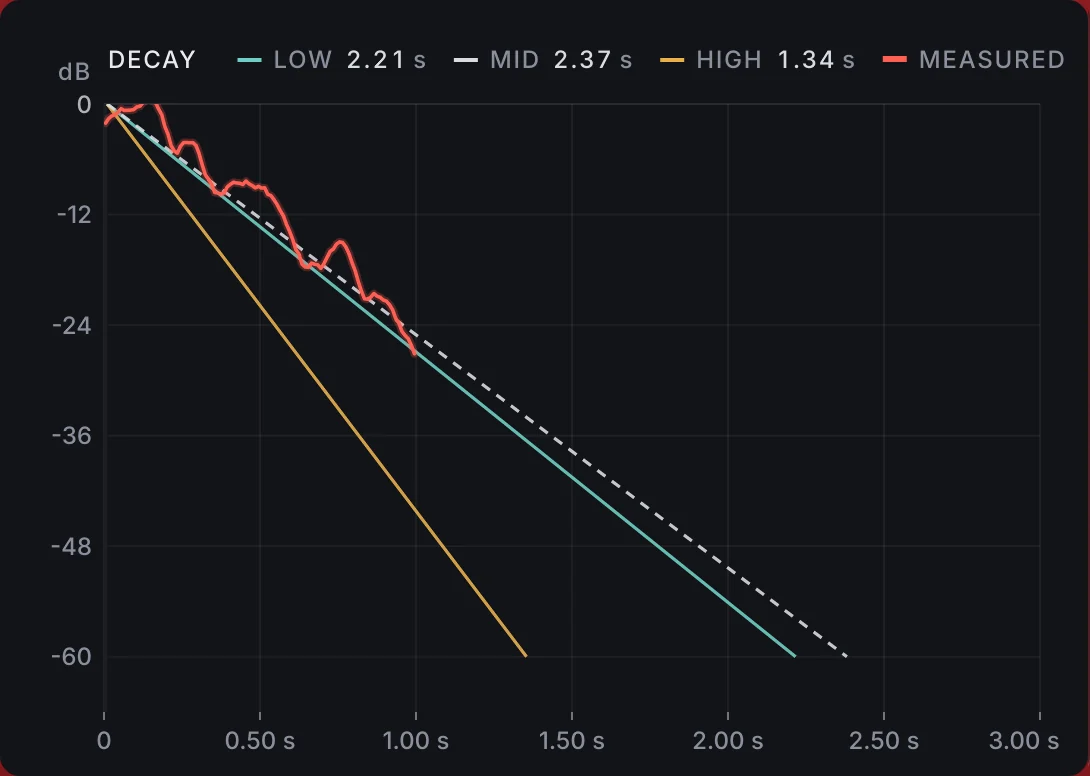
The DECAY display: the plate’s designed decay in the lows (2.21 s), mids (2.37 s) and highs (1.34 s) down to −60 dB, and the MEASURED tail.

See the plate decay

The DECAY display draws the plate’s designed decay in the lows, mids and highs with their reverb times, and its real level each time the input stops. The TAIL SPECTRUM shows the plate’s own sound per sixth of an octave with its reverb time across frequency over it, the TENSION crossover marked and LOW CUT shaded.

  • Measured against designed
  • TENSION crossover drawn
  • 1/6-octave spectrum
The controls of the red face: the big DAMP knob, then PRE-DELAY, PLATE and TONE above MOTION, DUCKING and OUTPUT.

Four colours of reverb, one family

VEIRA’s four colour reverbs are painted like the colour compressors, limiters, EQs and gates: White in pearl, Red in deep lacquered red, Gold in brushed champagne and Blue in 1970s steel blue. White is the pristine modern hall, Red the classic studio steel plate, Gold the studio echo chamber and Blue the early-1980s digital rack reverb. All four have tempo-synced pre-delay, a MIX LOCK for aux returns and a tail that ends in true digital silence, and every label on the paint stands at least 4.5:1 against it.

  • White, Red, Gold, Blue
  • MIX LOCK for aux returns
  • Text at 4.5:1 or more
The preset browser showing Default: Init, with previous, next and SAVE.

41 presets in 9 folders, measured

Default, Vocals, Drums, Guitars, Keys & Synths, Strings & Orchestral, Post & Film, Creative and Mix Bus: from Classic Vocal Plate and Snare Plate to Big 80s Snare, Surf Plate, Metal Box and Aux Plate Return. Each was measured through the plugin on matching material: every preset’s 1 kHz reverb time within 4 % of its design, output peaks at or under −4.1 dBFS, and the insert presets within 1.3 dB of the dry track.

  • 9 folders
  • Reverb time measured
  • Save your own

Get VEIRA Reverb Red

Pay once and it’s yours, with every future update included.

VEIRA Reverb Red

The plate of VEIRA’s four colour reverbs: the classic studio steel plate, bright, dense and immediate, with the damper’s 1-to-10 DAMP scale, TENSION and BRIGHTNESS, for vocals and snare above all.

  • Yours to keep: pay once, no subscription
  • Every future update, free for life
  • VST3, AU, Standalone on up to 3 computers
  • Changed your mind? Cancel within 14 days (refunds)
USD

One-time payment, in your cart.

Welcome offer

Get 10% off your first order

Leave your email and we’ll send you a code for 10% off your first order, on any plugins. One code per person.

Specifications

Type
Plate reverb: a model of the classic studio steel plate, its bending waves dispersive, with a driver, pickups and a damper
Damper
DAMP 1 to 10 (about 0.55 to 5.5 s in the mids; default 4.5), with a read-out of the real reverb time
Pre-delay
0 to 500 ms, or with SYNC a note from 1/64 to 1/2, dotted and triplets included, up to 2 s (default 1/16)
Plate
SIZE 0 to 100 % (1/1.5 to 1.5 times); TENSION 0 to 100 %, its crossover from about 90 Hz to about 1 kHz
Tone
BRIGHTNESS 0 to 100 %: the highs’ losses (8 kHz at about 0.6 to 0.95 of the mids at DAMP 4.5) and a 7 kHz shelf from −6 to +3 dB; LOW CUT off or 21 Hz to 1 kHz, 12 dB/oct, on the plate only
Motion and ducking
MOD 0 to 100 %; WIDTH 0 to 150 %, at the same level; DUCK 0 to 100 %, up to 24 dB
Output
MIX 0 to 100 %, equal power, with LOCK; OUTPUT −24 to +12 dB
Accuracy (measured)
Reverb time per octave band, 125 Hz to 8 kHz, within 7.7 % of the design; 1 kHz within 0.7 % at 44.1, 96 and 192 kHz; fully dense 10 to 15 ms after the first arrival
Latency
None; at MIX 0 % the output is the input, bit for bit
Tail
Ends in true digital zeros once it has fallen under −140 dBFS
Display
DECAY: the lows, mids and highs down to −60 dB with their reverb times and the measured tail; TAIL SPECTRUM in 1/6 octave with the reverb time across frequency and the TENSION crossover
Metering
IN and OUT peak and RMS, short-term and integrated LUFS, OUT − IN in LU
Presets
41 factory presets in 9 folders (Default, Vocals, Drums, Guitars, Keys & Synths, Strings & Orchestral, Post & Film, Creative, Mix Bus), plus your own
Channels
Mono, stereo, or mono in and stereo out
Face
Deep lacquered red, with cream print and black knobs; dark screens set into the paint
Window
1480 x 940 at 100 %, resizable from 75 to 200 %, saved with the session
CPU (measured)
About 3.5 % of one core of a 2-core cloud machine at 48 kHz (stereo), 8.5 % at 96 kHz
Formats
VST3, AU, Standalone
macOS
macOS 11 or later, Apple silicon or Intel (universal). VST3, AU and Standalone.
Windows
Windows 10 or later, 64-bit. VST3 and Standalone.
Pro Tools
Pro Tools (AAX) versions are built and tested, and arrive once they’re signed for Pro Tools.
Latest version
0.1.0, released November 2, 2026 · What’s new
Read more on the blog: Four colours of reverb: pristine, plate, chamber and vintage digital

Questions? 8 answers about VEIRA Reverb Red

Works well with

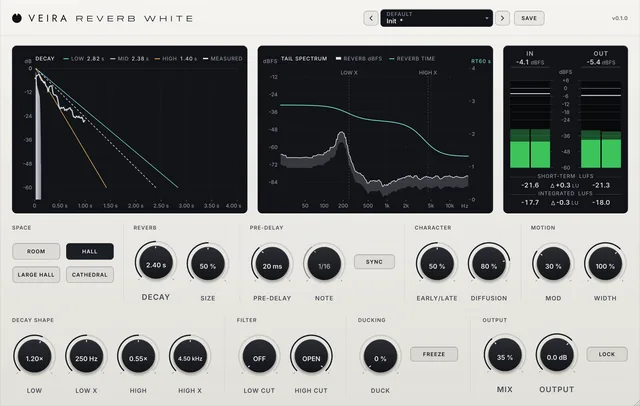
VEIRA Reverb White

The pristine one of VEIRA’s four colour reverbs: a modern algorithmic hall and room with four spaces, a DECAY from 0.2 to 20 s that you shape per band, tempo-synced pre-delay, DUCK and FREEZE.

$149.99

VEIRA Reverb Gold

The warm one of VEIRA’s four colour reverbs: a studio echo chamber in the tradition of the great 1950s-60s studio echo chambers, with four hard rooms, MIC DISTANCE, SPEAKER and MIC tone and the chain’s analog WARMTH.

$149.99

VEIRA Reverb Blue

The vintage digital one of VEIRA’s four colour reverbs: the lush, chorused halls and plates of the classic early-1980s digital rack reverbs, with five PROGRAMs, a random wander and ERA, the converters of the era.

$149.99