VEIRA Saturator Red

The bold one of VEIRA’s four colour saturators: overdrive, transistor, diode and fuzz, DRIVE up to 36 dB, a TONE that tilts what goes into the drive, level-matched AUTO GAIN and a parallel MIX.

$149.99, a one-time purchase with free updates

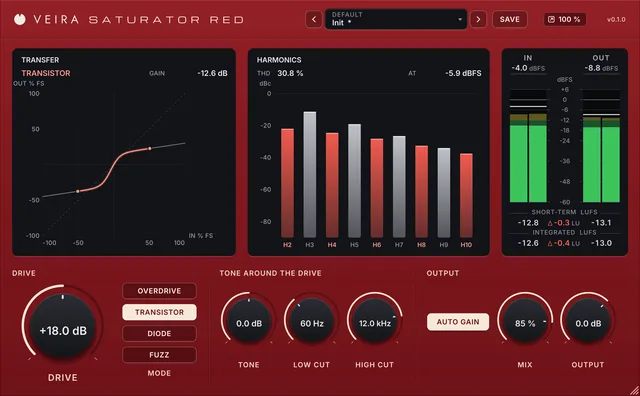
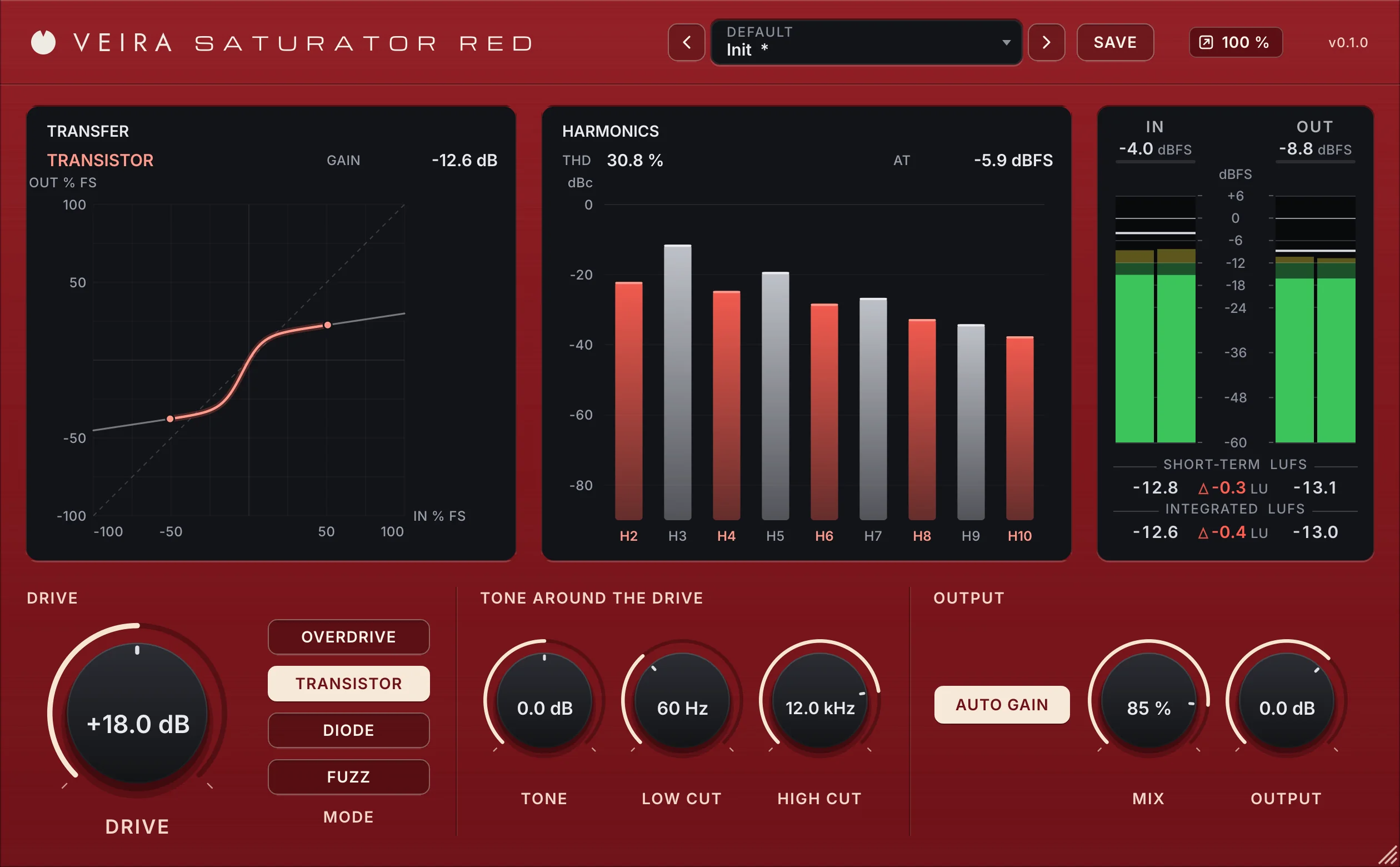
VEIRA Saturator Red, painted deep lacquered red, on a mix in TRANSISTOR: the TRANSFER curve with GAIN −12.6 dB, the HARMONICS from H2 to H10 with THD 30.8 % at −5.9 dBFS, and the IN and OUT meters; DRIVE at +18.0 dB, TONE 0.0 dB, LOW CUT 60 Hz, HIGH CUT 12.0 kHz, AUTO GAIN on, MIX 85 % and OUTPUT 0.0 dB.

VEIRA Saturator Red is the bold one of VEIRA’s four colour saturators, painted deep lacquered red. It adds grit, warmth and edge in the manner of analog circuits, with four modes: OVERDRIVE, the classic overdrive pedal, which drives the mids and leaves the lows tight; TRANSISTOR, a single transistor stage, warm and round; DIODE, hard clipping with two silicon diodes, edgy and bright; and FUZZ, the two-transistor fuzz, square and buzzy. DRIVE goes up to 36 dB, and TONE tilts what goes into the drive, so it changes the colour of the distortion more than the clean sound, with LOW CUT before the drive and HIGH CUT after it.

AUTO GAIN keeps the loudness where it was, so turning DRIVE changes the character, not the level, and MIX blends the dry signal back in time with the driven one for parallel saturation that never combs. The curve runs at eight times the sample rate with antiderivative anti-aliasing, so even the fuzz at full drive stays clean of aliasing. The TRANSFER display draws the curve with the span your peaks reach, and HARMONICS shows the harmonics and the THD at your level. The 39 factory presets in 9 folders are level-matched to bypass. Buy it once and VEIRA Manager installs it and keeps it up to date.

A tour of VEIRA Saturator Red

VEIRA Saturator Red, painted deep lacquered red, on a mix in TRANSISTOR: the TRANSFER curve with GAIN −12.6 dB, the HARMONICS from H2 to H10 with THD 30.8 % at −5.9 dBFS, and the IN and OUT meters; DRIVE at +18.0 dB, TONE 0.0 dB, LOW CUT 60 Hz, HIGH CUT 12.0 kHz, AUTO GAIN on, MIX 85 % and OUTPUT 0.0 dB.
  1. The whole of VEIRA Saturator Red

    VEIRA Saturator Red adds grit, warmth and edge in the manner of analog circuits, painted deep lacquered red. Four modes: the classic overdrive pedal, a single transistor stage, diode clipping and a two-transistor fuzz, with DRIVE up to 36 dB. TONE tilts what goes into the drive, LOW CUT and HIGH CUT shape it before and after, AUTO GAIN keeps the loudness so you hear the colour, and MIX blends the dry signal back in time. The curve runs at eight times the sample rate with antiderivative anti-aliasing, and the TRANSFER and HARMONICS displays show what it does to your signal.

  2. Four analog modes

    Overdrive, transistor, diode and fuzz, with DRIVE up to 36 dB.

  3. The curve, with your peaks on it

    Input across, output up, and the span your signal reaches right now.

  4. The harmonics it makes

    H2 to H10 and the THD at your level: even in red, odd in grey.

  5. A TONE around the drive

    Tilt what goes into the drive; cut lows before it, fizz after it.

  6. Hear the colour, not the volume

    AUTO GAIN keeps the loudness; MIX blends the dry signal in time.

What VEIRA Saturator Red does for you

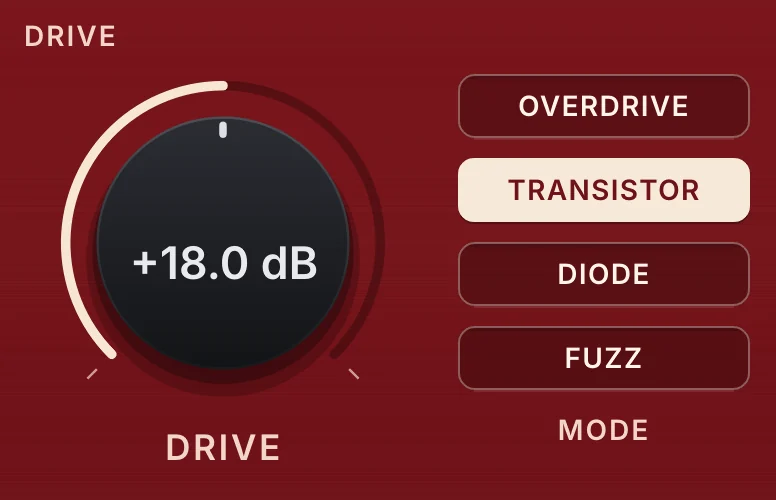
The DRIVE group: the big DRIVE knob at +18.0 dB, and the MODE buttons OVERDRIVE, TRANSISTOR (chosen), DIODE and FUZZ.

Four analog modes

OVERDRIVE is the classic overdrive pedal: a soft, slightly lopsided diode clip, with the drive applied above about 720 Hz so the lows stay tight. TRANSISTOR is a single transistor stage, warm and round, the 2nd harmonic first. DIODE is hard clipping with two silicon diodes: symmetric, odd harmonics, edgy. FUZZ is the two-transistor fuzz: 12 dB more gain and a hard, lopsided clip, square and buzzy.

  • 4 modes
  • DRIVE 0–36 dB
  • FUZZ +12 dB
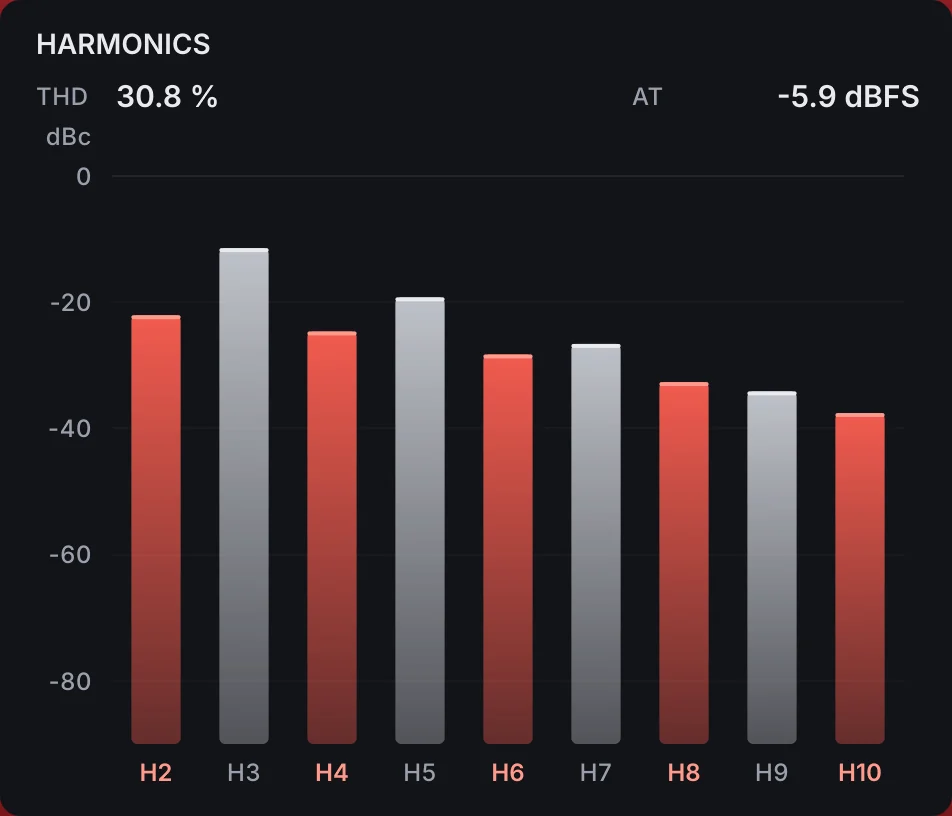
The HARMONICS display: bars from H2 to H10 in dBc, the even ones in red and the odd ones in grey, with THD 30.8 % at −5.9 dBFS.

The harmonics, measured and shown

The HARMONICS display shows the 2nd to 10th harmonic the curve makes at your input’s level right now, even ones in red and odd ones in grey, with the THD. Measured on a 1 kHz sine at −18 dBFS RMS with 12 dB of DRIVE: OVERDRIVE 4.6 %, TRANSISTOR 10.3 %, DIODE 0.40 % and FUZZ 35 % THD.

  • H2 to H10
  • THD at your level
  • Measured per mode
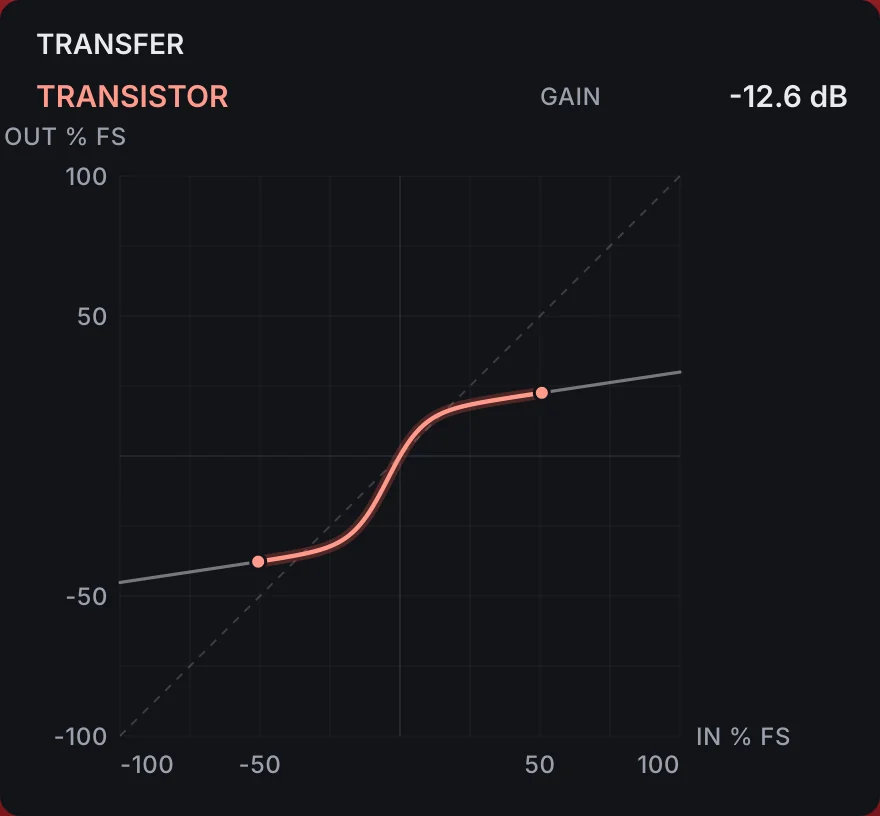
The TRANSFER display in TRANSISTOR: the curve from −100 to 100 % of full scale with the lit span between two dots, the dashed line of no change, and GAIN −12.6 dB.

The curve, with your peaks on it

TRANSFER draws the whole saturator as a curve, input across and output up, with DRIVE, AUTO GAIN, MIX and OUTPUT in it, and lights the span your signal’s peaks reach right now. Watch it flatten as you raise DRIVE, sit off-centre in FUZZ and straighten again as MIX blends the dry signal back in.

  • Live peak span
  • GAIN read-out
  • Every mode drawn
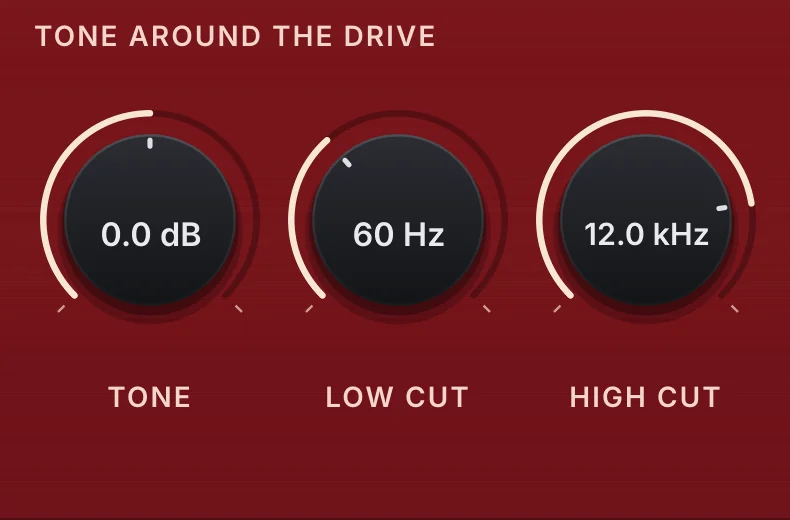
TONE AROUND THE DRIVE: TONE at 0.0 dB, LOW CUT at 60 Hz and HIGH CUT at 12.0 kHz.

A TONE around the drive

TONE tilts the signal into the drive around 800 Hz and takes half of it back after, so it changes the colour of the distortion more than the clean sound: at +6 dB a 3 kHz tone got 3.1 % THD where −6 dB gave none. LOW CUT before the drive tightens the lows going into it, HIGH CUT after it smooths the fizz, both at 12 dB per octave, and all three glide without clicks.

  • ±6 dB tilt
  • Cuts before and after
  • No clicks
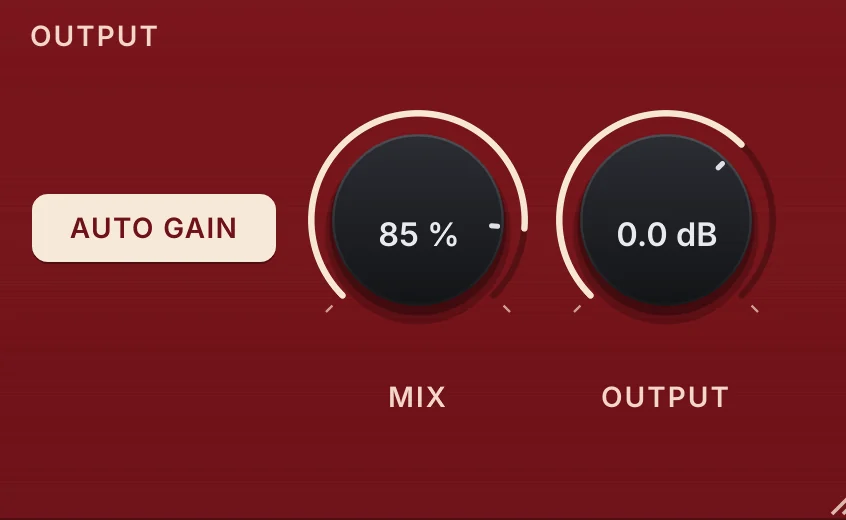
The OUTPUT group: AUTO GAIN on, MIX at 85 % and OUTPUT at 0.0 dB.

Hear the colour, not the volume

AUTO GAIN takes back what DRIVE adds in level at once, then matches the output’s loudness to the input’s over the last few seconds: a sine stays within 0.05 dB in every mode from 0 to 36 dB of DRIVE, and drums, bass and a rock mix within 0.5 dB. MIX blends the dry signal in time with the driven one (66 samples of latency, reported), so parallel saturation never combs; its blend can land up to 3 dB lower, which each preset’s OUTPUT trims.

  • AUTO GAIN
  • Parallel MIX in time
  • MIX 0 % bit-exact
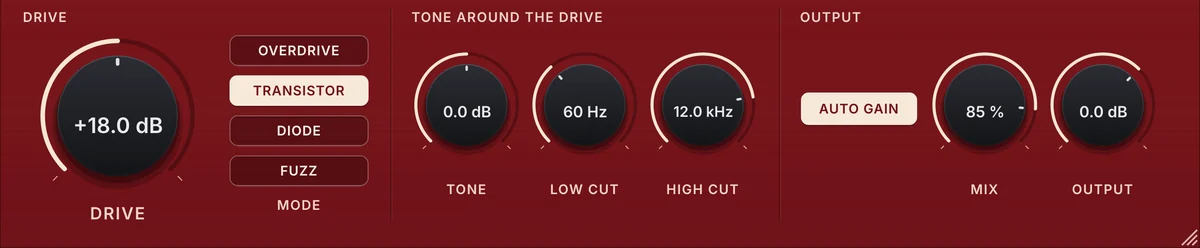
The strip along the bottom of the red face: DRIVE and MODE, TONE AROUND THE DRIVE, and OUTPUT.

Clean of aliasing, even in fuzz

The curve runs at eight times the sample rate through steep filters, with antiderivative anti-aliasing. A 5 kHz sine driven 24 dB left aliasing at the measurement’s floor of −94 dBc in OVERDRIVE, TRANSISTOR and DIODE, and −72 dBc in FUZZ (−46 dBc without the antiderivative step). It costs more CPU than a simple saturator, which is the price of that cleanliness.

  • 8x oversampling
  • Antiderivative anti-aliasing
  • −94 dBc
The preset browser showing Default: Init, with previous, next and SAVE.

39 presets in 9 folders, level-matched

Default, Drums, Bass, Guitar, Keyboards, Vocals, Mix Bus, Mastering and Creative FX: from Snare Crack, Bass Growl and Edge Of Breakup to Vocal Presence, Mix Glue Warmth, Total Fuzz and Telephone Grit. AUTO GAIN is on in every one, and each comes out within 0.05 dB of bypass (K-weighted) on the material it was made for.

  • 9 folders
  • Within 0.05 dB
  • AUTO GAIN in all

Get VEIRA Saturator Red

Pay once and it’s yours, with every future update included.

VEIRA Saturator Red

The bold one of VEIRA’s four colour saturators: overdrive, transistor, diode and fuzz, DRIVE up to 36 dB, a TONE that tilts what goes into the drive, level-matched AUTO GAIN and a parallel MIX.

  • Yours to keep: pay once, no subscription
  • Every future update, free for life
  • VST3, AU, Standalone on up to 3 computers
  • Changed your mind? Cancel within 14 days (refunds)
USD

One-time payment, in your cart.

Welcome offer

Get 10% off your first order

Leave your email and we’ll send you a code for 10% off your first order, on any plugins. One code per person.

Specifications

Type
Saturator: four analog-style curves at 8x the sample rate with antiderivative anti-aliasing
Modes
OVERDRIVE (drive above about 720 Hz), TRANSISTOR, DIODE, FUZZ (12 dB more gain)
Drive and tone
DRIVE 0 to 36 dB (default 12 dB); TONE −6 to +6 dB, a tilt around 800 Hz into the drive, half taken back after
Filters
LOW CUT OFF or 20 Hz to 1 kHz before the drive; HIGH CUT 1 to 20 kHz or OFF after it; both 12 dB/oct
Output
AUTO GAIN (on by default; within 0.05 dB on a sine at every DRIVE), MIX 0 to 100 % in time with the dry signal, OUTPUT −24 to +12 dB
THD (measured)
1 kHz at −18 dBFS RMS, DRIVE 12 dB: OVERDRIVE 4.6 %, TRANSISTOR 10.3 %, DIODE 0.40 %, FUZZ 35 %
Aliasing (measured)
5 kHz at −6 dBFS driven 24 dB: −94 dBc (the measurement’s floor) in OVERDRIVE, TRANSISTOR and DIODE, −72 dBc in FUZZ
Displays
TRANSFER (the curve, with the span the peaks reach); HARMONICS (H2 to H10 and THD at the input’s level); IN and OUT meters with short-term and integrated LUFS
Latency
66 samples at every sample rate (1.4 ms at 48 kHz), reported to the host; MIX 0 % is the input, delayed, bit for bit
Parameters
8, all automatable
Presets
39 factory presets in 9 folders, AUTO GAIN on, level-matched to bypass within 0.05 dB (K-weighted), plus your own
Window
1260 x 780 at 100 %, resizable from 75 to 200 % or to fit the screen (button, corner grip or Cmd/Ctrl + and −), saved with the session
CPU (measured)
6 to 12 % of one core of a 2-core cloud machine (stereo, 48 kHz; OVERDRIVE the heaviest)
Formats
VST3, AU, Standalone
macOS
macOS 11 or later, Apple silicon or Intel (universal). VST3, AU and Standalone.
Windows
Windows 10 or later, 64-bit. VST3 and Standalone.
Pro Tools
Pro Tools (AAX) versions are built and tested, and arrive once they’re signed for Pro Tools.
Latest version
0.1.0, released November 10, 2026 · What’s new
Read more on the blog: Red: punch, grit and low end

Questions? 8 answers about VEIRA Saturator Red

Works well with

VEIRA Tape Saturator

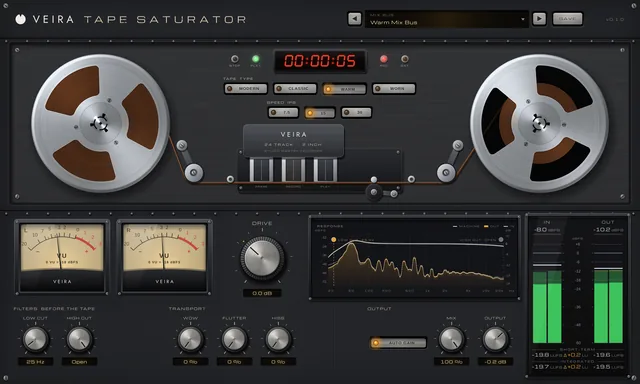
A 2-inch, 24-track tape machine: four tapes, three speeds, and reels that turn with your song.

$39.99

VEIRA Harmonic Saturator

Harmonic colour, by the band: a warm tube or exactly the harmonics you set, at the same level.

$29.99

VEIRA Bass Enhancer Red

The gritty one of VEIRA’s four colour bass enhancers: a compressor for 80 Hz and below, and one big ENHANCE knob that adds a transistor stage’s harmonics, so the bass is heard on phones, laptops and earbuds.

$49.99