Twin-channel tube limiting: linked, split, or mid and side
How a twin-channel vari-mu tube limiter holds a mix bus, a master or a pair of guitars: what the two channels are for, when to link them, when to split them, and why lateral and vertical is the secret of the classic units.
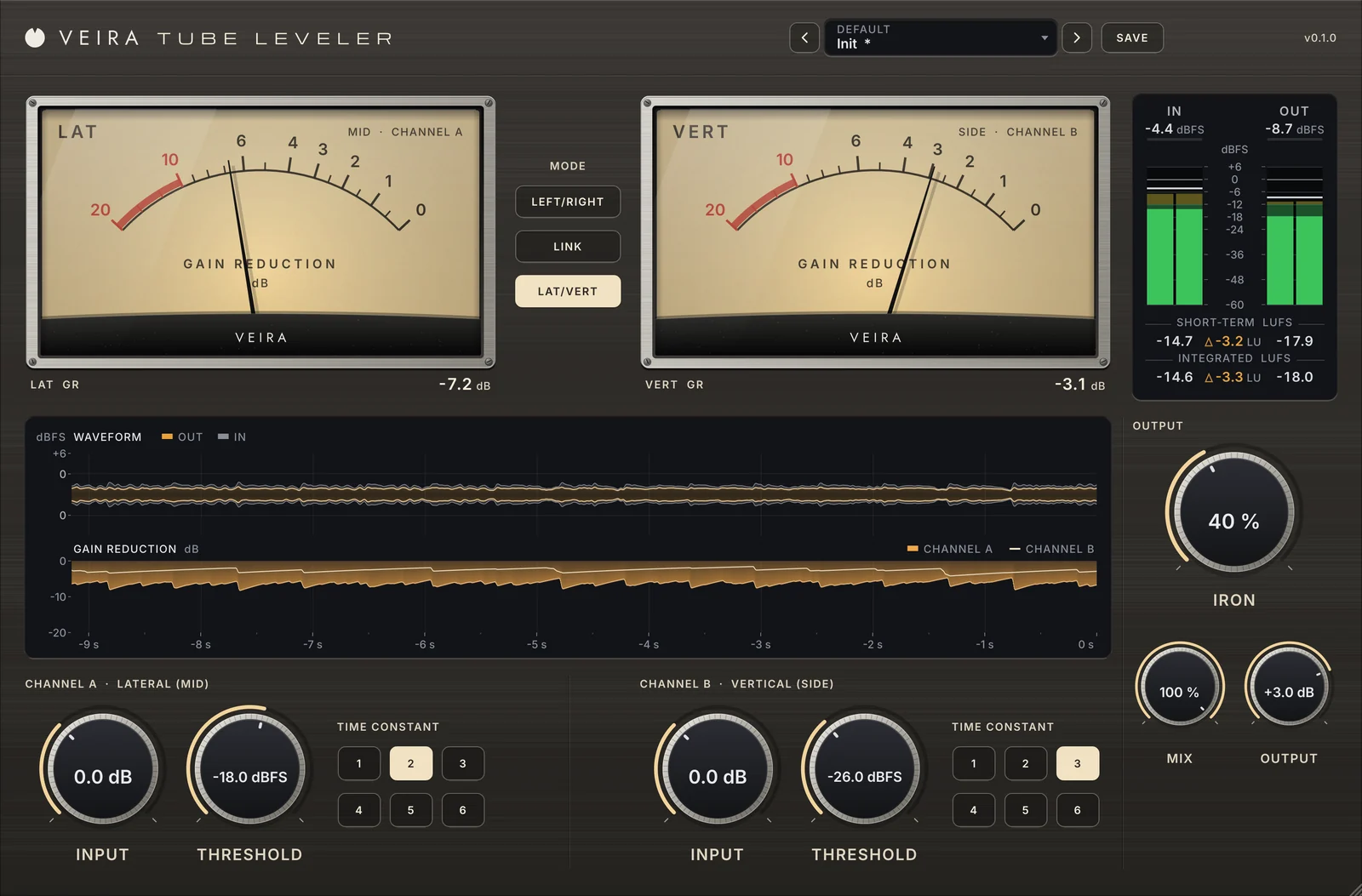
The great tube limiters of the late 1950s were built for cutting records, and the most prized of them had two complete channels in one box. That second channel wasn’t only for stereo: the same unit could hold two different things at once, or work on a stereo signal in a way no single compressor can. VEIRA Tube Leveler is built in that tradition, and the same three ways of running the two channels are still the best way to understand what it does.
Tubes as the gain control
In a vari-mu limiter the tubes themselves are the volume knob: the side chain changes their bias, and as a tube is turned down its gain falls. Through the feedback side chain the ratio isn’t fixed; it rises with level, from barely compressing near the threshold to about 4:1 when driven hard. Nothing is ever grabbed, which is why these units are the classic glue for a mix bus and a master. And because a tube turned towards cutoff bends the signal more, the harmonics grow with the reduction: clean at a decibel or two, thicker and more “tube” when you lean on it.
Linked: one image that never moves
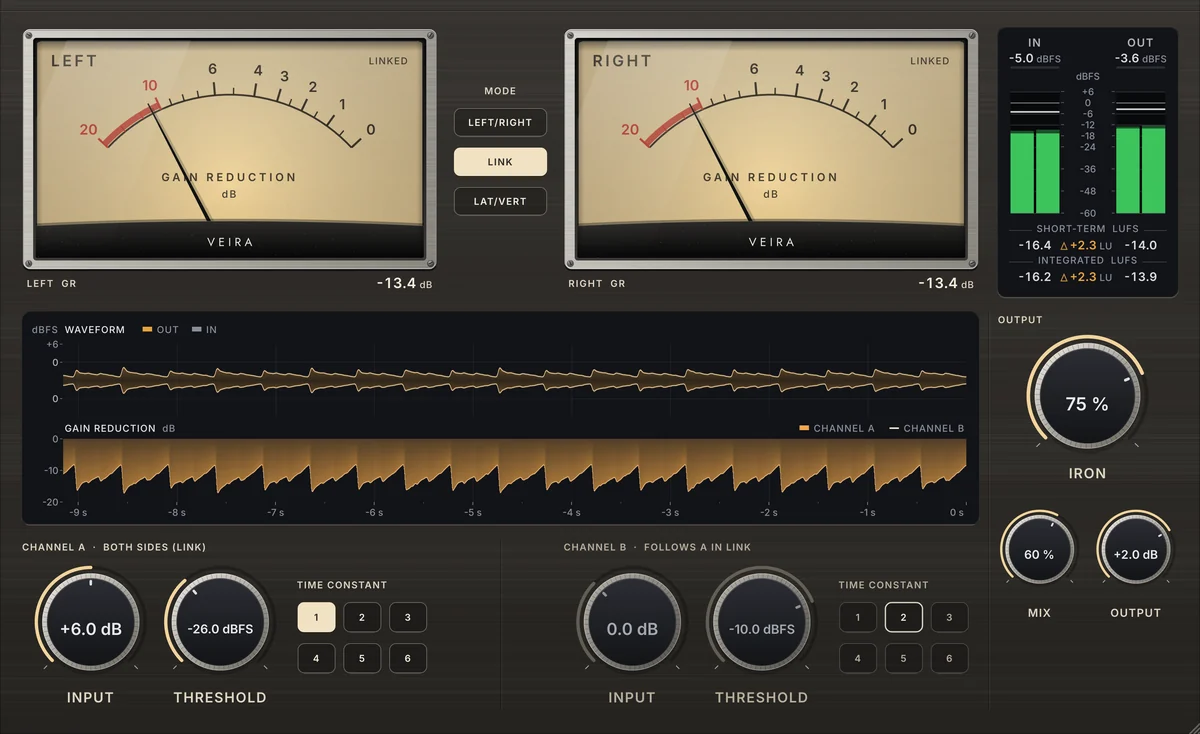
On a mix bus or a master, link the channels. In LINK, channel A’s INPUT, THRESHOLD and TIME CONSTANT drive both sides, and one control voltage, taken from whichever side is louder, turns both down by the same amount, so the stereo image never shifts. Start with TIME CONSTANT 2, lower THRESHOLD until the needle moves 1 to 3 dB on the loudest parts, and bring the level back with OUTPUT until the meter bridge reads about 0 LU between in and out. On a master, try 5 or 6: they let go quickly after a single peak but hold steadily through a dense chorus, so nothing pumps.
Split: two mono sources, each on its own
In LEFT/RIGHT the channels work apart, each with its own settings and its own side chain. This is the mode for hard-panned double-tracked guitars or two microphones on one source: a loud chord on the left won’t pull down the right, and each side can have a different threshold or time constant. It is also how the original units were often used in the studio, as two mono limiters in one rack space. On a stereo mix it will make the image lean, so keep it for pairs.

Lateral and vertical: the mid and the side
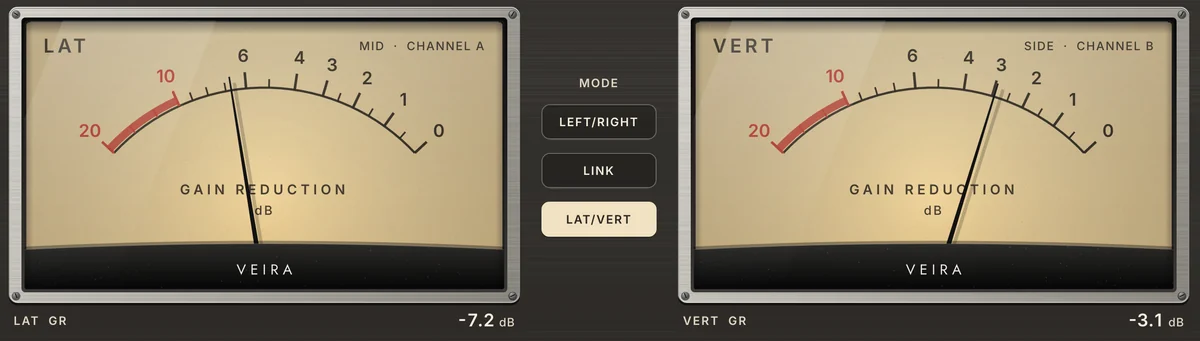
LAT/VERT is the secret weapon. The names come from record cutting: lateral groove motion is what both channels share, the mid, and vertical motion is their difference, the side. Channel A works on the mid and channel B on the side, each with its own side chain, and then they are recombined. A loud, wide guitar or synth can be held without touching the vocal, kick and bass in the middle; or the centre can be steadied while the width stays open. Give the side a higher THRESHOLD than the mid for a natural start, and watch the two needles move independently.
IRON, and when to stop
Beyond the tubes, IRON adds the input and output transformers and the output stage: weight and a little saturation on heavy bass, and a gentle roll-off at the top. The default 30 % is subtle; push it on a drum bus or a bass for size, pull it to 0 % for a transparent master. As with any bus processing, judge it at matched loudness, and if the needles swing past 6 dB on a mix bus, ask whether you really want a limiter there or a better balance underneath.
Read the VEIRA Tube Leveler page for every measurement, or start with its 67 presets: Leveler Glue for the mix bus, Master TC6 for a master, Steady Centre for LAT/VERT and Parallel Drum Crush for the drums.