How to pull an a cappella or an instrumental out of a finished song
How vocal separation works, what it can and can’t do, which settings matter for an instrumental, an a cappella or a vocal rebalance, and how to check the result.
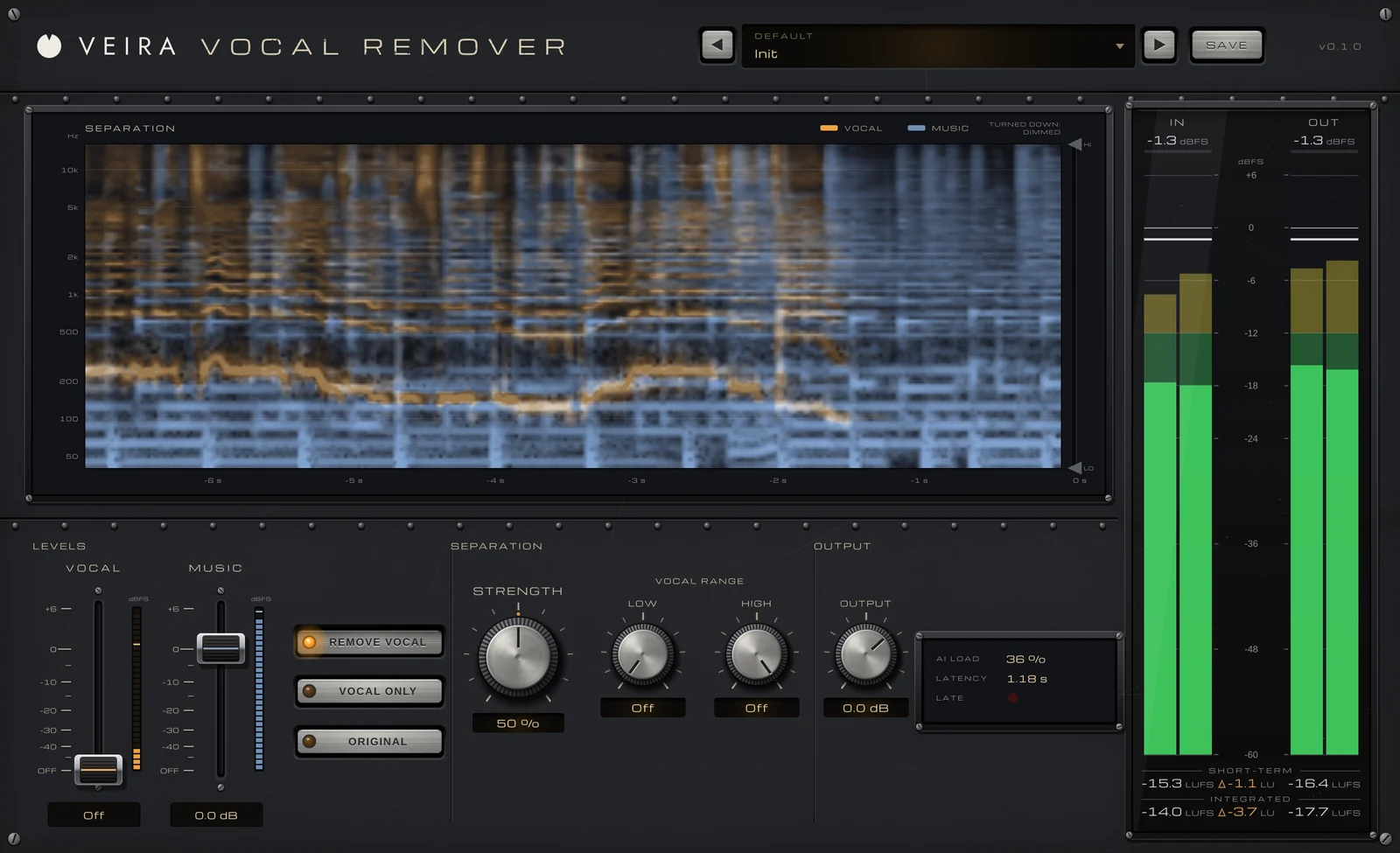
Sometimes all you have is the finished stereo mix. A remix needs the vocal on its own, a singer wants to rehearse over the band, a karaoke night needs the instrumental, and the multitracks are long gone or were never yours. Separation tools have become very good at this, but what they give you is still an estimate, and knowing where it struggles is what turns a rough result into a usable one.
Why the old phase trick falls short
The classic trick is to flip the polarity of one side and add it to the other, which cancels anything panned dead center. The lead vocal usually is, but so are the kick, the snare and the bass, and the vocal’s stereo reverb and doubles survive untouched. What’s left is a thin mono track with a ghost of the voice in it, and the trick can’t give you an a cappella at all.
What a separation model actually does
A separation model has learned what a voice looks like in the spectrum. Moment by moment and frequency by frequency, it decides how much of the sound is voice and how much is everything else, then rebuilds two signals from those decisions. Because they are decisions, there is always a trade: push the model to take more and it starts to take cymbals, synths and other bright sounds with the voice; hold it back and a faint ghost of the vocal stays in the music.
Set your expectations by the job
Different jobs forgive different flaws, so decide what you need before you start chasing a perfect result.
- Karaoke and practice tracks: a vocal that’s about 20 dB down is gone for most listeners once the band is playing, and small artifacts hide under the person singing along.
- Remixes and samples: an a cappella will carry a little of the band, often hi-hats and reverb. Under new drums that’s usually fine; left exposed in a quiet intro, it isn’t.
- Rebalancing: turning a vocal up or down a few dB is the most forgiving job of all, because both parts are still there, only in a different balance.
- Spoken word, choirs and heavily effected vocals separate less cleanly than a single sung lead, so plan for more cleanup.
Clean up what the separation leaves
Treat the separated parts like any other recording. A lead vocal has little useful energy below about 80–100 Hz, so keep that range in the music: it protects the kick and the bass from being pulled into the voice. Expect a separated vocal to sound a little rough on its own; a gentle EQ, and some editing or a gate between phrases, go a long way. Check on headphones, which reveal leftovers that speakers hide, and remember that the song still belongs to its owners: practice at home is one thing, a release needs permission.
Doing it with VEIRA Vocal Remover
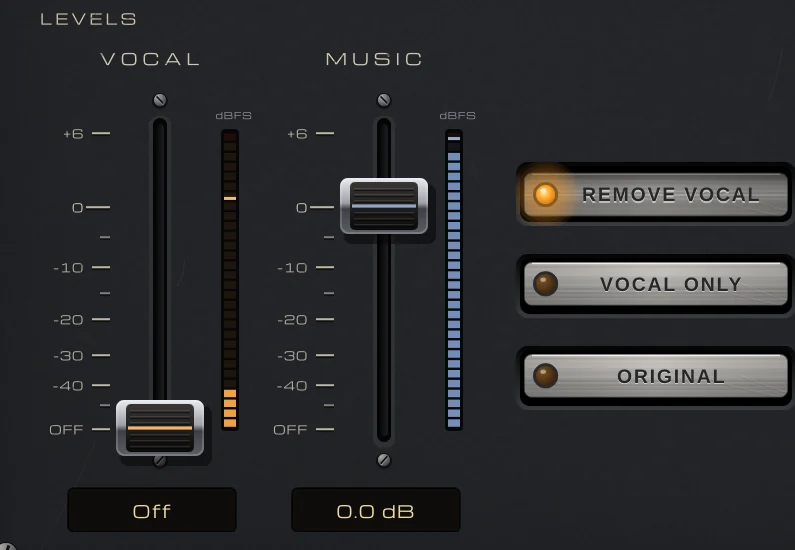
VEIRA Vocal Remover splits a finished stereo song into its vocal and everything else, with an AI separation model that runs inside the plugin, on your computer, with no internet and no upload. Two console faders, VOCAL and MUSIC, set how loud each part comes back, from Off to +6 dB, and REMOVE VOCAL, VOCAL ONLY and ORIGINAL set both in one click. Measured on test songs whose parts are known, its Karaoke presets leave the vocal 19 to 23 dB down with the music within 0.6 dB.
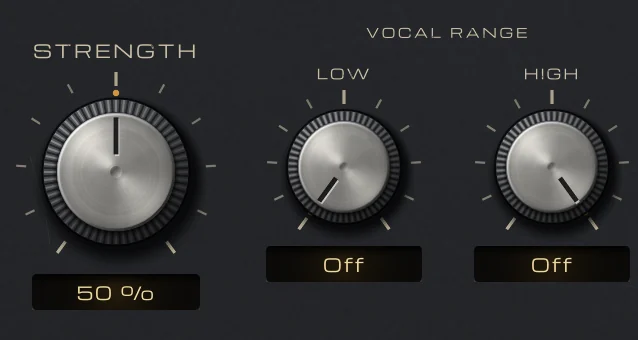
STRENGTH sets how firmly the model decides what is voice. 50 % measured best both ways and 35 to 70 % is a matter of taste: higher takes more of a vocal’s reverb, breaths and doubles but costs the cymbals’ air, and for an a cappella, lower means less bleed. The VOCAL RANGE keeps the kick, bass and cymbals out of it: LOW up to about 90 Hz costs a voice nothing, and HIGH at 10 to 14 kHz keeps the cymbals’ air.
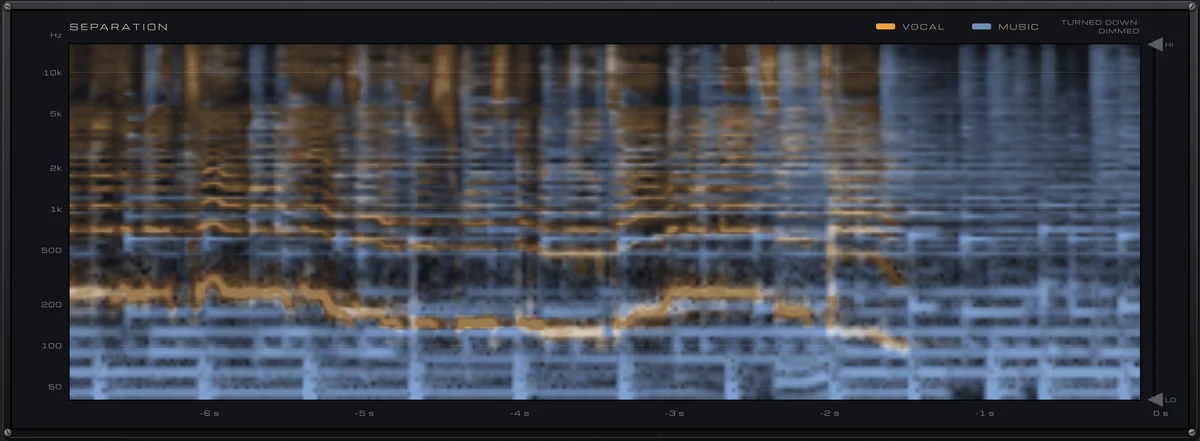
The SEPARATION display shows the vocal in amber and the music in blue, so you can see what the AI hears. It listens about 1.18 s ahead, which your DAW compensates on playback and in bounces, so it’s made for playback, mixing and bouncing rather than live monitoring. There is no peak protection: lower OUTPUT when you turn a vocal up on a loud master.