Building a guitar amp sound: pedals, channel, cabinet and microphone
How a miked guitar amp sound is built, in signal order, with VEIRA Amp Rig: the input level, a pedal in front, the amp’s channel and tone stack, the cabinet and where the microphone goes, and the effects after it.
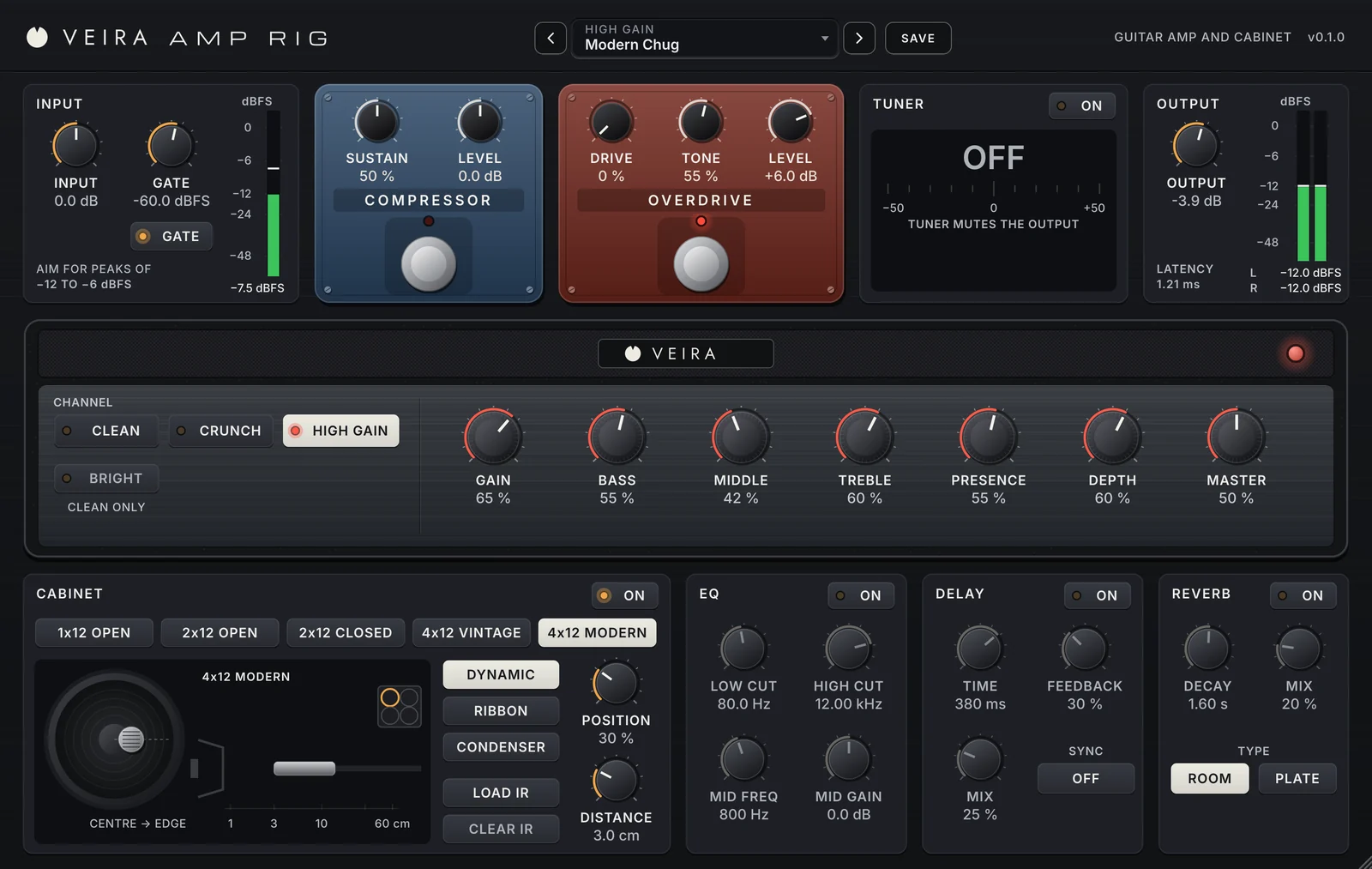
A recorded electric guitar is rarely just the guitar: it is a pedal or two, an amp, a speaker in a box and a microphone in front of it, and each one shapes the sound. Recording the guitar straight in, as a DI track, keeps every one of those choices open until the mix. VEIRA Amp Rig lays them out in signal order, as a rig, and this is how to build a sound with it, one stage at a time.
Start with the level
An amp responds to how hard it is hit, so the input level is part of the tone. Aim for peaks of −12 to −6 dBFS on the IN meter and set INPUT to get there. Then set the GATE just above the noise between notes: it opens in half a millisecond and fades out after a hold, so a decaying chord rings out instead of being chopped.
A pedal in front changes the amp
An overdrive in front of an amp does two jobs. At full DRIVE it is a lead sound of its own in front of a crunchy amp. At low DRIVE with LEVEL up it is a boost: it pushes the amp harder and, because its drive works on the middle and top and leaves the lows clean, it tightens a high-gain sound so palm mutes stay defined. The COMPRESSOR before it evens out strumming and lengthens sustain for clean parts.
Choose the channel, then the tone stack
The channel sets the character: an American-style CLEAN with a scooped middle and lots of headroom, a British-style CRUNCH that cleans up as you pick softer, or a tight, modern HIGH GAIN. BASS, MIDDLE and TREBLE are a passive tone stack, so they interact: turning MIDDLE down also changes how much BASS and TREBLE you hear. PRESENCE and DEPTH work in the power amp, on the top and the low end. Because GAIN mostly adds drive and not volume, you can judge the drive by ear and set the level last.

The cabinet and the microphone
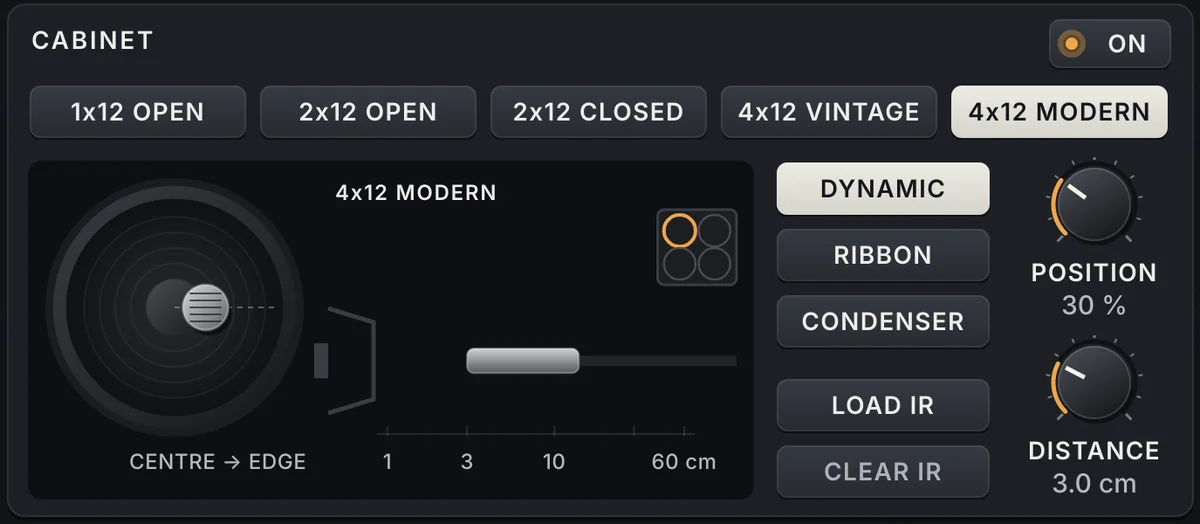
The speaker and the box do as much to a guitar sound as the amp. An open-back cabinet sounds airy and wide, a closed 4x12 deep and punchy. Then the microphone: in the centre of the speaker it is bright and cutting, towards the edge of the cone darker and rounder, and moving it a few centimetres back adds body before the room comes in. A dynamic microphone has a presence peak, a ribbon a smooth top and a strong proximity bass, a condenser an open, detailed sound. Drag the microphone and listen: it is the quickest way to fit a guitar into a mix.
Effects after the cabinet
- A LOW CUT around 80 to 100 Hz keeps a distorted guitar out of the bass and the kick drum.
- A HIGH CUT tames what is left of the top for a darker, vintage sound.
- A short DELAY with a little FEEDBACK thickens a lead; SYNC locks it to the song’s tempo, and dotted eighths give the classic rhythmic echo.
- A ROOM puts the amp in a space; a PLATE with a long DECAY suits clean swells and ambient parts.
Read the page of VEIRA Amp Rig for every control, or start from its presets: Glass Chime for clean parts, Vintage Push for crunch, Modern Chug for tight rhythm and Singing Lead for solos.