The classic subtractive synth: five sounds from one page
How a classic analog synthesizer works, left to right: oscillators, mixer, ladder filter and envelopes, and how to build a bass, strings, brass, a pluck and an acid line from Init.
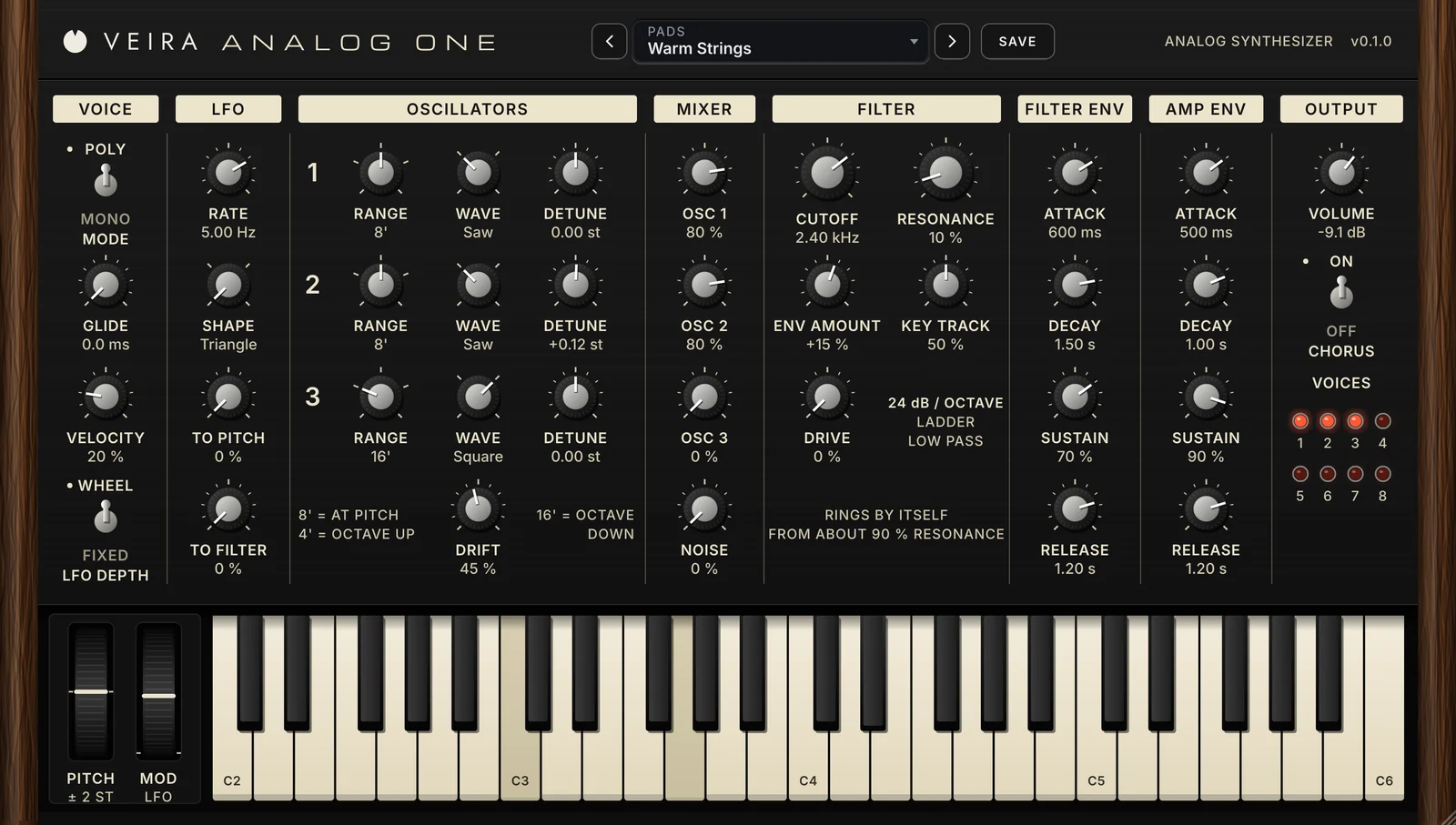
Most of the synth sounds you know from records were made the same way: start with bright, buzzy waves, then take away what you don't want with a filter, and shape each note with envelopes. That is subtractive synthesis, and the classic instruments that used it put every control on one panel, in the order the sound flows. VEIRA Analog One is built that way: no menus, no pages, one knob for each job.
Left to right
Three oscillators make the waves: triangle, saw, square or a narrow pulse, each at a range in feet (8' is the key's pitch, 16' an octave down) and with a DETUNE of up to ±7 semitones. The mixer sets how much of each, and of noise, goes into the filter: a 24 dB ladder low pass whose CUTOFF decides how bright the sound is and whose RESONANCE adds a peak at the cutoff. Two envelopes give each note its shape, one moving the filter and one the level. An LFO adds vibrato or slow filter movement, and a chorus makes it all stereo.
Five sounds from Init
Load Default ▸ Init, one saw through the ladder with a little filter envelope, and try these, one knob at a time.
- A bass: set MODE to MONO, put oscillator 3 at 16' and raise it on the mixer, lower CUTOFF to about 400 Hz, then raise ENV AMOUNT and shorten the filter envelope's DECAY for a pluck at the start of each note.
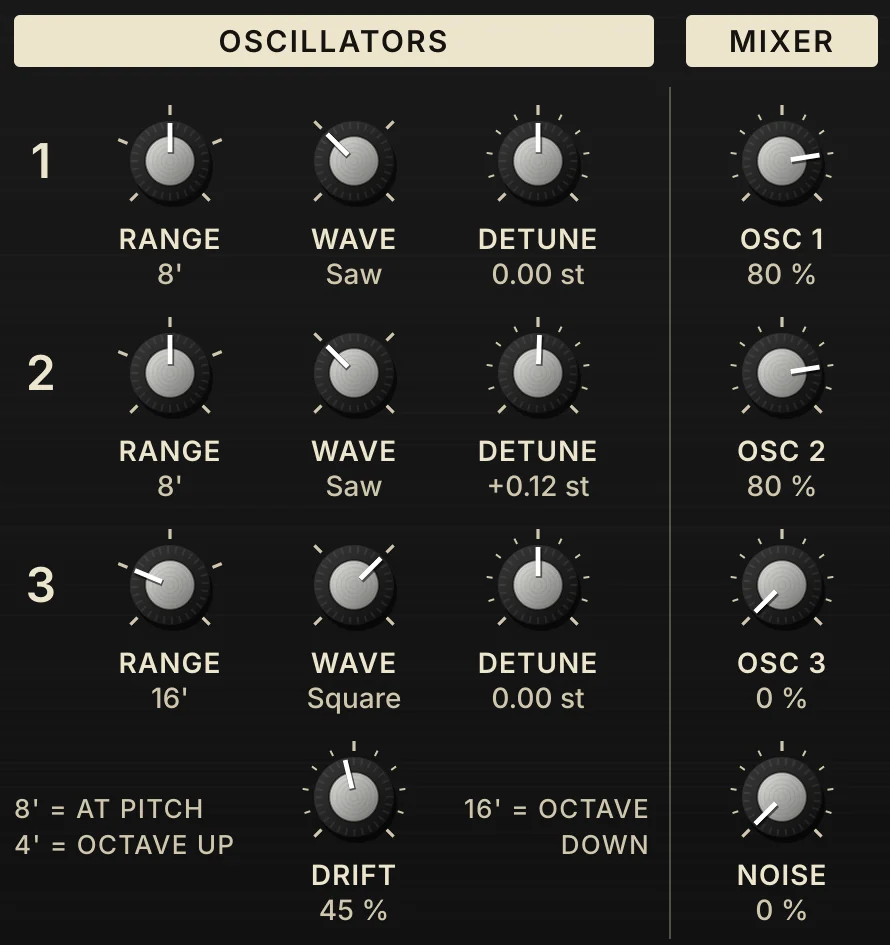
- Strings: raise OSC 2, give it a few cents of DETUNE, set DRIFT to about 45 %, lengthen the amp envelope's ATTACK and RELEASE to about a second, and turn CHORUS on.
- Brass: two saws, a slower filter ATTACK so the cutoff swells open with each note, and some VELOCITY so harder notes are brighter.
- A pluck: SUSTAIN low on both envelopes, a short filter DECAY, and CHORUS on.
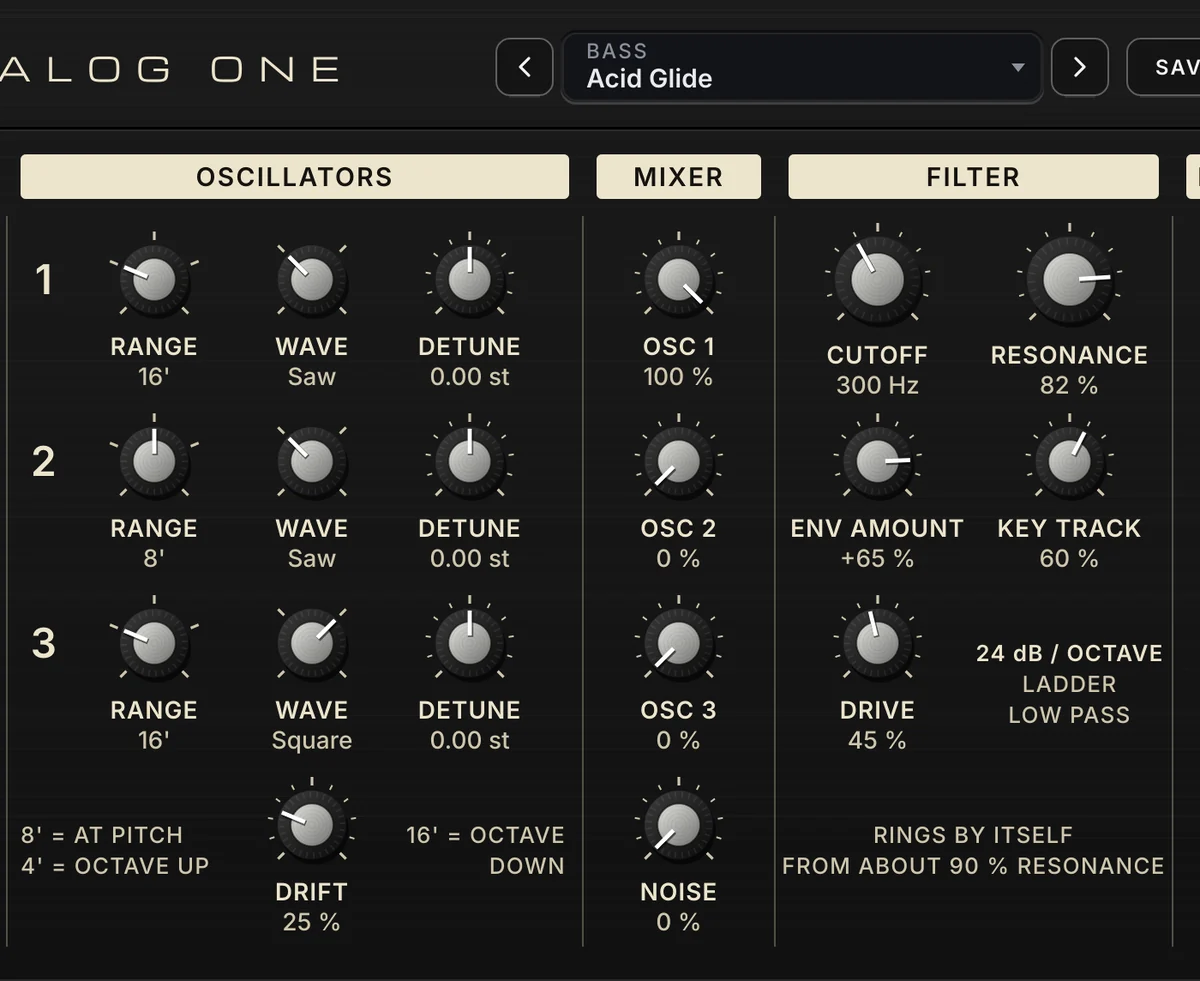
- An acid line: MONO, GLIDE at about 80 ms, RESONANCE towards 85 %, DRIVE at about 45 %, CUTOFF low and ENV AMOUNT high. Play legato so the notes slide without restarting the envelopes.
MONO or POLY
Basses and leads usually want one voice: in MONO the last note wins, and a note played while another is held changes the pitch without restarting the envelopes, so a line flows and, with GLIDE, slides. Chords and pads want POLY, eight voices, each with its own filter and envelopes. GLIDE works in both.
When the filter sings
Turn RESONANCE past about 90 % and the ladder rings by itself, a pure sine at the cutoff. With KEY TRACK at 100 % that sine follows the keys exactly, so you can turn every oscillator off and play the filter itself, as FX ▸ Ringing Filter does.
Read the VEIRA Analog One page for every control, or start from its 39 presets, from Round Mono Bass and Acid Glide to Warm Strings, Brass Section and Analog Pluck. For a modern wavetable engine try VEIRA Black Synth, and for cables and a whole modular, VEIRA System 1.