Patching a modular synthesizer, one cable at a time
How a modular synthesizer works and how to patch one: sources, shapers and control, normals, the first cables to try, and a bass, a sequence and a drone to build.
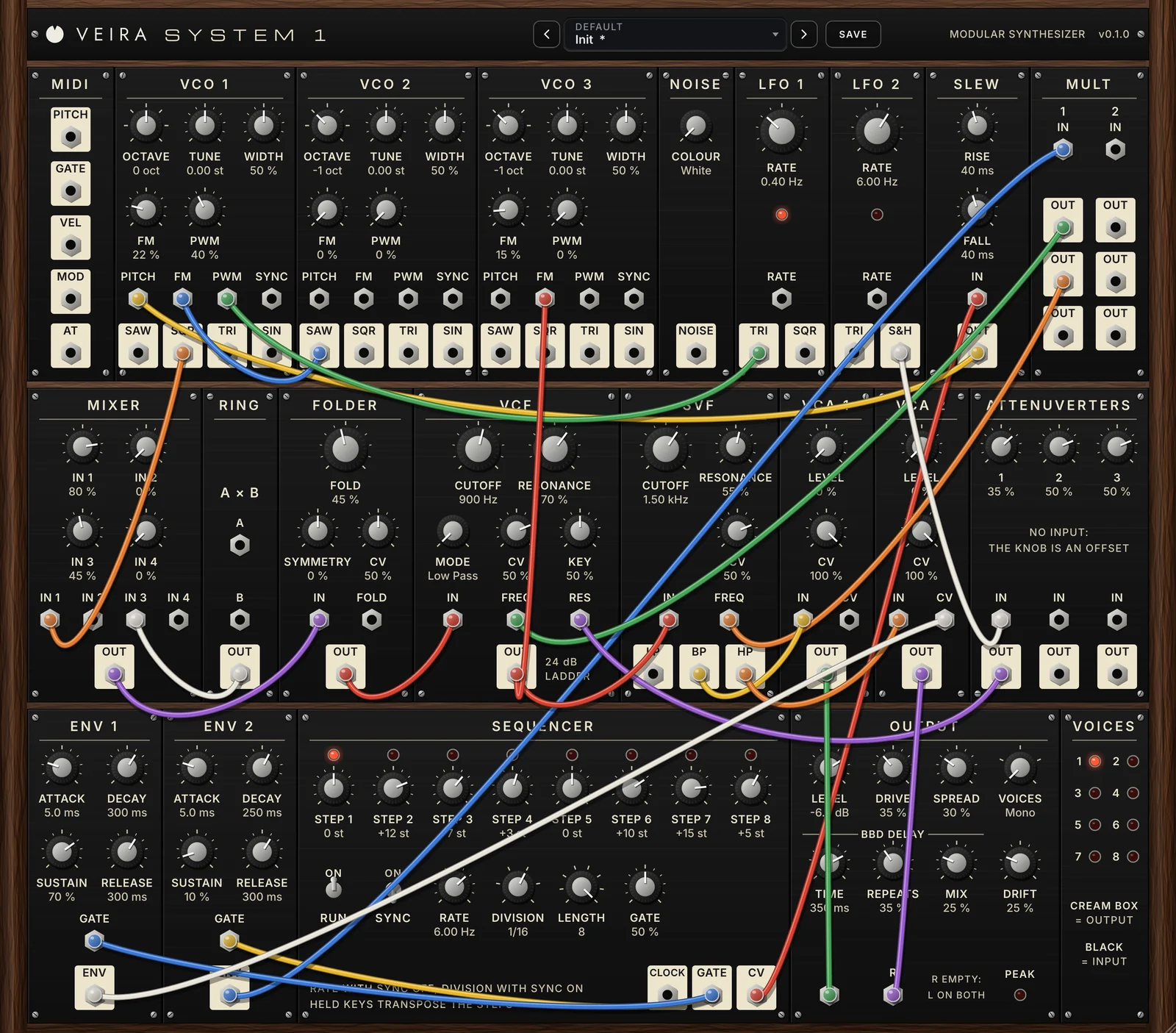
On most synthesizers the path of the sound is fixed: oscillators into a filter, into an amplifier, with a matrix or a few switches to change what moves what. A modular synthesizer has no fixed path. Each function is a separate module with inputs and outputs, and you decide the path by plugging cables between them. VEIRA System 1 is a modular in the spirit of the 1970s systems, in a walnut cabinet, and this is how to think about one.
Sources, shapers and control
Every module does one of three jobs. Sources make a signal: oscillators (VCOs), noise, LFOs and envelopes. Shapers change a signal: the mixer, the filters, the wavefolder, the ring modulator and the amplifiers (VCAs). Control decides when and how much: envelopes open the amplifier when a key is pressed, an LFO sweeps the filter, a sequencer plays a line. On System 1 the three rows follow that order: sources on top, shapers in the middle, envelopes, sequencer and output at the bottom.
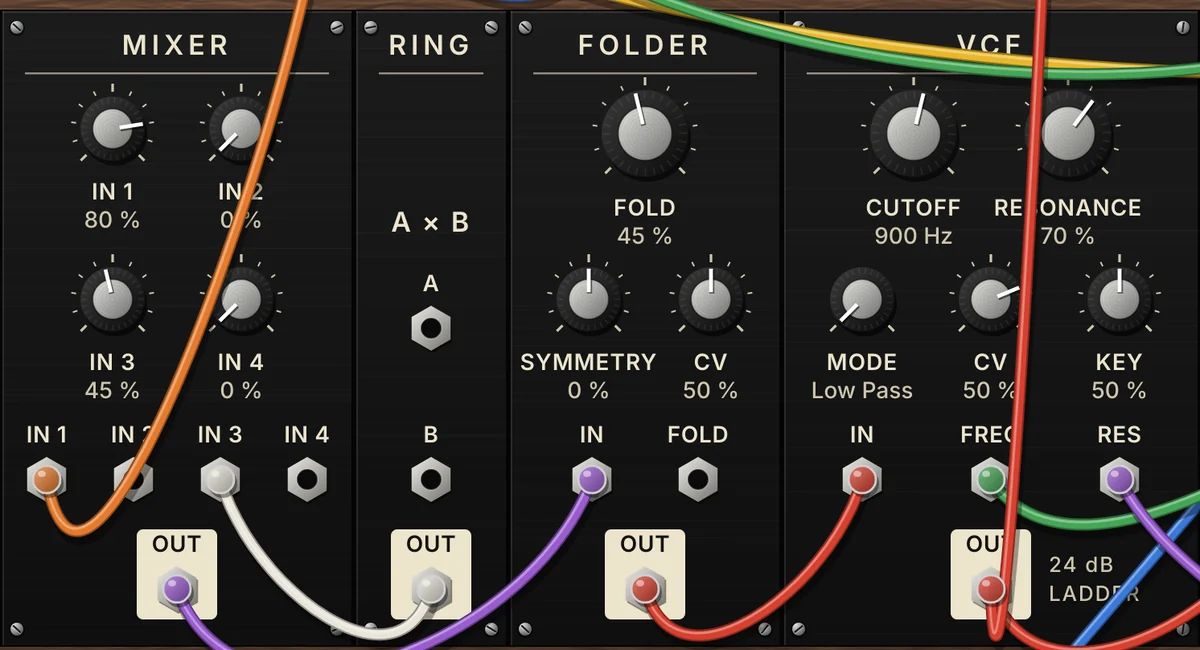
Normals: a modular that plays before you patch
An empty modular is usually silent. System 1 gives every input a normal, a connection that holds until you plug in a cable, so the empty cabinet already plays a classic voice: the oscillators into the mixer, the mixer into the ladder filter, the filter into VCA 1, ENV 1 opening the VCA and ENV 2 moving the cutoff. Start there. Each cable you add replaces one normal, so you always hear exactly what one connection changes.
The first cables to try
- LFO 1’s triangle into a VCO’s PWM: the slow chorus of a moving pulse.
- VCO 3 into VCO 1’s FM: bells and metal, because FM runs at audio rate.
- VCO 2 into VCO 1’s SYNC, then sweep VCO 1’s pitch: the classic hard-sync lead.
- MIDI PITCH through the SLEW into the VCOs’ PITCH: glide between notes.
- The filter’s output back into its own oscillator’s FM: feedback is allowed, and stable.
Three patches to build
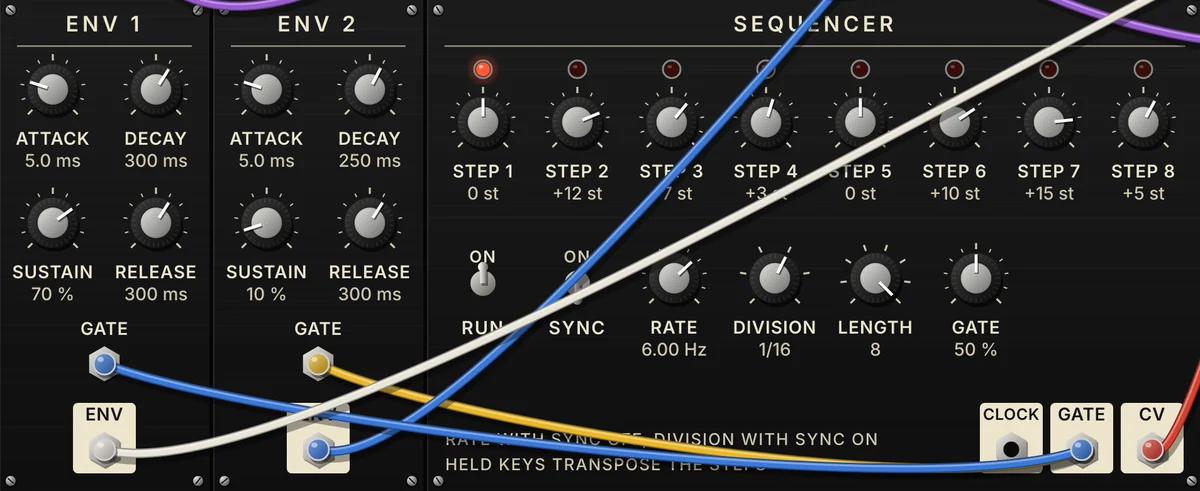
A bass: load Init, set VOICES to Mono, bring in VCO 2’s square on the mixer, lower the cutoff, raise the resonance a little and shorten ENV 2’s decay. A sequence: patch the sequencer’s CV into VCO 1’s PITCH and its GATE into the envelopes, press RUN, and hold a key to transpose the steps; with SYNC on it follows your DAW’s tempo. A drone: turn VCA 1’s LEVEL up so it plays with no keys, then patch LFO 2’s sample and hold through the SLEW into the filter’s FREQ for slow, random movement.
Polyphony, the modular way
Many modular-style instruments share one filter between all the notes of a chord. On System 1 each voice is the whole patch: set VOICES to 2, 4, 6 or 8 and every note gets its own filter, folder, envelopes and feedback, so a chord through a resonant ladder sounds like a chord, not a blur. DRIFT then gives each voice small fixed differences, the way no two analog voices were ever quite alike.
Read the VEIRA System 1 page for every module, or open its 46 presets and pull their cables out one by one to hear what each did. If you would rather shape sounds with a modern wavetable engine and a drag-and-drop matrix, VEIRA Black Synth is the other instrument.