Wavetable synthesis, from one cycle to a moving sound
How a wavetable synthesizer works and how to get the most from one: tables and POSITION, unison and warp, the filter, and the modulation that makes a patch move, with a bass, a pad and a pluck to build.
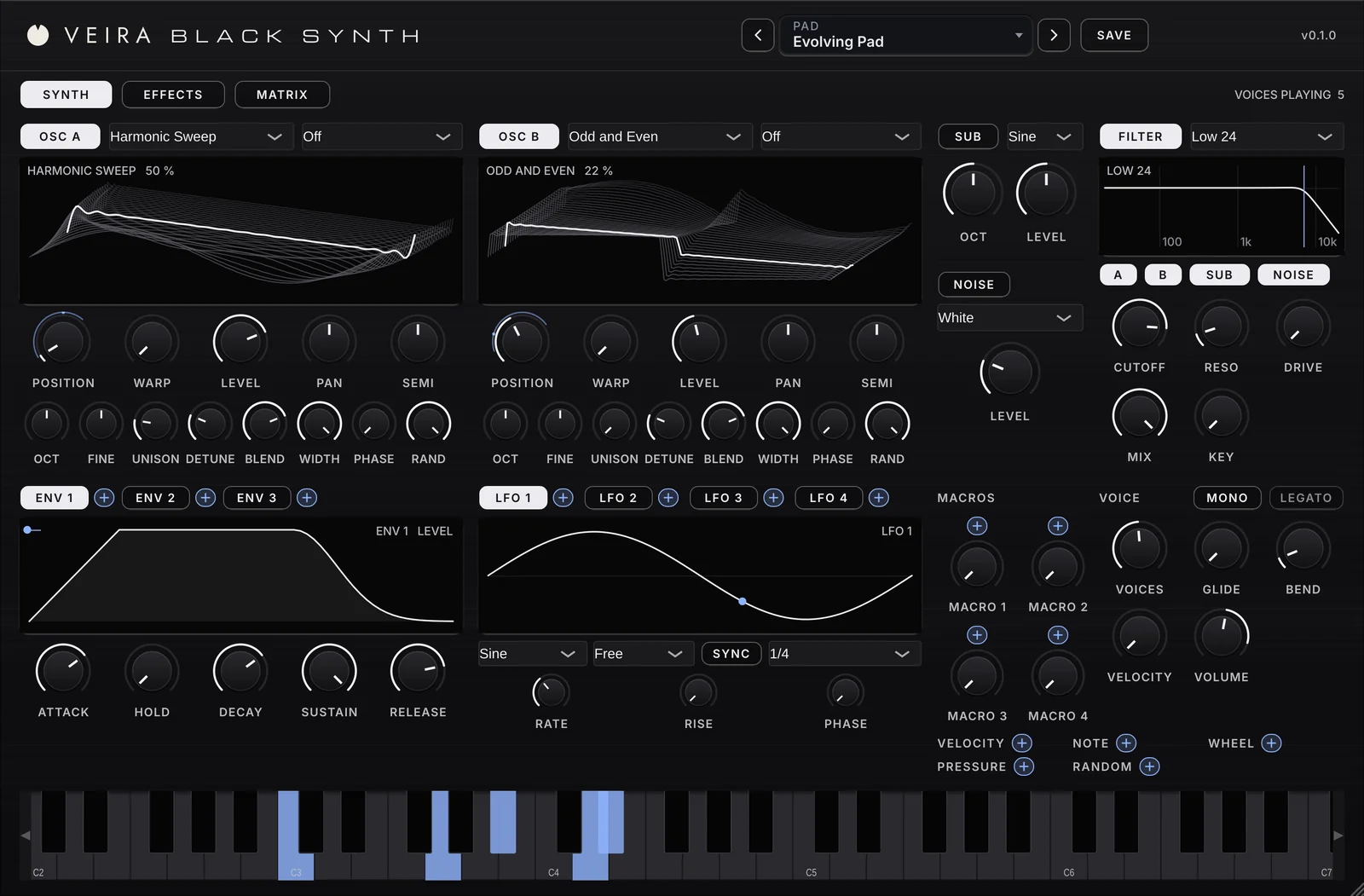
Every synthesizer starts with an oscillator repeating one cycle of a wave, as many times a second as the note’s pitch. A classic analog synth gives you a few fixed cycles: sine, triangle, saw, square. A wavetable synthesizer gives you whole rows of them, called frames, and lets you move along the row while the note plays. That one idea is behind most of the moving basses, evolving pads and vocal leads in modern music, and it is the heart of VEIRA Black Synth, VEIRA’s first instrument.
Tables and POSITION
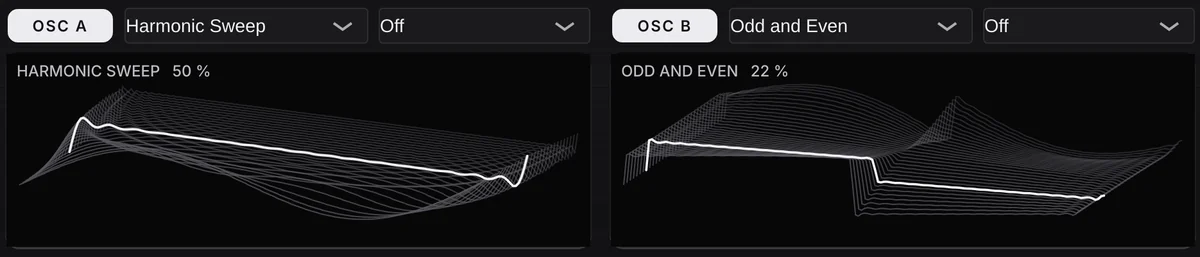
A wavetable is a series of single cycles lined up from one end to the other: from dark to bright, from one vowel to another, from a sine to a square. POSITION picks where you are in the row, and good wavetable oscillators blend smoothly between neighbouring frames, so turning it doesn’t step, it morphs. Set POSITION by ear first, as you would pick a waveform; then let something else move it, and the sound starts to change on its own.
High notes are where cheap oscillators give themselves away: harmonics that should be above hearing fold back down as harsh, unrelated tones. The cure is to keep, for every octave, a copy of each frame with only the harmonics that fit. It costs memory, not sound, and it is why a well-made wavetable synth stays clean right up the keyboard.
Unison and warp: width and edge
Unison stacks several copies of the oscillator on every note, each slightly out of tune and placed somewhere across the stereo field. Seven detuned saws is the classic supersaw; two or three thicken a bass without smearing it. Keep DETUNE low for lush and higher for deliberately sour, and watch the low end: on basses, keep WIDTH narrow so the bottom stays in the middle. Warp modes bend the way the oscillator reads its table, so one table can sound many ways: Sync gives the tearing, vocal sweep of a hard-synced oscillator, Bend and Squeeze sharpen the edge, FM lets the other oscillator wobble it into bells and growls.
The filter, and what goes through it
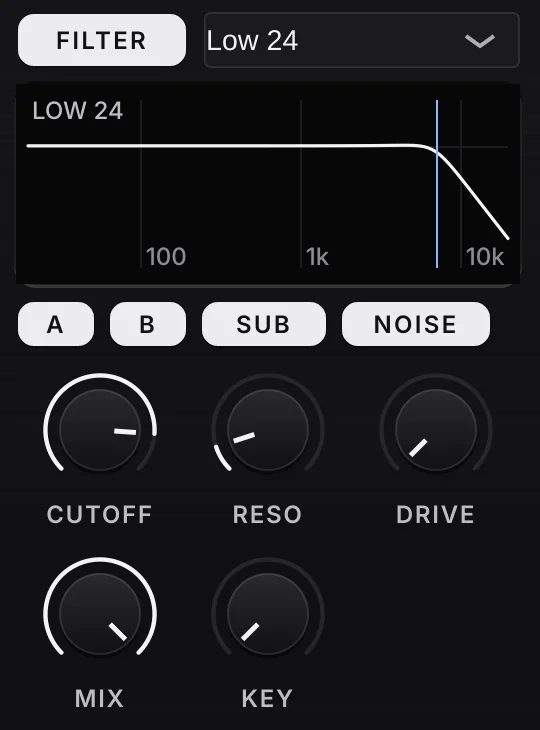
After the oscillators, the filter takes tone away, usually the top. A 24 dB low-pass is smooth and steep; a ladder grows a singing peak as you raise resonance and thickens as you drive it; a comb filter tuned to the note gives metallic, flanged colours. A useful trick is to choose what goes through the filter at all: filter a pad’s oscillators but let its sub oscillator past untouched, and the weight stays while the top breathes.
Modulation is the sound
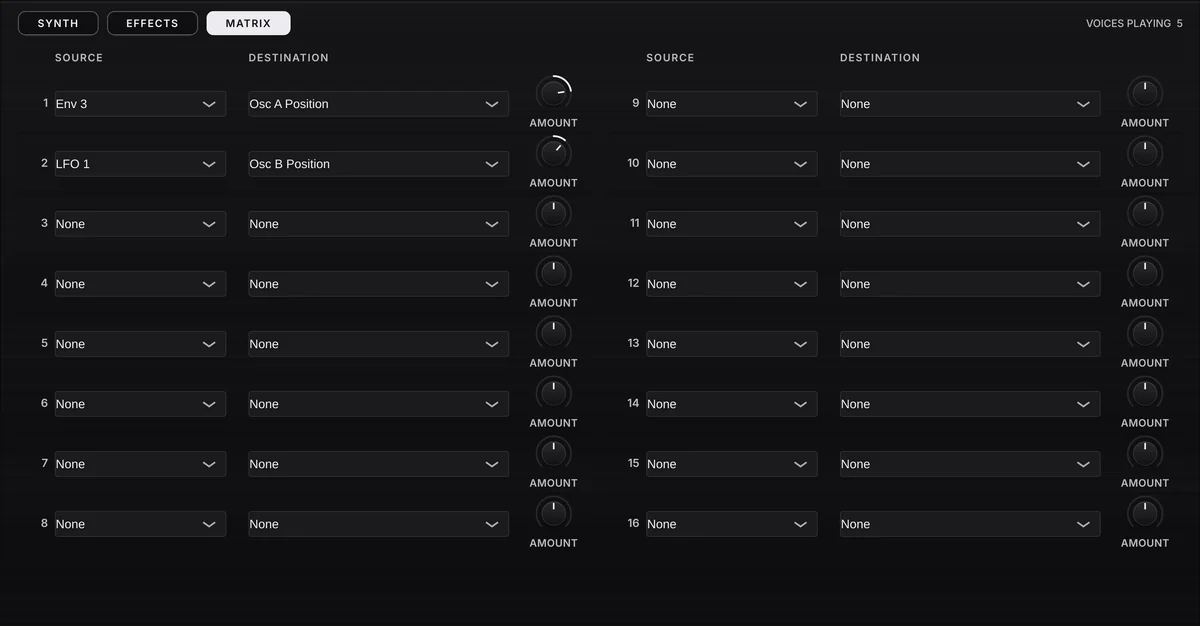
A static patch is rarely interesting for long. Modulation is anything that moves a control for you: an envelope that shapes each note, an LFO that sweeps over time, velocity, the mod wheel, a random value per note. In VEIRA Black Synth you drag a source’s handle onto a knob, and a ring around the knob shows how far it will move. The amounts are a share of the knob’s own travel, so 30 % on the cutoff moves it about a third of the way round, whatever the frequencies.
- A pluck: a saw, a low CUTOFF, and the second envelope on CUTOFF with a short decay and no sustain. Each note snaps open and closes.
- A bass that moves: an LFO in sync with the song on the filter’s cutoff, in quarter-note triplets, with MONO and a little GLIDE.
- A pad that evolves: a slow third envelope on POSITION, so each held chord grows brighter over a few seconds, and a slow free LFO on the second oscillator’s POSITION so it never repeats.
Levels, and when to stop
Synths are loud: every note adds up, and a five-note chord with seven unison voices per oscillator can be thirty-five oscillators at once. Leave headroom at the instrument (VEIRA Black Synth starts its VOLUME at −12 dB for exactly this), judge changes at matched loudness, and remember that the arrangement decides how big a sound can be: a pad that fills the room alone often needs half its width and less of its low end in the mix.
Read the VEIRA Black Synth page for every detail, or start from its 41 presets: Reese Bass and Wobble Bass for the low end, Supersaw Lead, Evolving Pad, Tine Piano, Gated Arp and Riser.