Tuning before you record: guitar, bass and ukulele that stay in tune with the track
Why a few cents matter in a recording, how to tune a string so it stays there, when to change the reference pitch, and how to check tuning between takes.
A part can be played perfectly and still sound wrong because one string is a few cents off. On its own the difference is easy to miss; against a piano, a synth or a double-tracked guitar it turns into a slow wobble between the two, and chords stop sounding clean. Tuning is the cheapest fix in the whole session, but only if you do it the same careful way every time, before every take.
Tune with the instrument as you will play it
Tune in the position you play in, with the strap on and the capo where it will be, because both change the pitch a little. Play one open string at a time and let it ring: a strummed chord has no single pitch, and the first moment of a pluck is always a little noisy. Then come up to the note from below. A string tuned down to pitch can leave slack around the tuning peg that lets it drift flat again after a few hits.
Get close fast, then finish slowly
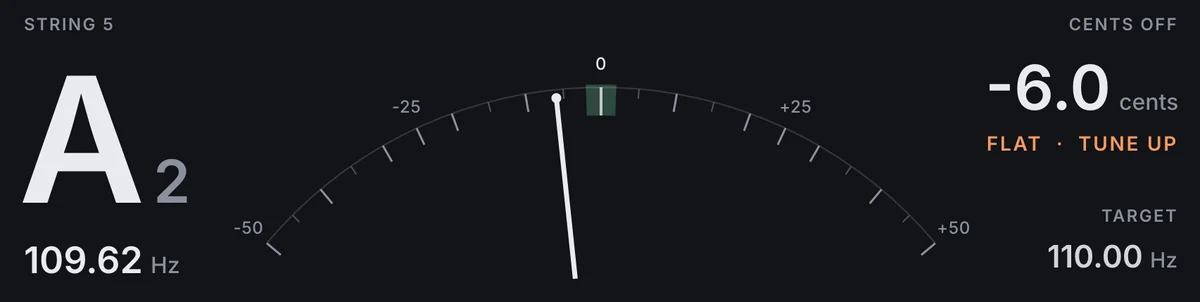
A needle is good for the first part of the job: it tells you which way to turn and roughly how far. The last few cents are where tuning by eye gets vague, and that is where a strobe helps. Instead of pointing at a number, it keeps moving while the string is off, and only stands still when the string is right on the note, so you can hear and see the moment you get there.

Agree on the reference
Almost all music today is tuned to A4 at 440 Hz, and that is the right setting unless someone tells you otherwise. But a piano, an orchestra or an earlier recording may sit somewhere else, a little higher at 442 Hz, for example. If you add parts to a track that was tuned differently, find its reference first and tune every instrument to that, rather than tuning to 440 Hz and correcting later.
Check again between takes
New strings stretch, heavy playing pushes strings out, and the room warming up through the day moves them too. Check the tuning before each take, not only at the start of the session, and listen back to the first bars of a take for any string that has moved. A bass is worth checking just as often as a guitar: in a low register a small difference is felt as much as heard.
Doing it with VEIRA Tuner
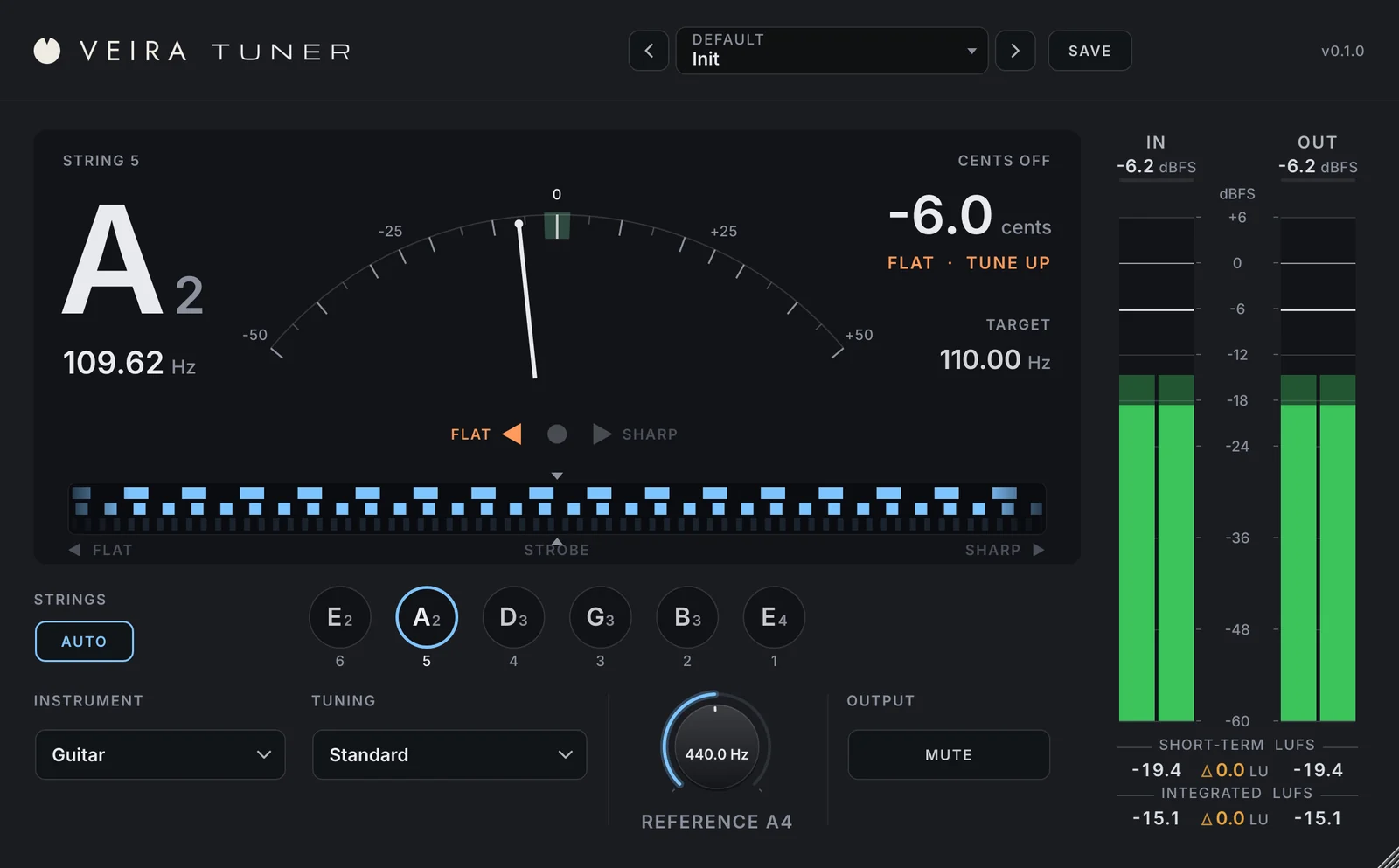
VEIRA Tuner is a free tuner for guitar, 4- and 5-string bass and ukulele, with a chromatic mode for anything else. Put it on the instrument’s track, pick the INSTRUMENT and its TUNING, from Standard and Drop D to DADGAD, the low B of a 5-string or a ukulele’s high or low G, and play a string. AUTO finds the string you are playing; click a string to lock it when it is far out of tune.

The needle covers −50 to +50 cents and turns green within 2 cents, and the strobe under it shows the last tenth of a cent. REFERENCE A4 runs from 415 to 466 Hz. With MUTE off the sound passes through bit for bit with no latency, so the tuner can stay on the track while you record; MUTE silences the output in 10 ms for tuning on stage.